
Top 12 Best Water Softener for Tankless Water Heater Revealed
Hard water causes scale buildup that shortens the lifespan and efficiency of a tankless water heater, which is a well-known issue for anyone trying to keep their system running smoothly. Choosing the best water softener for tankless water heater use helps prevent mineral deposits that lead to costly repairs or reduced water flow. A cheap or mismatched softener can either waste salt and water or fail to protect the heater adequately, defeating the purpose entirely.
A good water softener suited for tankless heaters should have a properly sized resin tank to handle the household’s daily water usage without frequent regeneration, typically around 24,000 to 32,000 grains capacity. It should be compatible with the water heater’s flow rate, usually between 2 to 5 gallons per minute, to avoid pressure drops or overloading. Easy access for cleaning and salt refilling also matters since frequent maintenance is necessary to keep the softener performing efficiently over time.
Need a Quick Check?
| Image | Product | Price |
|---|---|---|
Our Top Picks 1  | Waterdrop Scale Inhibitor | Check Price |
Our Top Picks 2  | Inline Water Heater Softener | Check Price |
Our Top Picks 3  | Salt Free Water Descaler | Check Price |
Our Selected Top 12 Water Softener for Tankless Water Heater Worth Considering
This list features carefully chosen water softeners designed to work effectively with tankless water heaters. Each review highlights performance details, suitability for different needs, and key strengths and weaknesses to help readers make an informed decision based on their specific requirements.
1. Waterdrop AP431 Whole House Scale Inhibitor
Living with a scale inhibitor that quietly works in the background feels reassuring. Perfect for those with tankless water heaters, this model stands out by preventing scale buildup without the bulk or complexity of traditional water softeners, making daily water use smoother and appliances last longer.
Installation is straightforward thanks to the 3/4 NPT inlet and outlet, which fits most pipelines easily. The system handles a strong flow rate of 10 GPM, maintaining stable water pressure that suits normal household demand.
Using food-grade polyphosphates, it stops scale from forming, keeping water healthy and plumbing components protected without frequent maintenance or special attention.
It does a solid job at inhibiting lime-scale growth, protecting heaters, dishwashers, and plumbing fixtures effectively. Built to last with materials certified to NSF/ANSI 372 standards, this setup keeps water moving smoothly. The common praise highlights improved appliance efficiency, while some mention the single pack might need extra units for larger homes.
Most users appreciate how it protects appliances from scale buildup and improves electrical appliance efficiency. The common drawback noted is that it comes in only a single pack, which might not be sufficient for bigger households or extensive plumbing systems.
People with standard-sized homes and tankless water heaters will find it a reliable solution for scale prevention. Those with larger setups or existing heavy scale may want to consider additional units or complementary treatments for full protection.
Pros
- Prevents scale buildup on water heaters
- Maintains stable water pressure at 10 GPM
- Uses food-grade polyphosphates for safe water
- Simple installation on standard 3/4″ pipes
Cons
- Single pack may not cover larger homes
- Does not physically remove existing scale
| Specification | Details |
|---|---|
| Model Number | WD-8065S |
| Inlet/Outlet Size | 3/4″ NPT |
| Flow Rate | 10 GPM |
| Certification | NSF/ANSI 372 |
| Included Components | Scale inhibition system *1 |
2. Inline Water Softener for Water Heater
Great for anyone wanting to protect a tankless water heater from hard water damage, this inline water softener focuses on cutting down scale buildup. Its strongest point lies in using certified food-grade resin to reduce calcium and magnesium far more effectively than typical scale inhibitors.
Setup happens under the sink, which fits right into existing plumbing without taking up much space. The ion exchange method noticeably softens water, keeping flow rates up to 7 gallons per minute while handling water with up to 300 ppm total dissolved solids.
Maintaining it is straightforward but requires replacing the filter every 2 months.
It does a solid job removing around 99.6% of calcium and 99.3% of magnesium, which really helps prevent scale in heaters and pipes. The build feels reliable with NSF/ANSI certified filter media and is polyphosphate-free, making it safer for household use.
Some users mention that filter replacement every 2 months can be a bit frequent.
Many appreciate the strong reduction of scale buildup thanks to the certified resin, which protects tankless heaters effectively. Frequent filter changes every 2 months come up as a common downside.
A good match for those with moderate water hardness who want clear water protection without chemicals. People with very hard water or looking for lower maintenance might want to explore other options.
Pros
- Reduces calcium up to 99.6%
- Removes magnesium up to 99.3%
- NSF/ANSI certified food-grade resin
- Polyphosphate-free for safer use
Cons
- Requires filter replacement every 2 months
- Limited to water with up to 300 ppm TDS
| Specification | Details |
|---|---|
| Installation Type | Under Sink |
| Purification Method | Ion Exchange |
| Maximum Flow Rate | 7 gpm |
| Supported Water TDS Level Maximum | 300 ppm |
| Filter Life Cycle | 2 months |
3. Salt Free Water Descaler Whole House System
Built with a special alloy inside, this salt-free water descaler is tailored for whole-house use and perfect for those with tankless water heaters who want an easy way to reduce scale buildup. Its main strength lies in physically altering hard water minerals to prevent crystallization without using salt.
Setup involves placing the unit as a countertop device where water flows through it under pressure. The alloy inside releases free electrons as water passes through, which keeps calcium and magnesium ions from forming scale. It supports water with TDS levels up to 300 ppm, and ongoing maintenance is minimal due to a long 10-year filter life.
The scale inhibition rate hits about 86%, effectively protecting water mains up to 3 km long. The physical descaler method means it doesn’t strip healthy minerals from the water, retaining beneficial elements.
The device is praised for its reliability over years of use, although some mention that it may not completely eliminate scale if water hardness is extremely high.
Strong scale prevention happens because the alloy changes mineral structure, achieving an 86% inhibition rate while preserving beneficial minerals. Some users note less effectiveness in extremely hard water, meaning scale reduction isn’t absolute in every situation.
Anyone looking to cut down scale buildup without using salt and protect their plumbing will appreciate this system. Those dealing with exceptionally hard water or limited installation space might want to explore alternative options better suited to those needs.
Pros
- Prevents scale buildup without adding salt
- Long-lasting filter life of 10 years
- Retains healthy minerals in water
- Handles high flow rate of 17.6 gpm
Cons
- May not fully stop scale with very hard water
- Requires countertop space for installation
| Specification | Details |
|---|---|
| Purification Method | Ion Exchange |
| Maximum Flow Rate | 17.6 gpm |
| Supported Water TDS Level Maximum (PPM) | 300 |
| Filter Life Cycle | 10 years |
| Installation Type | Countertop |
| Other Special Features | SAAS Physical Descaler |
4. Aquasana EQ-AS20 Salt-Free Water Conditioner

Salt-free water conditioning stands out as the main draw, making it perfect for households with tankless water heaters looking to avoid scale without using salt or chemicals. It’s particularly suited for those wanting to protect appliances while reducing environmental impact.
Setting it up as a countertop unit is straightforward, requiring no electricity just water flow. The activated carbon purification method works continuously without frequent intervention. Since it operates on water pressure alone, regular maintenance mainly involves monitoring the filter life, which lasts up to two years, keeping everyday use easy and relatively low-effort.
The conditioner effectively transforms hard minerals into harmless particles, helping reduce scale buildup inside appliances. Its build is simple yet solid, focused on function rather than complexity. Positive notes frequently mention how water spots become easier to wipe off, while some note the maximum TDS limit of 300 ppm may restrict use in very hard water areas.
Many find that water stains and spots become easier to clean thanks to the salt-free conditioning. Common concerns revolve around the unit’s limit for water hardness, which can reduce its effectiveness in areas with very high TDS levels.
Those with moderately hard water and tankless heaters will appreciate this system’s low maintenance and environmental benefits. Homes with extremely hard water or higher temperature needs might look for conditioners that handle broader conditions.
Pros
- Salt-free conditioning prevents scale buildup effectively
- Easy countertop installation without power requirements
- Filter lasts up to two years before replacement
- Activated carbon filtering reduces total dissolved solids
Cons
- Maximum TDS level of 300 ppm limits very hard water use
- Only supports water temperatures up to 90 °F
| Specification | Details |
|---|---|
| Purification Method | Activated Carbon |
| Installation Type | Countertop |
| Maximum Flow Rate | 7 gpm |
| Filter Life Cycle | 2 years |
| Supported Water TDS Level Maximum (PPM) | 300 |
| Upper Temperature Rating | 90 °F |
5. 3M Aqua-Pure AP430SS Whole House Scale Inhibitor

Choosing a water softener that protects without overcomplicating things suits anyone running a tankless water heater. What stands out most is its use of polyphosphates to stop mineral scale build-up, which helps extend your appliances’ life without the need for a traditional salt-based system.
Setup includes attaching the head and cartridge, then following the user’s manual for an easy installation. Daily use means the scale inhibitor runs quietly, working in the background to keep hardness minerals from settling.
No regular refilling or heavy maintenance is needed, so you just get on with using your water without worry.
Performance stays focused on preventing scale and corrosion, which is crucial for appliances and pipes. The build quality from 3M feels solid and reliable, giving confidence in ongoing use.
Reviews often highlight how well it reduces scale but mention occasional concerns about the upfront cost compared to simpler softeners.
The 3M system is praised for its ability to lessen mineral scale buildup, protecting devices and fittings over time. Some point out the expense when starting out, feeling the price is steep for what it offers compared to salt-based models.
Ideal for those wanting protection without salt and complex maintenance routines, especially with tankless heaters. Those needing stronger water softening might look into conventional systems instead.
Pros
- Works without salt or electricity
- Reduces scale build-up effectively
- Extends life of appliances and pipes
- Simple installation with included manual
Cons
- Higher initial cost compared to basic softeners
- May not fully soften very hard water
| Specification | Details |
|---|---|
| Model Number | AP43011 |
| Set Name | AP430SS |
| Included Components | Head and Cartridge, User’s Manual |
| Manufacturer Part Number | AP430SS |
| Unit Count | 1 Count |
6. Chromex Tankless Water Heater Flush Kit

Hard water scale can seriously shorten the life of a tankless water heater, and the Chromex Tankless Water Heater Flush Kit suits anyone wanting an easy way to keep their unit running longer. Its biggest strength is the all-in-one setup that includes everything needed to descale your heater without hassle.
Setting it up means placing the included 5-gallon bucket, connecting the pump and hoses to your tankless heater, and using the citric acid-based descaler solution. Day-to-day use is straightforward since all components fit well together, and the electric pump does the work of circulating the cleaner through the system.
The pump grate helps keep things steady during the flush, which makes maintenance feel secure and manageable.
Removing scale deposits is handled effectively, improving heater performance and extending lifespan. The kit’s build feels solid, with PVC-coated hoses that show durability and a pump that isn’t too bulky. The clearest praise points to how well the descaler works on various metals and plastics.
Some mention the electric pump’s wall mount as a minor inconvenience, limiting placement flexibility during flushing.
Cleaning with the kit clearly removes scale deposits, making your water heater more efficient and prolonging its life. Many users appreciate the complete, brand-compatible setup, though some find the electric pump’s wall mount restricts where it can be positioned, adding a small challenge during use.
Anyone with a compatible tankless water heater looking for a thorough and safe descaling method will value this kit. Those needing more flexible pump placement or quieter operation might consider other options better suited to those preferences.
Pros
- Works with most tankless water heater brands
- Safe citric acid based formula for various materials
- Includes all necessary parts for a full flush
- Compact electric pump with stable mounting
Cons
- Wall mount limits pump placement options
- Pump may be noisy during operation
| Specification | Details |
|---|---|
| Power Source | electric |
| Special Features | Citric acid based descaler solution; wide brand compatibility |
| Mount Type | Wall |
| Included Components | 5 gallon bucket with lid, 1/6 HP pump, 2 PVC coated hoses, descaler solution, elevated pump grate |
7. Aquasure Harmony Series Whole House Water Softener

Rated to handle 50,000 grains of water hardness, this water softener works well for homes with 3 to 4 bathrooms, removing minerals that can cause skin irritation. Its strongest feature is the combination of a digital metered control head and a triple-purpose pre-filter that cleans water throughout the house.
Installation fits right onto a whole house water tank, making it a solid choice for tankless water heaters. The pre-filter takes care of chlorine, sediments, and bad odors while softening the water.
Operating the automatic digital meter is straightforward, so day-to-day use feels worry-free, especially with its ability to maintain cleaner water quality with little fuss.
The system does an excellent job reducing hardness and improving water quality over time. Build quality is professional grade with a dispenser container and advanced filtration methods like reverse osmosis. Reviews often praise its efficiency and water taste improvement, though some mention the size as a bit bulky for smaller spaces.
Works well in homes needing strong water softening and filtration; the digital meter offers precise control. Bulkiness is a real consideration for compact areas where space is tight, which some find inconvenient.
Perfect for households with moderate water hardness and several bathrooms wanting clean, softened water. Those with very limited space or fewer bathrooms might want to look at smaller or differently sized units.
Pros
- Removes 99% of chlorine and contaminants
- Automatic digital meter for easy control
- Suitable for multiple bathrooms
- Improves water taste and reduces hardness
Cons
- Bulky size can be challenging for small spaces
- Installation may require professional help
| Specification | Details |
|---|---|
| Grain Capacity | 50,000 |
| Bathrooms Served | 3-4 |
| Control Head | High Performance Automatic Digital Metered |
| Pre-Filter Type | Triple Purpose Sediment/GAC/Zinc |
| Purification Method | Reverse Osmosis |
| Installation Type | Whole House Water Tank |
8. iSpring ED2000 Whole House Water Descaler
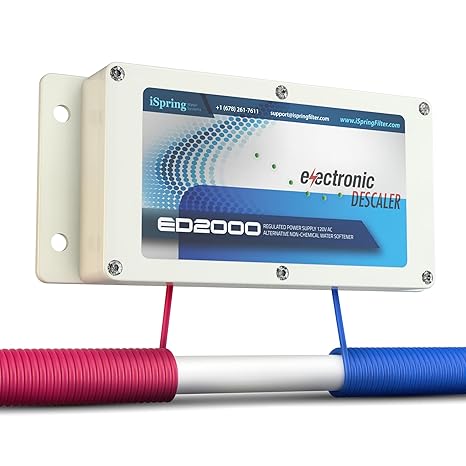
People dealing with very hard water who want a chemical-free solution will find the iSpring ED2000 Whole House Water Descaler suits their needs. It works well for those with tankless water heaters by preventing scale buildup and protecting appliances without adding salt or requiring maintenance.
Installation is straightforward and designed for self-installation, so it won’t require a plumber. Once set up, it runs on corded electric power and continuously prevents scale from forming in pipes.
There’s no need to add chemicals or salt, which makes it easy to maintain. The device uses activated carbon for purification, supporting up to 326 PPM total dissolved solids in water.
It effectively reduces scale deposits throughout the entire water system and helps existing scale break down. The unit is rust resistant and built to last, with a power-saving design that often repays its energy cost in about a year. Strong points include good energy efficiency and environmental friendliness.
Some users mention it doesn’t completely eliminate hard water issues but improves them significantly.
The device is praised for saving energy and reducing scale in pipes effectively, with many noting less buildup over time. The most common complaint is that it doesn’t completely solve all hard water problems, meaning some mineral deposits might still appear.
Those looking for a low-maintenance, chemical-free water treatment for very hard water areas will appreciate this product. People needing complete hardness removal or a solution without electrical power should explore other options.
Pros
- No salt or chemical required
- Easy self-installation process
- Energy-saving with quick payback
- Prevents scale while keeping minerals
Cons
- May not fully remove all hard water problems
- Requires corded power connection only
| Specification | Details |
|---|---|
| Installation Type | self-installation |
| Power Source | Corded Electric |
| Purification Method | Activated Carbon |
| Rust Resistant | Yes |
| Supported Water TDS Level Maximum (PPM) | 326 |
9. Aqua-Rex WK1-E Salt Free Water Softener Alternative

Salt-free and chemical-free, the Aqua-Rex WK1-E is designed for people wanting to protect electric water heaters without fuss. Its standout feature is the easy installation that doesn’t require cutting pipes, making it perfect for those who want to avoid complex plumbing work and regular maintenance.
Setting it up takes about 20 minutes since it just needs to be plugged in and mounted on the wall. There’s no salt to add or cartridges to change, so daily use is basically forgettable. Its lightweight and portable design mean it doesn’t add weight or complicated handling, and you won’t need to worry about refilling anything or cleaning filters.
The main job of removing old scale buildup and stopping new scale works well, especially for electric water heaters and well water situations. Built to be a physical water conditioner powered by a corded electric source, it offers zero maintenance once installed.
Most praise highlights its plug-and-play convenience. On the downside, some might find the lack of salt or filters limiting if they expect a traditional softening experience.
Many users appreciate how easy it is to install and maintain with no need for salt or cartridge replacements. On the other hand, some report that it doesn’t soften water in the traditional sense, which could be disappointing if hard water issues are severe.
People looking for a no-fuss, low-maintenance water conditioner for electric or well water heaters will find this product suits them well. Those wanting strong traditional softening effects or a non-powered solution might prefer different systems.
Pros
- No salt, chemicals, or cartridge changes needed
- Simple 20-minute installation without cutting pipes
- Lightweight and easy to mount on the wall
- Physical water conditioner with zero maintenance
Cons
- May not fully replace traditional salt-based softeners
- Requires electric power connection for operation
| Specification | Details |
|---|---|
| Power Source | Corded Electric |
| Special Features | Lightweight, Portable, physical water conditioner, plug and play, zero maintenance |
| Installation Time | 20 minutes, no pipes to cut |
| Mount Type | Wall |
| Application | Electric Water Heaters and Well Applications |
10. Salt Free Water Descaler Inline System

Salt Free Water Descaler Inline System is ideal for anyone looking to protect their tankless water heater from scale buildup without using salt. Its main strength lies in physically preventing limescale formation, which keeps your water heater and plumbing parts running smoothly for longer.
Installation under the sink is straightforward, with the system using an electric power source. It works by changing the way calcium and magnesium ions behave in water, reducing scale and even dissolving old buildup. Because it targets scale physically, it avoids the mess and maintenance of salt-based softeners, making daily operation simple and largely hands-off.
The system performs well at stopping scale formation, ensuring your water heater and appliances stay in good shape. Built with rust-resistant materials and a special alloy anti-scale component, it’s durable and reliable.
Users appreciate its energy-saving benefits most, while some note the temperature limit of 55 °C can restrict certain setups.
The system excels at significantly reducing scale buildup, which users find beneficial for extending the life of water heaters and appliances. A common drawback involves the temperature limit, which restricts usage in hotter water setups. The lack of salt use simplifies maintenance and improves energy efficiency, a highlighted advantage.
Those with tankless water heaters below 55 °C and moderate water hardness will appreciate how easily this system fits and works. Situations requiring higher temperature tolerance or very high TDS water may need alternative options designed to handle those conditions.
Pros
- Physically inhibits limescale without salt
- Rust-resistant and durable design
- Energy-saving for connected appliances
- Reduces surface tension to dissolve old scale
Cons
- Upper temperature limit of 55 °C
- Only suitable for water TDS level up to 1000 ppm
| Specification | Details |
|---|---|
| Purification Method | Ion Exchange |
| Installation Type | Under Sink |
| Power Source | Electric |
| Upper Temperature Rating | 55 °C |
| Filter Life Cycle | 3 years |
| Rust Resistant | Yes |
11. Tankless Water Heater Descaler

Keeping a tankless water heater running smoothly often depends on how well you handle scale buildup. Perfect for anyone wanting to protect their heater without fuss, this liquid descaling solution’s biggest strength lies in its quick action to flush out mineral deposits, helping maintain peak performance with minimal effort.
Using the descaler is straightforward, just apply it yearly for best results. It works by rapidly opening up flow paths clogged by scale and dirt.
Since it has no scent and is safe for your equipment, handling it during maintenance feels simple and worry-free, making it easy to fit into your routine without disrupting daily life.
The solution does a solid job at clearing out unwanted buildup, improving heater efficiency noticeably after a flush. Its liquid form ensures it reaches all the tight spots inside the tankless heater. While most users praise its effectiveness, some point out that regular yearly use is necessary to keep seeing good results; it’s not a one-and-done fix.
The descaling solution reliably clears scale and dirt to keep tankless water heaters efficient, though it requires annual use to maintain these benefits. People often mention how it opens up blocked flowways quickly, but the need for regular maintenance can feel like a commitment.
Anyone looking for a straightforward, safe way to protect and maintain their tankless water heater will find it fits well. Those seeking a one-time fix or a product for other water systems might want to explore other options better matched to their needs.
Pros
- Highly effective at flushing scale and mineral deposits
- Safe for use on tankless water heaters
- No scent makes handling comfortable
- Rapidly improves heater efficiency
Cons
- Needs yearly use for continued effectiveness
- Only suitable for tankless heaters, not other water systems
| Specification | Details |
|---|---|
| Item Form | Liquid |
| Scent | NO |
| Specific Uses For Product | Descaler Solution |
| Volume | 32 fl oz |
12. Rheem RRTG20251 All Clear Water Treatment System

Ideal for anyone looking to protect a tankless water heater from scale, this water softener system focuses on softening water while slowly removing existing scale buildup. Its biggest advantage lies in the visual refill reminder, ensuring the cartridge is changed right on time.
Installation fits under the sink with a 3/4 in. female NPT connection, which suits many standard setups. The clear housing with a fill label makes monitoring straightforward, so daily maintenance isn’t complicated.
Since it operates on ion exchange and is powered by a corded electric source, it requires a standard power outlet and careful placement to stay below its 100 °F upper temperature rating.
Performance revolves around distorting calcium carbonate crystals to prevent scale accumulation, helping your tankless water heater stay in good condition. The unit cleans itself, which limits upkeep, but some users mention the Prop 65 warning for California residents as a concern.
Most reviews highlight how well it reduces scale, with the primary complaint focusing on the warning label rather than function.
Most users appreciate the clear housing that offers a simple visual cue for cartridge replacement, helping maintain the system effectively. The main complaint centers around the Prop 65 warning, which raises safety concerns for California residents despite not affecting performance.
People wanting an under-sink softener for their tankless water heater that requires moderate upkeep will find this device suitable. Those looking for higher temperature tolerance or without concerns about chemical warnings should consider other options.
Pros
- Clear housing shows cartridge fill level
- Self-cleaning reduces maintenance needs
- Softens water and removes existing scale
- Fits under-sink spaces easily
Cons
- Upper temperature limited to 100 °F
- Prop 65 warning concerns some users
| Specification | Details |
|---|---|
| Installation Type | Under Sink |
| Purification Method | Ion Exchange |
| Power Source | Corded Electric |
| Upper Temperature Rating | 100 °F |
| Connection Size | 3/4 in. female NPT |
| Special Features | Self Cleaning |
Best Water Softeners for Tankless Water Heaters Comparison
| Product | Installation Type | Purification Method | Power Source | Max Flow Rate / Capacity |
|---|---|---|---|---|
| Waterdrop Scale Inhibitor | Single | – | – | – |
| Inline Water Heater Softener | Under Sink | Ion Exchange | – | 7 gpm |
| Salt Free Water Descaler | Countertop | Ion Exchange | – | 17.6 gpm |
| Aquasana Salt-Free Conditioner | Countertop | Activated Carbon | Water | 7 gpm |
| 3M Aqua-Pure Scale Inhibitor | Single | – | – | – |
| Chromex Flush Kit | Wall Mount | – | Electric | – |
| Aquasure Harmony Softener | Whole House Tank | – | – | 50,000 grains |
| iSpring ED2000 Descaler | Self-installation | Activated Carbon | Corded Electric | – |
| Aqua-Rex Salt Free Softener | Wall Mount | Physical Condition | Corded Electric | – |
| Inline Salt Free Descaler | Under Sink | Ion Exchange | Electric | – |
| Tankless Heater Descaler | – | Liquid | – | – |
| Rheem All Clear System | Under Sink | Ion Exchange | Corded Electric | – |
- Installation TypeSingle
- Purification Method–
- Power Source–
- Max Flow Rate / Capacity–
- Installation TypeUnder Sink
- Purification MethodIon Exchange
- Power Source–
- Max Flow Rate / Capacity7 gpm
- Installation TypeCountertop
- Purification MethodIon Exchange
- Power Source–
- Max Flow Rate / Capacity17.6 gpm
- Installation TypeCountertop
- Purification MethodActivated Carbon
- Power SourceWater
- Max Flow Rate / Capacity7 gpm
- Installation TypeSingle
- Purification Method–
- Power Source–
- Max Flow Rate / Capacity–
- Installation TypeWall Mount
- Purification Method–
- Power SourceElectric
- Max Flow Rate / Capacity–
- Installation TypeWhole House Tank
- Purification Method–
- Power Source–
- Max Flow Rate / Capacity50,000 grains
- Installation TypeSelf-installation
- Purification MethodActivated Carbon
- Power SourceCorded Electric
- Max Flow Rate / Capacity–
- Installation TypeWall Mount
- Purification MethodPhysical Condition
- Power SourceCorded Electric
- Max Flow Rate / Capacity–
- Installation TypeUnder Sink
- Purification MethodIon Exchange
- Power SourceElectric
- Max Flow Rate / Capacity–
- Installation Type–
- Purification MethodLiquid
- Power Source–
- Max Flow Rate / Capacity–
- Installation TypeUnder Sink
- Purification MethodIon Exchange
- Power SourceCorded Electric
- Max Flow Rate / Capacity–
How to Choose the Right Water Softener
Choosing the right water softener for a tankless water heater involves focusing on efficiency, capacity, and compatibility with your system’s water flow. Properly matching these factors helps prevent scale buildup, extends your heater’s lifespan, and reduces maintenance costs over time.
Compatibility with Tankless Systems
Many tankless water heaters experience reduced efficiency or frequent error codes if paired with a water softener that can’t handle the high flow rates. This happens because some softeners cause pressure drops or don’t regenerate quickly enough, leading to hard water bypassing the system.
It’s important to pick a model with a flow rate rating close to or exceeding the heater’s maximum gallons per minute.
Electronic controls and sensors on tankless systems can be sensitive. A poorly matched water softener may introduce electrical interference or cause fluctuating water pressure that disrupts these controls.
Checking manufacturer compatibility or user reviews for specific models is wise. The softener’s capacity should align with your water heater’s size to maintain consistent water quality and prevent scaling or damage, which means sizing based on daily water use and hardness level.
Salt and Resin Quality
Resin beads are the core of softening performance. Some cheaper resins degrade quickly or don’t exchange hardness minerals efficiently, requiring more frequent replacements and driving up costs.
Investing in high-quality resin ensures the system keeps softening effectively for years without noticeable drops in performance.
The type of salt used for regeneration affects maintenance. Salt with high purity reduces residue and buildup inside the tank, which can clog the resin bed and reduce lifespan. Pelleted salt is often a better choice than rock salt for this reason.
Strong resin durability combined with clean salt usage makes a noticeable difference in workload over time.
Regeneration Process and Efficiency
The frequency of regeneration cycles has a direct impact on water and salt consumption. Systems that regenerate too often waste resources, while those that regenerate too rarely can reduce water quality.
Many effective models offer demand-initiated regeneration, which triggers only based on actual water use, striking a balance between efficiency and performance.
Programming regeneration settings affects operation but varies widely across models. A softener with clear, user-friendly controls makes it easier to adjust cycles based on household changes or hardness levels, saving money and avoiding manual recalibration headaches.
Installation and Space Requirements
Space around the tankless heater is often limited, and water softeners can be bulky. Oversized units can cause cramped installations or make maintenance difficult.
Finding one that fits neatly in the available area is necessary to avoid costly relocation or plumbing modifications.
Some models require more advanced plumbing and electrical work, which means professional installation. It’s important to confirm what tools and skills will be needed beforehand.
Clear access must be maintained for putting salt into the brine tank and performing regular checks without interrupting the heater’s operation.
Maintenance and Ease of Use
Simple, visible indicators for salt levels and system alerts prevent surprises and reduce the chance of running the softener dry. Many units have LED panels or gauges that make it easy to see when refills or servicing are needed without opening the lid or guessing.
Over time, resin bed cleaning or replacements might be necessary. Systems designed with removable components or straightforward servicing instructions cut down on maintenance time. Having responsive customer support and clear manuals helps solve common issues faster without unnecessary downtime.
Optimizing Water Softener Settings for Tankless Water Heaters
Adjusting the regeneration cycle of a water softener is critical for maintaining efficiency with a tankless water heater. The system should be set to regenerate based on actual water usage and hardness level to avoid excess salt use and scaling. Most softeners allow customizing the hardness setting in grains per gallon; setting this accurately prevents mineral buildup inside the heat exchanger.
It is also important to monitor the salt level regularly to ensure the resin beads can effectively remove hardness minerals. A low salt level can reduce performance drastically.
- Set hardness level according to test results.
- Program regeneration timing based on household demand.
- Keep salt tank at least one-third full at all times.
Proper settings can help protect the tankless heater from scale buildup, ensuring its efficiency and longevity.
Essential Maintenance Practices to Prolong Your Water Softener and Heater Lifespan
Routine maintenance extends the life of both the water softener and the tankless heater. Check the softener resin periodically; over time, resin beads wear out and lose effectiveness.
Cleaning the resin tank with specialized cleaners every few years removes trapped iron or sediment.
Flush your tankless water heater annually to clear mineral deposits from inside the heat exchanger. This process lowers the risk of clogging and maintains heat transfer efficiency.
- Inspect salt tank monthly and refill as needed.
- Clean brine tank annually to remove salt mush and sludge.
- Descale tankless heater using a vinegar or commercial descaler.
Consistent care will reduce costly repairs and keep water flowing properly through both systems.
Comparing Salt-Based and Salt-Free Softeners for Tankless Systems
Salt-based water softeners remove hardness minerals by ion exchange, producing very soft water ideal for tankless water heaters. This type of softening prevents scale buildup effectively but requires regular salt refills and occasional maintenance.
Salt-free conditioners work by altering hardness minerals to prevent them from sticking to surfaces rather than removing them. These systems need less upkeep and no salt but are less effective at protecting tankless heaters in areas with very hard water.
- Salt-based: requires salt, better scale prevention.
- Salt-free: low maintenance, fewer chemicals.
- Performance depends on water hardness level.
Choosing between them depends on water hardness severity, maintenance preference, and budget.
People Also Asked
How Do I Size a Water Softener for a Tankless Heater?
Choose a water softener based on your household water usage and hardness level. Check the grains of hardness it can handle and match that to daily gallons used to avoid frequent regeneration that can stress your system.
Is It Safe to Use a Water Softener with Tankless Heaters?
Using a water softener with a tankless water heater is safe and can prevent scale buildup. Make sure the softener is properly installed before the heater to protect it from hard water damage.
How Often Should I Maintain a Water Softener for Tankless Systems?
Maintain the water softener at least once every 3 to 6 months by checking salt levels and cleaning the brine tank. Regular maintenance keeps it running efficiently and extends the life of the tankless heater.
Can Hard Water Damage a Tankless Water Heater Without Softening?
Hard water can cause mineral buildup inside the tankless heater, lowering efficiency and causing damage over time. This buildup can lead to expensive repairs or early replacement of the unit.
What Common Problems Occur with Water Softeners on Tankless Heaters?
Common problems include fouled resin beads, salt bridging, and incorrect regeneration cycles. These can reduce softener effectiveness and lead to scale buildup inside the tankless heater despite having the softener installed.
Conclusion
Choosing a water softener for a tankless water heater depends on how well it handles hard minerals, the capacity to match your household water use, and how easily it integrates with your existing plumbing. The efficiency of regeneration and the frequency of maintenance also matter for long-term performance and cost.
Consider the size of your space and your budget when making a choice, as some units need more room or investment upfront. Also think about how often you’ll use hot water to avoid over- or under-sizing the system.
Refer back to the comparison table and detailed picks above to find the option that fits your specific needs.