
Top 12 Best Ultrasonic Cleaner for Carbs You Can’t Miss!
Carburetors often carry stubborn grime and fuel residues that a cheap ultrasonic cleaner can’t handle, leading to incomplete cleaning and more time spent scrubbing by hand. The best ultrasonic cleaner for carbs cuts through these deposits efficiently, avoiding damage while reaching narrow passages that brushes miss.
Many users face frustration when their cleaner either lacks the right power or doesn’t fit their carb pieces properly, making the whole process slower and less effective.
The key to a good ultrasonic cleaner starts with the tank size, usually around 1 to 2 liters, which accommodates most carb parts without wasteful overflow. Power output matters as well; 35 to 50 watts of ultrasonic power ensures thorough cleaning without excessive heat buildup. Materials like stainless steel tanks resist corrosion from cleaning solutions, while straightforward controls and easy drainage simplify maintenance after each use.
Need a Quick Check?
| Image | Product | Price |
|---|---|---|
Our Top Picks 1  | Ultrasonic Carburetor Solution | Check Price |
Our Top Picks 2  | VEVOR 15L Cleaner | Check Price |
Our Top Picks 3  | CREWORKS 10L Cleaner | Check Price |
Our Selected Top 12 Ultrasonic Cleaner for Carbs for Every Budget
This list features a variety of ultrasonic cleaners designed specifically for carburetors, covering different budgets and needs. Each review explains how well the cleaner performs, who it is best suited for, and highlights its main advantages and drawbacks.
1. Ultrasonic Cleaner Solution for Carburetor Parts
Ultrasonic Cleaner Solution for Carburetor Parts specializes in removing stubborn dirt and varnish from carburetors and engine parts. It suits anyone looking for a concentrated liquid that works well with ultrasonic cleaning machines to tackle both interior and exterior grime effectively.
Using the solution involves simply mixing it with water in your ultrasonic cleaner tank before immersing the carburetor or engine components. Its concentrated formula makes sure that even tiny nooks and crannies get cleaned as the ultrasonic waves create vacuum bubbles that break down deposits.
The solution is unscented and designed for repeated use with various metal parts.
The cleaning power stands out, taking advantage of ultrasonic technology to thoroughly remove dirt and varnish buildup. The concentrated liquid comes in a simple, no-frills form that is easy to store and handle. Praises focus on its effectiveness in restoring carburetor parts, while some mention that the strong concentration means careful dilution is necessary to avoid damage or leftover residue.
The strongest praise comes from how well the solution cleans carburetor parts by breaking down tough deposits with ultrasonic bubbles. Common complaints mention the need to dilute carefully to avoid leftover residue or potential part damage. Handling concentration levels is key to getting good results.
This cleaner is ideal for people who regularly disassemble and clean carburetors or engine parts with an ultrasonic machine. Those wanting a ready-to-use, mild cleaner might want to look elsewhere for a less concentrated option.
Pros
- Effectively removes dirt and varnish
- Concentrated for longer use
- Unscented, no strong odors
- Works well with ultrasonic machines
Cons
- Requires careful dilution before use
- May leave residue if not rinsed properly
| Specification | Details |
|---|---|
| Item Form | Liquid |
| Scent | Unscented |
| Specific Uses For Product | Carburetors, Engine Parts, Chains |
| Surface Recommendation | Ultrasonic Machines |
| Special Features | Concentrated |
2. VEVOR 15L Ultrasonic Cleaner
Running smoothly and making quick work of greasy carburetors, this ultrasonic cleaner suits anyone who wants powerful, all-around cleaning without extra fuss. Its biggest strength lies in blasting grime away with intense ultrasonic waves that reach every tricky spot.
Setup is straightforward, and the sizable 15L tank gives plenty of room for multiple parts at once. High-efficiency transducers deliver strong, consistent cleaning by generating 40,000 microbubbles every second.
The compact dimensions make it manageable on a workbench, while the weight of just over 15 pounds keeps it portable enough to move as needed.
Cleaning carburetors feels thorough thanks to the 360° deep cleaning action, breaking down stubborn grease beautifully. The build is solid and reliable, focusing on industrial parts but delicate enough for jewelry or electronics. Best praise highlights its powerful cleaning ability, while notes mention that the unit’s relatively large size can take up a decent amount of space.
Strongest praise goes to how effectively the ultrasonic waves break down tough grease and grime on carburetors and other parts. The most common complaint revolves around its size, which requires a good amount of space in a workshop or garage. Handling and storage need consideration.
Great for anyone working regularly with carburetors, jewelry, or electronic parts who can accommodate its dimensions. Those with very limited workspace or needing a lighter, more compact machine should look elsewhere for easier portability.
Pros
- Powerful 40,000 microbubbles per second
- Large 15L tank for multiple parts
- Works on various materials and parts
- Portable at 15.08 pounds
Cons
- Takes up considerable bench space
- Relatively heavy for some setups
| Specification | Details |
|---|---|
| Product Dimensions | 15.75 x 12.8 x 11.61 inches |
| Item Weight | 15.08 pounds |
| Frequency | 40kHz ultrasonic waves |
| Model Number | TH-60ATP |
| Manufacturer | VEVOR |
3. CREWORKS 10L Ultrasonic Parts Cleaner
Ideal for cleaning carburetors and other tough parts, this ultrasonic cleaner packs 240W of power and a spacious 10L basin to tackle multiple items at once. It fits well in a home workshop and stands out for its ability to reach intricate areas that manual cleaning would miss.
Setup involves filling the large 2.6-gallon basin with water and your cleaning solution, then placing your parts inside. The 300W heating feature helps loosen grime faster, making daily use straightforward. Its mid-size footprint fits conveniently on a workbench, and the controls are simple to operate without needing extra tools or setup time.
Cleaning is thorough due to strong cavitation bubbles generated by the 240W ultrasonic power. The stainless steel basin and sturdy design hold up well under repeat use. Praise focuses on how well it removes hard-to-reach debris, while the most common complaint concerns its weight of 14.1 pounds, which can make moving it less convenient.
Users find the cleaning power very effective especially on intricate parts thanks to strong cavitation and heating. The unit’s bulk and weight are common drawbacks, making it harder to move frequently around the workspace. Solid construction supports regular use but adds to its heft.
Those needing to clean multiple carburetor parts thoroughly will appreciate the basin size and power. Users wanting a lightweight or more portable unit might look for a smaller alternative better suited to constant relocation.
Pros
- Large 10L basin fits multiple parts
- Strong 240W ultrasonic power
- 300W heater speeds cleaning
- Compact size fits home workspaces
Cons
- Weighs 14.1 pounds, less portable
- No info on automatic shut-off
| Specification | Details |
|---|---|
| Ultrasonic Power | 240W |
| Volume | 10 Liters (2.6 gallons) |
| Heating Power | 300W |
| Dimensions | 14.9 x 10.9 x 10.8 inches |
| Weight | 14.1 pounds |
4. VEVOR 6L Ultrasonic Cleaner

Stainless steel design and a 6-liter capacity make this ultrasonic cleaner a solid choice for those needing to clean carburetors and similar parts. Its biggest strength lies in powerful ultrasonic waves that break down grease and grime in hard-to-reach places.
Setting up involves placing parts in the tank, adding cleaning solution, and turning it on. Operating at 40kHz, it produces 40,000 microbubbles each second to clean thoroughly.
The size fits well on a workbench, and its weight of just over 8 pounds makes it stable but still manageable to move around.
Cleaning performance is impressive, with deep 360° penetration thanks to advanced transducers that handle tough oil stains effectively. The build feels durable and solid, suitable for industrial parts or delicate items like watches. The main praise often mentions excellent grease removal, while the most common complaint notes the unit’s size may be bulky for smaller workspaces.
Strong ultrasonic power consistently removes stubborn grime from detailed carburetor passages. Bulkiness and weight make it less convenient for tight spaces or frequent transport.
Those with a dedicated workspace who need reliable, deep cleaning for oily parts will appreciate its performance. Smaller shops or users with limited room may find a more compact model more suitable.
Pros
- Effective cleaning deep into carburetor channels
- Suitable for various materials and parts
- Solid stainless steel construction
- Manageable size with decent 6L capacity
Cons
- Takes up significant bench space
- May be heavier than smaller models
| Specification | Details |
|---|---|
| Frequency | 40kHz |
| Capacity | 6L |
| Dimensions | 14.96 x 7.09 x 11.61 inches |
| Weight | 8.16 pounds |
| Model number | TH-30ATP |
5. Ultrasonic Carburetor & Parts Cleaner Solution

Strong cleaning power stands out as the key feature, making it ideal for anyone working on carburetors and small engine parts. DIY mechanics and auto enthusiasts will find this concentrate perfect for keeping their ultrasonic machines stocked and ready, thanks to its high dilution ratio and compatibility.
Mixing the concentrate into your ultrasonic cleaner is straightforward, just add it at a 1:250 ratio with water. The large 32 oz bottle produces up to 50 gallons of cleaning fluid, so it lasts through many sessions. It’s unscented and non-abrasive, which means it won’t leave streaks or damage delicate metals, making daily maintenance simple and safe for aluminum, brass, steel, and other durable surfaces.
The solution works efficiently on carburetors, jets, valves, and other small parts, ensuring grime and deposits get removed with minimal scrubbing. Its liquid form blends well in any ultrasonic or immersion machine. Users appreciate how powerful the cleaning is, but some mention the need for careful measuring to avoid waste.
Streak-free and gentle on metals, it delivers clean components consistently.
Cleaning results have been praised for removing grease and buildup effectively without damaging parts. Some find mixing the concentrate to be a bit tricky at the recommended ratio, which can lead to overuse if not careful.
Those regularly cleaning small engine components like carbs and jets will appreciate the concentration and versatility. Folks needing a cleaner for delicate or non-metal parts might want to look elsewhere for options tailored to those materials.
Pros
- Highly concentrated for great value
- Compatible with all ultrasonic cleaners
- Non-abrasive and streak-free formula
- Unscented for comfortable working environment
Cons
- Requires precise measuring to avoid waste
- Only suitable for durable metal parts
| Specification | Details |
|---|---|
| Item Form | Liquid |
| Scent | Unscented |
| Mix Ratio | 1:250 concentrate to water |
| Compatible With | All ultrasonic and immersion machines |
| Surface Recommendation | Aluminum, Brass, Copper, Steel, Durable Metals |
6. Ultrasonic Cleaner Solution for Auto Parts

Ultrasonic Cleaner Solution for Auto Parts is made for anyone serious about thoroughly cleaning carburetors and metal engine parts. Its biggest strength lies in the concentrated formula, which gives you plenty of cleaning power per gallon, making it a cost-effective pick for tackling tough dirt and buildup.
Using the solution involves mixing 2 cups per gallon of water to create a cleaning bath. The liquid is unscented and non-abrasive, so it’s gentle on delicate metal parts. It dissolves stubborn varnish, dirt, and gum without extra effort, fitting well with your regular ultrasonic cleaner setup for engines and carburetors.
It quickly removes contaminants from both the inside and outside of metal parts like carburetors and valves during cleaning. It’s designed specifically to handle engine parts without damaging surfaces. A major plus mentioned is its powerful cleaning action, while a common downside is that you need to mix it properly to see full results.
The Ultrasonic Cleaner Solution receives praise for its strong cleaning ability that tackles tough buildup on carburetors and engine parts effectively. Common feedback points out the need for proper mixing to unlock its full potential and avoid weak cleaning results.
People needing a reliable, engine-safe cleaner will appreciate this solution’s concentrated formula and gentle action. Those looking for a scented or ready-to-use cleaner might want to consider other options, as this one requires dilution and is unscented.
Pros
- Concentrated formula makes 8 gallons
- Effectively removes dirt and varnish
- Safe for both interior and exterior metal
- Non-abrasive on delicate parts
Cons
- Requires precise mixing for best results
- Not scented, which some may find less pleasant
| Specification | Details |
|---|---|
| Item Form | Liquid |
| Scent | Unscented |
| Specific Uses For Product | Engine |
| Surface Recommendation | Metal |
| Special Features | Non Abrasive |
7. CREWORKS 15L Ultrasonic Cleaning Machine

Cleaning carburetors and other intricate automotive parts can be a real pain, especially when stubborn grime and rust stick around despite your best scrubbing efforts. The CREWORKS 15L Ultrasonic Cleaning Machine suits anyone needing a deep, gentle clean for small, detailed components with its large basin and powerful ultrasonic cavitation as its standout feature.
Setting it up involves filling the 15-liter basin with water and placing your parts inside. The 360W cavitation power generates tiny bubbles that scrub surfaces softly yet effectively, while the heater can be switched on to boost cleaning by warming the water up to 300W of heating power.
Its portable size means you can set it on a workbench or kitchen counter without fuss, making frequent use manageable and straightforward.
The machine gets into hard-to-reach spots on carburetors and other auto tools, removing rust and carbon with noticeable results. The stainless steel basin feels sturdy and easy to clean afterward.
Reviews praise its cleaning power as professional-grade but note that the large size requires a dedicated space and that it lacks a fragrance or scent addition to mask the chemical smells sometimes used with ultrasonic cleaners.
Cleaning power is highly effective and comparable to professional solutions, while the most mentioned drawback is its bulky size that may not suit all workspaces. The sturdy build also adds to its weight, reinforcing the need for an allocated area for use.
This machine works well for those who routinely clean automotive parts and want powerful ultrasonic action without chemical damage. Smaller hobbyists or users with limited space may want a more compact option with odor controls included.
Pros
- Large 15L basin fits multiple parts comfortably
- Strong 360W ultrasonic power for thorough cleaning
- Heater option speeds up and improves cleaning process
- Portable and easy to place in small spaces
Cons
- Requires considerable space due to its size
- No scent or odor control during cleaning
| Specification | Details |
|---|---|
| Power | 360W ultrasonic cavitation, 300W heating |
| Capacity | 15 Liters (4 gallons) |
| Material Surface Recommendation | Glass, Rubber, Stainless Steel |
| Form | China |
| Special Features | Portable |
8. VEVOR 30L Ultrasonic Cleaning Machine

600W ultrasonic power running at 40kHz makes this cleaner ideal for heavy-duty carb cleaning. Ideal for anyone needing a powerful, professional-grade machine that can handle thorough cleaning without risk of damage.
Setup involves plugging it in and filling the 30L tank, which is a good size for multiple parts at once. Featuring ten transducers and a sandwich piezoelectric design, it consistently delivers efficient cleaning. The built-in heater helps loosen dirt, making daily use straightforward and reliable.
Safety certifications mean it fits well in both workshop and home environments.
Cleaning performance is strong thanks to the combined ultrasonic and heating power, providing a deep clean on intricate carb components. The metal build feels sturdy and durable, though its 27.6-pound weight requires some effort to move around.
Most users praise its cleaning efficiency but note the weight as a downside for portable use.
Strong cleaning power and reliable heating get praise for tackling dirty carb parts effectively. Weight and size come up frequently as drawbacks, especially where portability or space-saving are priorities.
Anyone needing a powerful ultrasonic cleaner for regular or professional carb maintenance will appreciate its capability. Those looking for a lighter, more compact unit might want to consider smaller, less powerful alternatives.
Pros
- High 600W ultrasonic power for thorough cleaning
- Large 30L tank fits multiple parts
- Heating function aids tough grime removal
- Ten advanced transducers boost efficiency
Cons
- Relatively heavy at 27.6 pounds
- Size may be bulky for small workspaces
| Specification | Details |
|---|---|
| Ultrasonic Power | 600W |
| Frequency | 40kHz |
| Heating Power | 500W |
| Dimensions | 20.87 x 12.99 x 12.99 inches |
| Weight | 27.6 pounds |
| Model Number | TH-100A |
9. CREWORKS 6L Digital Ultrasonic Cleaner
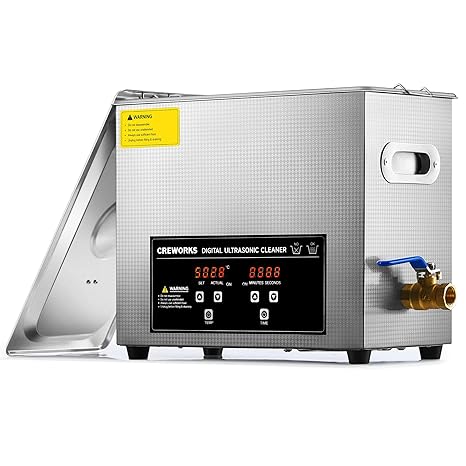
People who regularly clean carburetors or small parts will find the CREWORKS 6L Digital Ultrasonic Cleaner a strong option. Its main strength lies in using 180W ultrasonic power combined with heating to handle stubborn residues and reach intricate surfaces effectively.
Setting it up is straightforward with its digital controls and a basin that holds 1.6 gallons, sizable enough for multiple carb parts at once. You won’t need chemicals thanks to ultrasonic cavitation, and daily tasks become quick since the unit heats up to intensify cleaning.
Its moderate weight of just under 12 pounds makes it stable but still easy enough to move when needed.
The cleaning hits most grime, rust, and carbon left on carburetors with noticeable thoroughness, showing professional-quality results. The build feels solid and compact, fitting well in a garage or workshop.
Many users appreciate how well it cleans fine details, though some mention the size might be a bit bulky for smaller bench spaces.
Users praise the cleaner’s power and ability to remove stubborn residues from small, intricate parts without needing harsh chemicals. The digital interface adds simplicity to the process. Many also find the unit’s size a little large for limited bench space, which can be inconvenient if counter space is tight.
Anyone needing a thorough ultrasonic cleaner for multiple carburetor parts or other delicate tools will benefit from its capacity and power. Those with very small workshops or who want a lighter, more compact option might want to look for smaller models.
Pros
- Strong 180W ultrasonic power with heating option
- Large 1.6 gallon basin fits multiple carb parts
- Digital controls make operation precise and easy
- Well-built and stable during use
Cons
- Relatively bulky footprint for small workspaces
- Weight close to 12 pounds limits portability
| Specification | Details |
|---|---|
| Power (Ultrasonic) | 180W |
| Heating Power | Up to 200W |
| Basin Capacity | 1.6 gallon (6 liters) |
| Dimensions | 16.61 x 13.89 x 7.68 inches |
| Item Weight | 11.84 pounds |
| Manufacturer | CREWORKS |
10. Ultrasonic Carburetor Cleaner Solution

Ultrasonic Carburetor Cleaner Solution is made for anyone working on engine parts who needs a cleaning fluid that digs into tight spaces. Its biggest advantage lies in its concentrated formula designed to work with ultrasonic machines, breaking down grime on carburetors and other metal engine components without leaving residue or color.
Mixing the concentrate with water is straightforward, fitting well with standard ultrasonic cleaning units. The unscented, dye-free liquid avoids adding any unwanted smell or dye to your parts, making the cleaning process feel simple and clean. It reaches into narrow cracks and hard-to-reach angles, which is critical when dealing with complex carburetor shapes and other engine elements.
The cleaning action is thorough on metal parts like carburetors, valves, and pistons, effectively loosening dirt, grease, and varnish. The concentrate nature means you get strong performance by adjusting the mix ratio. Some users appreciate how odorless it is, while others notice it requires compatible ultrasonic equipment to reveal its full power.
There’s no mess or leftover coloring, which helps maintain the original condition of cleaned parts.
The strongest praise highlights its ability to loosen tough grime from intricate engine parts without leaving any odor or color behind. The main complaint centers on needing an ultrasonic cleaner for full effectiveness, limiting casual or manual cleaning use.
People who already own or plan to operate an ultrasonic cleaning machine will appreciate its powerful, concentrated action. Those looking for a stand-alone cleaner or non-metal applications should look for other options better suited to their needs.
Pros
- Concentrated formula mixes easily with water
- Removes grease and varnish deeply
- Unscented and dye-free, no residue
- Works on variety of engine components
Cons
- Requires compatible ultrasonic machines
- Only designed for metal surfaces
| Specification | Details |
|---|---|
| Item Form | Liquid |
| Scent | Unscented |
| Specific Uses For Product | Engine |
| Surface Recommendation | Metal |
| Special Features | Concentrated |
11. Ultrasonic Cleaner Solution for Automotive Parts

Tillbrook Ultrasonic Cleaner Solution for Automotive Parts excels at breaking down grime on carburetors and other engine parts. It suits those who work on automotive or small engine restoration and need a heavy-duty formula that thoroughly cleans metal components.
Mixing the concentrated liquid with water is straightforward, allowing a range between 2 to 4 gallons depending on how tough the dirt is. Using more solution creates a stronger clean, while less is fine for lighter tasks. The unscented formula means no strong odors, and since it doesn’t require rinsing, cleanup after use is simple and quick.
This solution handles stubborn grime on metal surfaces very well, achieving deep cleaning when paired with ultrasonic machines. It’s meant for heavy-duty use, making it a solid choice for carburetors, valves, and seats.
Most praise highlights how effectively it dissolves grease. On the downside, users sometimes find the need to adjust concentration for different jobs a bit inconvenient.
Cleaning strength earns high marks for removing stubborn engine grime easily, though adjusting dilution levels can add complexity during use. It delivers reliable deep cleaning but takes some measuring to get right for each job.
People restoring automotive or small engine parts needing a strong carburetor cleaner will appreciate this solution. Those requiring a scent or needing to clean non-metal surfaces might want to explore different products.
Pros
- Concentrated formula allows mixing 2-4 gallons
- Powerful on tough automotive grime
- Unscented, avoids strong chemical odors
- No rinsing needed after cleaning
Cons
- Requires varying dilution for different cleaning strengths
- Only designed for metal surfaces
| Specification | Details |
|---|---|
| Item Form | Liquid |
| Scent | Unscented |
| Specific Uses For Product | All Purpose |
| Surface Recommendation | Metal |
| Special Features | No Rinse |
12. VEVOR 3L Ultrasonic Cleaner

Cleaning carburetors and small parts gets thorough with the 3L ultrasonic cleaner suited for commercial or lab settings. Its strongest point is the powerful 40kHz ultrasonic waves that reach every nook and cranny, making tough grease removal manageable and efficient.
Setting it up is straightforward with a simple knob controlling frequency, time, and temperature. Using warm water and neutral detergent boosts its cleaning effect. Switching between two power modes lets you adjust for delicate items or heavier grime without causing damage.
Degassing mode improves cleaning by removing air from the liquid, which increases efficiency noticeably.
Performance matches the claims well, cutting through stubborn oils on carburetors effectively. The unit is box-shaped and built for industrial use, offering solid reliability with a clear, easy interface.
Most common praise highlights how well it cleans detailed parts, while the usual complaint involves the size being a bit large for home use.
The strongest praise points to its effectiveness at removing stubborn grease from detailed carburetor parts, ensuring everything comes out clean. The most frequent complaint is about its larger size, which can be less convenient for personal or small-space use.
Those working in commercial or laboratory environments with frequent and varied cleaning needs will appreciate this model. People looking for a compact cleaner for occasional home tasks might want to consider a smaller alternative.
Pros
- Powerful 40kHz ultrasonic waves for deep cleaning
- Easy knob controls for frequency, time, and temperature
- Degassing mode boosts cleaning efficiency by 30%
- Suitable for delicate and heavy-duty parts
Cons
- Size may be too large for home or casual use
- Needs neutral detergent and warm water for best results
| Specification | Details |
|---|---|
| Specific Uses | Carburetors, circuit boards, dental equipment, jewelry, glasses, watches, tableware |
| Special Features | Dual Power Modes, Easy Operation |
| Container Type | Box |
| Recommended Uses | Commercial settings, laboratories |
| Cleaning Frequency | 40kHz |
Best Ultrasonic Cleaners for Carbs Compared
| Product | Best For | Capacity | Weight | Special Features |
|---|---|---|---|---|
| Ultrasonic Carburetor Solution | Carburetors, Engine Parts | – | – | Concentrated |
| VEVOR 15L Cleaner | General Parts | 15L | 15.08 lbs | – |
| CREWORKS 10L Cleaner | General Parts | 10L | 14.1 lbs | – |
| VEVOR 6L Cleaner | General Parts | 6L | 8.16 lbs | – |
| Carburetor Cleaning Solution | Carburetors, Engine Parts | – | – | – |
| Auto Parts Cleaner Solution | Engine Parts | – | – | Non Abrasive |
| CREWORKS 15L Cleaner | Auto Tools, Jewelry | 15L | – | Portable |
| VEVOR 30L Cleaner | General Parts | 30L | 27.6 lbs | – |
| CREWORKS 6L Digital Cleaner | General Parts | 6L | 11.84 lbs | Digital Cleaner |
| Carburetor Cleaner Solution | Carburetors, Engine Parts | – | – | Concentrated |
| Automotive Cleaner Solution | All Purpose | – | – | No Rinse |
| VEVOR 3L Cleaner | Carburetors, Multiple Uses | 3L | – | Dual Power Modes |
- Best ForCarburetors, Engine Parts
- Capacity–
- Weight–
- Special FeaturesConcentrated
- Best ForGeneral Parts
- Capacity15L
- Weight15.08 lbs
- Special Features–
- Best ForGeneral Parts
- Capacity10L
- Weight14.1 lbs
- Special Features–
- Best ForGeneral Parts
- Capacity6L
- Weight8.16 lbs
- Special Features–
- Best ForCarburetors, Engine Parts
- Capacity–
- Weight–
- Special Features–
- Best ForEngine Parts
- Capacity–
- Weight–
- Special FeaturesNon Abrasive
- Best ForAuto Tools, Jewelry
- Capacity15L
- Weight–
- Special FeaturesPortable
- Best ForGeneral Parts
- Capacity30L
- Weight27.6 lbs
- Special Features–
- Best ForGeneral Parts
- Capacity6L
- Weight11.84 lbs
- Special FeaturesDigital Cleaner
- Best ForCarburetors, Engine Parts
- Capacity–
- Weight–
- Special FeaturesConcentrated
- Best ForAll Purpose
- Capacity–
- Weight–
- Special FeaturesNo Rinse
- Best ForCarburetors, Multiple Uses
- Capacity3L
- Weight–
- Special FeaturesDual Power Modes
How to Choose the Right Ultrasonic Cleaner
Choosing an effective ultrasonic cleaner for carbs involves considering tank size, cleaning frequency, and power settings to match your specific needs. Selecting the right features ensures thorough cleaning without damaging parts, saving money on replacements and avoiding unnecessary repairs.
Tank Size and Capacity
Carburetor parts vary widely in size, so the tank must comfortably fit them without forcing anything in. Running a machine where parts are crammed together leads to poor cleaning results because the ultrasonic waves can’t reach all surfaces evenly. Larger tanks allow placing multiple components at once, speeding up maintenance sessions.
Depth is also important; shallow tanks don’t generate sufficient ultrasonic agitation below the surface, leaving grime untouched in hard-to-reach areas.
A strong tank for this use tends to start around 1 to 2 liters, with depths of 3 or more inches to ensure proper wave action. Accommodating small carb parts and even entire carburetors without overlap or crowding prevents damage and increases cleaning efficiency. Steel tanks over plastic are preferable for maintaining stability and sound wave consistency during operation.
Ultrasonic Power and Frequency
Ultrasonic power directly affects how quickly and thoroughly parts get clean. Models with low wattage sometimes require multiple cycles or manual scrubbing afterward. A unit delivering at least 50 watts of power ensures decent cleaning times without overworking the device.
Frequency plays a critical role too; the typical range around 40 to 45 kHz hits the right balance between strong cavitation and gentle treatment that doesn’t harm delicate carburetor components.
Consistency throughout the tank is essential. Uneven power output means some spots remain dirty or need longer cleaning, wasting time. Reliable units maintain uniform intensity, ensuring every nook and cranny sees the same ultrasonic effect in one cycle.
This reduces user frustration and speeds up routine maintenance.
Build Materials and Durability
Stainless steel tanks resist corrosion caused by common cleaning solvents like alcohol or detergents used in carburetor maintenance. Plastic tanks might degrade or stain over time, which compromises cleaning quality. High-quality external materials such as coated steel or durable plastic resist dings, scratches, and moisture that accumulate in workshop environments.
Frequent use generates vibration and heat, so a solid overall construction prevents warping or breaking. A well-built cleaner stays stable on the bench during operation, avoiding spills or damage. Components like reinforced corners and sturdy feet contribute to a longer lifespan, making it a better value over time.
Ease of Use and Controls
Ultrasonic cleaners with straightforward controls speed up work by reducing setup time. Accessible buttons or dials allow quick adjustments of cycle duration and power, while pre-set cleaning modes add convenience for common tasks.
Clear digital readouts showing time remaining and current settings improve awareness during operation, so users don’t have to guess how long a cycle will take.
Additional features such as built-in heaters help boost cleaning efficiency by loosening grime faster. Drain plugs simplify solution changes, reducing mess and effort when swapping cleaning fluids.
These details matter even more when cleaning happens regularly, making the whole process less tiresome.
Safety Features and Noise Levels
Overheating risks damage to both the cleaner and sensitive carb parts. Models equipped with overheat protection shut down automatically when temperatures rise too far, reducing accident risks.
This safeguard also extends machine lifespan by preventing internal damage. Quiet operation makes a difference too, especially in shared workshop spaces or when running cycles repeatedly throughout the day.
Secure lids prevent splashing and exposure to potentially harmful solvents, keeping the workspace safer and cleaner. A tight-fitting cover also reduces noise output. Considering this factor ensures the cleaning process remains safe, comfortable, and well contained during use.
Tips for Effectively Cleaning Carburetors with an Ultrasonic Cleaner
Carburetors have many small parts and tight spaces that are difficult to clean thoroughly by hand. Ultrasonic cleaners use high-frequency sound waves to create tiny bubbles that agitate and remove dirt, varnish, and debris from every nook and cranny. For the best results, disassemble the carburetor completely before placing the parts in the cleaner.
Here are some practical tips to keep in mind:
- Use a cleaning solution designed specifically for carburetors to dissolve fuel residues without damaging metal components.
- Soak smaller parts, like jets and screws, in a mesh basket to prevent them from getting lost.
- Run multiple cleaning cycles if parts are heavily soiled, allowing time to cool between cycles to avoid warping.
- After cleaning, rinse all parts with clean water and dry them thoroughly to prevent rust.
Common Mistakes to Avoid When Using Ultrasonic Cleaners for Carbs
Common errors during ultrasonic cleaning can reduce effectiveness or cause damage. One frequent mistake is overcrowding the cleaner’s tank.
When parts are too close together, the ultrasonic waves cannot reach all surfaces evenly, leaving dirt behind.
Other things to watch out for include:
- Using harsh or inappropriate cleaning liquids that can corrode aluminum or rubber parts.
- Neglecting to pre-clean extremely dirty components, which can overload the solution and reduce cleaning power.
- Running the cleaner for too long in one cycle, which may cause parts to overheat or degrade.
- Failing to disassemble the carburetor fully, which limits the cleaner’s reach and effectiveness.
Comparing Ultrasonic Cleaning to Traditional Carburetor Cleaning Methods
Traditional carburetor cleaning often involves manual scrubbing, soaking in solvent, and using compressed air. These methods depend heavily on physical effort and may not reach tight crevices. Ultrasonic cleaning, by contrast, targets every small opening simultaneously.
This reduces time spent and improves thoroughness.
There are a few key differences to consider:
- Manual methods risk scratching or damaging delicate parts if too much force is applied.
- Solvent soaking alone can soften deposits but may not fully dislodge hardened dirt inside small passages.
- Ultrasonic waves remove contaminants without abrasive contact, preserving component integrity.
- The cleaning solution can be reused in ultrasonic units, trimming costs and waste compared to continuous solvent use.
People Also Asked
How Do I Choose the Right Size Ultrasonic Cleaner for Carburetors?
Choose a size that fits your largest carburetor parts comfortably without crowding the tank. Overloading reduces cleaning efficiency. Measure the biggest piece and allow extra room for bubbles to circulate freely around all surfaces.
What Cleaning Solutions Are Safe to Use with Ultrasonic Carb Cleaner?
Use solutions specifically formulated for carburetor or engine parts; mild detergents or degreasers work best. Avoid acidic or overly alkaline cleaners that can damage metal or rubber parts. Always check compatibility with seals and gaskets before use.
How Long Should I Run the Ultrasonic Cleaner for Carburetor Parts?
Run the cleaner for about 5 to 10 minutes depending on grime levels. Longer cycles don’t always improve results and might affect sensitive parts. Break the cleaning into shorter intervals and inspect parts periodically for best outcomes.
Can Ultrasonic Cleaners Damage Delicate Carburetor Components During Cleaning?
Some delicate components like rubber seals or plastic floats can suffer damage if exposed too long or to harsh chemicals. Remove sensitive parts before cleaning or use a milder solution and shorter cleaning time to protect them.
What Common Problems Occur When Using Ultrasonic Cleaners for Carburetors?
Common problems include incomplete cleaning from overcrowding, leftover debris in corners needing manual brushing, and potential damage if the wrong solution or time is used. Rinsing and drying parts well after cleaning also prevents corrosion or sticking.
Conclusion
Choosing the right ultrasonic cleaner for carburetors comes down to tank size, cleaning power, and ease of use. The tank needs to be large enough for your carb parts without being excessively bulky.
Cleaning power is essential to break down tough deposits, while simple controls help you avoid complications during cleaning cycles.
Consider your available workspace and how often you plan to clean carbs before making a decision. Smaller units save space and cost less for occasional use, while bigger machines suit frequent or larger jobs.
The comparison table above can help match a cleaner to your needs, so review the options again before buying.