Top 12 Best Saltless Water Softener That Will Change Your Life
Hard water stains on dishes and spots on glassware are everyday frustrations for anyone relying on a best saltless water softener that doesn’t perform well. Often, cheaper units can’t reduce scale buildup effectively, leaving a residue that damages appliances and clogs pipes over time.
Those who choose the wrong softener will find the system struggles with consistent output, causing hard water issues to persist despite treatment attempts.
The key to a reliable saltless water softener lies in its technology and capacity. High-quality units use template-assisted crystallization or similar methods to alter minerals without salt, requiring properly sized tanks to handle your household’s water hardness and volume.
Ease of installation and minimal maintenance, like occasional filter changes without complex cleaning, make a big difference in long-term satisfaction. Materials resistant to corrosion and safe certification standards also indicate durability and a better investment.
Need a Quick Check?
| Image | Product | Price |
|---|---|---|
Our Top Picks 1  | A. O. Smith Salt-Free Descaler | Check Price |
Our Top Picks 2  | PIURIFY Water Descaler System | Check Price |
Our Top Picks 3  | Kind Water E-3000 Softener | Check Price |
Our Selected Top 12 Saltless Water Softener You Can Trust
This list features carefully chosen saltless water softeners that help reduce hardness without using salt. Each review explains how the product performs, highlights who it is ideal for, and outlines its main advantages and potential drawbacks to help you make an informed choice.
1. A. O. Smith Whole House Salt-Free Scale Control AO-WH-DSCLR
Salt-free scale prevention stands out as the main advantage here, perfect for homes with moderate water hardness under 15 grains per gallon. It’s designed for people wanting to reduce scale without altering the water’s mineral content or using salt and chemicals.
Installation is for the whole house, using water pressure without needing electricity, salt bags, or regular cleaning. It runs quietly and doesn’t need backwashing, so once set up, daily use is smooth and easy. The system handles a maximum flow rate of 7 gpm, enough for an average family, and supports water temperatures between 40 °F and 90 °F.
The descaler manages scale buildup well according to those who use it, keeping your pipes and plumbing cleaner without softening the water. Built to last about six years, most praise its salt- and chemical-free operation.
Some note it won’t remove iron or reduce total dissolved solids, which can be downsides depending on your water quality.
Many appreciate the salt-free scale control as it reduces buildup in plumbing without ongoing maintenance or added chemicals. Common feedback points out that it doesn’t soften water or target iron removal, which limits effectiveness in some situations.
Ideal for households wanting to prevent scale with moderate hardness water and minimal upkeep. Those needing true water softening or iron removal may want to explore other solutions better suited for those specific needs.
Pros
- Works without salt or chemicals
- No electricity or backwashing needed
- Long 6-year filter life
- Handles moderate hardness well
Cons
- Does not actually soften water
- Does not remove iron or reduce TDS
| Specification | Details |
|---|---|
| Maximum Flow Rate | 7 gpm |
| Operating Pressure Range | 20-100 psi |
| Lower Temperature Range | 40 °F |
| Upper Temperature Rating | 90 °F |
| Supported Water TDS Level Maximum (PPM) | 1200 |
| Filter Life Cycle | 6 years |
2. PIURIFY Whole House Electronic Water Descaler System
People living in apartments or smaller homes with moderate to high water hardness will find this electronic water descaler system fits well for managing their water issues. Its biggest appeal is the strong protection it offers against scale buildup without needing salt, which keeps pipes and appliances safer long-term.
Setting up the system takes about three minutes without any tools, making it very renter-friendly and easy to move if needed. You just clip two magnetic electrodes around the pipe and plug it in, which makes the daily operation completely hands-off. Running quietly on corded electric power, it requires no maintenance or chemicals, fitting well into a busy lifestyle.
The device handles hard water hardness levels up to 15 GPG (250 PPM) with a powerful 168V peak-to-peak output that’s stronger than many similar products. Its build focuses on durability and practicality. Most praise highlights its effectiveness in reducing scale, while some note the limited suitability only for smaller households as a drawback.
The system effectively reduces scale buildup thanks to its high 168V output, which makes a noticeable difference for water hardness up to 15 GPG. However, the most common complaint revolves around its limited suitability for larger households and reliance on an electrical outlet.
Anyone living in apartments or smaller homes with moderate to high hard water will appreciate how easy it is to set up and use without salt. Larger families or those without stable electric access might want to consider different options designed for higher capacity or off-grid use.
Pros
- Strong scale defense for moderate to high hardness
- Quick installation without tools
- Salt-free operation safe for pipes
- Compact and renter-friendly design
Cons
- Best suited for small households only
- Requires continuous power supply
| Specification | Details |
|---|---|
| Water Hardness Capacity | up to 15 GPG / 250 PPM |
| Output Voltage | 168V peak-to-peak |
| Setup Time | 3-minute tool-free setup |
| Power Source | Corded Electric |
| Purification Method | Electronic Descaling |
| Household Suitability | 1–3 people |
3. Kind Water Systems E-3000 Salt-Free Whole House Softener & Filter
Kind Water Systems E-3000 stands out by combining salt-free water softening with sediment and carbon filtration, making it ideal for those on city water looking to improve taste and reduce contaminants. Its biggest strength lies in offering a whole-house solution that doesn’t rely on salt or electricity.
Installation is straightforward thanks to its compact, lightweight design. The system operates manually and handles flow rates up to 15 gallons per minute, fitting right into your whole-house water system without extra drain lines or bulky tanks. Daily, it filters out sediments and chemicals like chlorine while naturally reducing scale buildup, so your water feels cleaner from every tap.
Performance-wise, it effectively targets 95% of sediment and over 155 chemical contaminants without removing healthy minerals, which is a big plus. The build is solid but light, which makes handling easier but might not satisfy those looking for heavy-duty hardware.
Many praise its salt-free approach and improved water taste, while some wish it dealt better with extremely hard water scale.
The clean, better-tasting water and effective removal of a wide range of chemical contaminants earn strong praise. The system’s limited impact on very hard water scale is a commonly mentioned drawback. People appreciate the salt-free softening that protects appliances and plumbing without adding salt waste.
Those on city water with moderate hardness and concern for chemicals will be satisfied by this product. It’s less suited for homes with extremely hard water or users looking for fully automated systems without manual upkeep.
Pros
- Combines filtration and salt-free softening
- Retains healthy natural minerals in water
- No electricity or salt required
- Compact and lightweight design
Cons
- Less effective on very hard water scale
- Needs manual operation for maintenance
| Specification | Details |
|---|---|
| Maximum Flow Rate | 15 gpm |
| Purification Method | Carbon Block |
| Power Source | Manual Operation |
| Supported Water TDS Level Maximum (PPM) | 1500 |
| Lower Temperature Range | 36 °F |
| Upper Temperature Rating | 120 °F |
4. NuvoH2O Manor Salt-Free Whole Home Water Softener

NuvoH2O Manor Salt-Free Whole Home Water Softener is designed for anyone wanting to soften water without the use of salt or chemicals. It works well for households concerned about maintaining essential minerals in their water while controlling scale buildup. Its biggest strength is the salt-free, citrus-based softening that keeps water healthy and appliances protected.
Setup is straightforward with an inline installation using a cartridge system. No electricity is needed, which means it runs silently and efficiently without added power cost. The cartridge lasts about six months before needing replacement.
Water flows through the CitraCharge technology, treating it by preventing scale without removing calcium or magnesium, so your water still feels natural without the slickness of traditional softeners.
Performance meets expectations by effectively controlling existing hard water scale and stopping new buildup, which extends the lifespan of plumbing and appliances. The build is simple but sturdy with a design focused on convenience and low maintenance.
Praise often highlights how it avoids the typical salt residue. The main drawback noted in reviews is the cartridge needing replacement every six months, which some find inconvenient.
The product receives strong praise for effectively preventing and removing scale without adding salt or chemicals, leaving water feeling natural. Most users point out the inconvenience of having to replace the cartridge every six months as the main drawback, especially if they are managing multiple filtration devices.
People looking for a salt-free solution that maintains water minerals and protects appliances will appreciate this softener. Those requiring significant softening beyond 427 PPM or wanting a lower maintenance option might prefer alternative systems with longer filter life or salt-based softeners.
Pros
- Softens water while retaining essential minerals
- No electricity required for operation
- Prevents and removes hard water scale buildup
- Simple inline cartridge installation
Cons
- Cartridge replacement needed every 6 months
- May not soften water beyond 427 PPM TDS
| Specification | Details |
|---|---|
| Purification Method | Salt-free Citrus-based Water Conditioning Technology |
| Installation Type | Inline Installation |
| Filter Life Cycle | 6 months |
| Power Source | Zero Electricity |
| Supported Water TDS Level Maximum (PPM) | 427 |
| Upper Temperature Rating | 100 °C |
5. Aquasure Harmony Series Whole House Water Softener

Water feels softer and cleaner throughout the house with this whole-house system suited for homes with 3 to 4 bathrooms. The biggest strength lies in its ability to treat up to 40,000 grains of hardness, effectively removing minerals that cause skin irritation and buildup in pipes.
Installation is straightforward since it’s designed as a whole-house system with a high-performance automatic digital metered control head, which adjusts water treatment based on usage. Day-to-day operation is simple as the built-in Triple Purpose Pre-Filter clears out sediment, chlorine, and other contaminants, helping maintain better water quality without the need for salt.
The system reliably reduces hardness caused by calcium and magnesium, improving water softness and protecting skin from irritation. Build quality feels solid and the dispenser container is practical for whole-house treatment.
One highlight from feedback is how well it removes unwanted tastes and odors. Some users mention occasional maintenance of the pre-filter as a common task.
Users appreciate how well the system softens water and improves taste by removing a wide range of contaminants. Cleaning and replacing the pre-filter can be a handful for those not used to maintenance tasks. The digital metered control helps optimize performance based on water flow.
People living in homes with 3 or 4 bathrooms wanting a saltless softening option will find this system fitting well. Those needing higher temperature water or less frequent filter maintenance might want to explore other alternatives.
Pros
- Handles water hardness up to 40,000 grains
- Removes 99% of contaminants including chlorine and sediment
- Automatic digital control adjusts treatment by usage
- Suitable for homes with 3-4 bathrooms
Cons
- Requires regular pre-filter maintenance
- Limited to max water temperature of 100 °F
| Specification | Details |
|---|---|
| Grain Capacity | 40,000 Grains |
| Bathrooms Supported | 3-4 |
| Purification Method | Reverse Osmosis |
| Upper Temperature Rating | 100 °F |
| Maximum TDS Level | 2500 PPM |
| Control Head | Automatic Digital Metered |
6. iSpring ED2000 Whole House Electronic Salt-Free Water Descaler
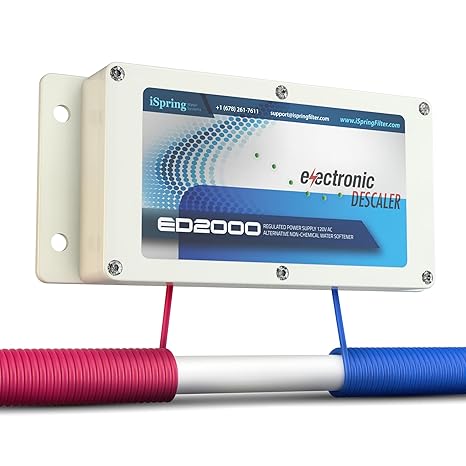
Great for homes facing hard water issues, the iSpring ED2000 provides a maintenance-free saltless solution that keeps beneficial minerals intact. It works best for people wanting to reduce scale buildup without chemicals or salt, supporting healthier skin and appliances over time.
Installation is straightforward since the device is designed for self-installation. Once set up, the electronic descaler uses a corded electric power source and runs continuously without needing chemicals or salt refills.
It’s quiet and doesn’t require any ongoing upkeep, making day-to-day use simple and convenient for anyone with hard water concerns.
The ED2000 effectively prevents scale deposits in the entire water system and gradually breaks down existing scale. Customers praise its energy-saving aspects and rust-resistant build.
Some note, however, that it may not handle extremely high mineral levels beyond 19 grains per gallon as efficiently. Still, it consistently protects appliances and pipes in very hard water areas.
Many users highlight how effectively it lowers scale buildup and saves energy, while some mention that very hard water levels beyond 19 grains challenge its performance. The rust resistance adds reassurance about long-term use.
People living in areas with hard water up to 19 grains will appreciate this product’s saltless descaling. Those needing solutions for more severe hardness or without reliable power might need to consider other options.
Pros
- Easy to install without professional help
- Requires no salt or chemicals
- Energy-saving with one-year payback potential
- Rust-resistant housing for durability
Cons
- Less effective with extremely hard water over 19 grains
- Needs continuous electric power to operate
| Specification | Details |
|---|---|
| Installation Type | Self-installation |
| Power Source | Corded Electric |
| Supported Water Hardness | 10-19 grains per gallon |
| Maximum Water TDS Level | 326 PPM |
| Purification Method | Activated Carbon |
| Special Features | Easy Installation, Power Saving, Rust Resistant |
7. Aquasure Harmony Series Whole House Water Softener

Made with a solid dispenser container and designed to cover homes with 1-2 bathrooms, the Aquasure Harmony Series is a water softener that focuses on treating hard minerals without salt. It’s a great fit for those looking to reduce scale buildup and protect appliances from damage caused by hard water.
Setup requires installing the whole house water tank and plugging in the corded electric power source. Daily use is straightforward with programmable settings to adjust based on your water conditions.
The system consistently delivers softened water throughout every outlet in the house, which makes everyday routines like washing and showering more pleasant without needing salt refills.
Performance-wise, it effectively tackles up to 32,000 grains of hardness by removing calcium and magnesium, which are known to clog pores and irritate skin. The unit feels sturdy and reliable but some mention that programming takes a bit of time to get used to. The strongest point is how it protects appliances like dishwashers and washers by preventing scale, while the common downpoint is the initial setup and programming learning curve.
Most users praise how well it prevents scale buildup and protects home appliances, which helps extend their lifespan. On the flip side, figuring out the programming settings takes effort and patience during initial setup.
People with smaller households and moderately hard water will find this softener meets their needs. Those with higher TDS levels or bigger homes may need to look for a different system with higher capacity or simpler controls.
Pros
- Protects appliances from scale buildup
- Programmable for customized water softening
- Treats up to 32,000 grains of hardness
- Suitable for homes with 1-2 bathrooms
Cons
- Programming can be tricky at first
- Limited to maximum TDS of 1000 PPM
| Specification | Details |
|---|---|
| Installation Type | Whole House Water Tank |
| Purification Method | Water Softener |
| Power Source | Corded Electric |
| Supported Water TDS Level Maximum (PPM) | 1000 |
| Grain Capacity | 32,000 Grains |
| Special Features | Programmable |
8. NuvoH2O Citrus-Based Salt-Free Water Filter & Softener

Salt-free water softening stands out most with its gentle touch on minerals. Perfect for those wanting softer water without losing calcium or magnesium, it avoids the usual salt buildup and slick water feel.
The use of citrus-based tech makes it a unique choice for homes concerned about scale without added sodium.
Setup requires inline installation, so it fits right into your water line without extra power, runs entirely without electricity. The filter cartridge lasts about six months, which means semi-annual changes keep water tasting fresh and chemicals filtered. Handling 15 gallons per minute suits many households, keeping your flow regular while preventing scale naturally.
This system softens water by preventing scale using CitraCharge technology rather than salt salts or potassium. It cleans water with an activated carbon filter, improving taste noticeably. Built to work up to 500 PPM TDS, it handles moderate water hardness well but demands cartridge swaps every six months.
Some mention filter life as a routine maintenance factor to keep track of.
Many users appreciate that the system effectively softens water without salt and improves its taste through chemical filtration. The common drawback is the need to replace the cartridge every six months, which requires attention to maintain performance.
This setup works well for those with hard water below 500 PPM TDS and who prefer a salt-free softening method. Homes needing to handle higher water hardness or who want less frequent replacements might want to consider alternatives.
Pros
- No salt, retains essential minerals
- Cleans water, improves taste
- Zero electricity needed
- Good flow rate for regular household use
Cons
- Filter cartridge needs replacement every 6 months
- Maximum TDS support limited to 500 PPM
| Specification | Details |
|---|---|
| Purification Method | Activated Carbon |
| Power Source | Zero Electricity |
| Maximum Flow Rate | 15 gpm |
| Filter Life Cycle | 6 months |
| Supported Water TDS Level Maximum | 500 PPM |
| Installation Type | Inline Installation |
9. NuvoH2O Advanced 3-Stage Citrus-Based Salt-Free Water Filter & Softener

Salt-free water softening that keeps essential minerals intact makes this model a good pick for anyone wanting to avoid salt or slippery water. It’s especially suited for people looking to prevent scale buildup without changing water taste or texture.
Installation fits inline easily and requires no electricity, which makes daily maintenance simple. The three-stage filtration takes out chlorine, sediment, and heavy metals, improving water quality and taste noticeably. Cartridges need changing every six months, making upkeep straightforward.
Performance delivers clearly softer water without the typical salty or slick feeling. The build feels sturdy and compact enough for standard home plumbing. A standout feature is the citrus-based softening technology doing well to stop scale, though some users mention that very hard water may need extra treatment.
Highly praised for leaving water tasting fresh and preventing scale buildup using natural citrus technology. Common criticism points to limited effectiveness on very hard water and ongoing cartridge replacements.
Suitable for those wanting salt-free softening and improved water taste without complicated setups. Not ideal for homes with extremely hard water or for those looking to avoid periodic cartridge changes.
Pros
- Softens water without salt or slippery feel
- Removes chlorine, sediment, and heavy metals
- Easy inline installation with no power needed
- Cartridge lasts six months before replacement
Cons
- May not fully treat very hard water conditions
- Requires cartridge changes every six months
| Specification | Details |
|---|---|
| Purification Method | Salt-free Citrus-based Water Conditioning Technology |
| Installation Type | Inline Installation |
| Power Source | Zero Electricity |
| Filter Life Cycle | 6 months |
| Supported Water TDS Level Maximum (PPM) | 428 |
10. NuvoH2O Advanced 2-Stage Salt-Free Softener & Carbon Filter

Hard water can leave annoying scale buildup and an unpleasant feel on skin and dishes, but this saltless water softener handles that without using salt. Great for people wanting to keep minerals in their water while reducing scaling, it stands out by using citrus-based softening that avoids the slimy residue typical of traditional softeners.
Installation is inline, so it fits right into your plumbing system without fuss. It works on a zero-electricity basis, which means no extra energy cost or noise.
The cartridge needs replacing around every six months, keeping maintenance simple. Day to day, you get cleaner, fresher water thanks to its two-stage filtration that deals with chlorine, heavy metals, and other contaminants.
The main job of reducing scale buildup is solid, and the water tastes noticeably better. The build uses CitraCharge technology for salt-free conditioning, and the carbon filter adds good contaminant removal.
The strongest praise notes the water’s fresh taste and the lack of slick feeling on skin, while the most common complaint points to the need to swap the cartridge every six months.
Water tastes fresher and feels cleaner without any slimy residue, though replacing the cartridge twice a year is necessary for optimal performance. The system’s zero electricity use and inline setup make it easy to fit into a household with moderate water conditions.
People wanting chemical-free, saltless conditioning with better taste will appreciate this. Those needing a softener that can handle hotter water or prefer less frequent maintenance might want to look elsewhere.
Pros
- Salt-free softening keeps essential minerals
- Two-stage filtration removes chlorine and metals
- Requires zero electricity to operate
- Improves water taste noticeably
Cons
- Cartridge needs replacement every 6 months
- Upper temperature limit of 120 °F
| Specification | Details |
|---|---|
| Purification Method | Salt-free Citrus-based Water Conditioning Technology |
| Installation Type | Inline Installation |
| Power Source | Zero Electricity |
| Filter Life Cycle | 6 months |
| Upper Temperature Rating | 120 °F |
| Supported Water TDS Level Maximum (PPM) | 1000 |
11. NuvoH2O Advanced 3-Stage Citrus-Based Salt-Free Water Filter & Softener
Uses a salt-free citrus-based softening system designed for anyone wanting to avoid salt in their water treatment. Its biggest strength lies in reducing scale buildup without stripping essential minerals, keeping water healthy and natural tasting.
Installation involves a simple inline setup that requires no electricity, making day-to-day use straightforward and eco-friendly. The cartridge system lasts about six months, letting you focus on cleaner water without worrying about frequent replacements. The three-stage filtration takes care of chlorine, iron, and heavy metals, so your tap water tastes noticeably better and feels fresh.
Effectiveness in softening water and removing contaminants stands out, with the build quality centered on durability and convenience. The main praise users express is the better tasting and cleaner water. One common complaint is the six-month lifespan means replacing the cartridge relatively often, adding minor upkeep.
Water treated with this filter tastes noticeably cleaner and fresher thanks to its triple filtration system removing chlorine and metals. The need to replace the cartridge every six months comes up often as a minor inconvenience for maintaining performance.
Ideal for those seeking salt-free water treatment with minimal environmental impact and easier installation. Not recommended for households with very high TDS water levels requiring more intensive softening solutions.
Pros
- Salt-free water softening retains essential minerals
- Removes chlorine, iron, heavy metals efficiently
- Requires no electricity for operation
- Improves water taste noticeably
Cons
- Filter cartridge needs replacement every six months
- May not soften very hard water beyond 427 TDS level
| Specification | Details |
|---|---|
| Purification Method | Salt-free Citrus-based Water Conditioning Technology |
| Installation Type | Inline Installation |
| Filter Life Cycle | 6 months |
| Power Source | Zero Electricity |
| Supported Water TDS Level Maximum (PPM) | 427 |
12. PRO+AQUA Salt-Free Whole House Softener & 3-Stage Well Water Filter

Anyone looking for a saltless water softener and whole house filter for a small to medium household will appreciate this model’s filtration power. It stands out by combining four stages of filtration and softening without salt, making sure your water stays free from odors, heavy metals, and unwanted colors while keeping it soft and healthy.
Installation requires a permanent setup, and it connects directly into your home’s water supply. The unit uses electric power but runs efficiently to keep water flowing smoothly at over 10 gallons per minute. Featuring programmable controls and a dispenser container style, it’s easy to manage day to day while ensuring your water gets treated throughout the house.
Performance is strong, with filters designed to work together for safe, odor-free water that feels softer thanks to the salt-free conditioning. The build quality is solid for a built-in system, holding up well over time.
One frequent criticism is the complex installation; however, those willing to invest the setup effort find the overall water quality improvement worth it.
Filtration and softening functions combine well to deliver clear, odor-free water suitable for daily use throughout the home. The biggest challenge lies in the installation process, which can be tricky or time-consuming without professional help.
People seeking a comprehensive saltless water treatment solution for smaller households will find this product meets expectations. Those looking for a simpler setup or portable softener may prefer alternative models.
Pros
- Salt-free softening ideal for sensitive systems
- High maximum flow rate of 10.31 gpm
- Removes heavy metals and odors effectively
- Programmable for customized use
Cons
- Requires permanent built-in installation
- May need professional setup due to complexity
| Specification | Details |
|---|---|
| Maximum Flow Rate | 10.31 gpm |
| Purification Method | Sedimentation |
| Power Source | Electric |
| Installation Type | Built-In or Permanent |
| Supported Water TDS Level Maximum (PPM) | 1000 |
| Container Type | Dispenser |
Best Saltless Water Softeners Comparison Table
| Product | Installation Type | Purification Method | Power Source | Max Supported TDS (PPM) |
|---|---|---|---|---|
| A. O. Smith Salt-Free Descaler | Whole House | Scale Control Media | Water Pressure | – |
| PIURIFY Water Descaler System | – | Electronic Descaling | Corded Electric | 250 |
| Kind Water E-3000 Softener | Whole House Water Tank | Carbon Block | Manual Operation | – |
| NuvoH2O Manor Softener | Inline Installation | Salt-free Citrus-based Tech | Zero Electricity | – |
| Aquasure Harmony Softener | Whole-House System | – | – | – |
| iSpring ED2000 Descaler | Self-installation | Activated Carbon | Corded Electric | 326 |
| Aquasure Harmony Softener II | Whole House Water Tank | Water Softener | Corded Electric | 1000 |
| NuvoH2O Citrus Softener | Inline Installation | Activated Carbon | Zero Electricity | 500 |
| NuvoH2O Advanced 3-Stage Citrus | Inline Installation | Salt-free Citrus-based Tech | Zero Electricity | 428 |
| NuvoH2O Advanced 2-Stage Softener | Inline Installation | Salt-free Citrus-based Tech | Zero Electricity | – |
| NuvoH2O Advanced 3-Stage Citrus II | Inline Installation | Salt-free Citrus-based Tech | Zero Electricity | 427 |
| PRO+AQUA 3-Stage Softener | Built-In | Sedimentation | Electric | 1000 |
- Installation TypeWhole House
- Purification MethodScale Control Media
- Power SourceWater Pressure
- Max Supported TDS (PPM)–
- Installation Type–
- Purification MethodElectronic Descaling
- Power SourceCorded Electric
- Max Supported TDS (PPM)250
- Installation TypeWhole House Water Tank
- Purification MethodCarbon Block
- Power SourceManual Operation
- Max Supported TDS (PPM)–
- Installation TypeInline Installation
- Purification MethodSalt-free Citrus-based Tech
- Power SourceZero Electricity
- Max Supported TDS (PPM)–
- Installation TypeWhole-House System
- Purification Method–
- Power Source–
- Max Supported TDS (PPM)–
- Installation TypeSelf-installation
- Purification MethodActivated Carbon
- Power SourceCorded Electric
- Max Supported TDS (PPM)326
- Installation TypeWhole House Water Tank
- Purification MethodWater Softener
- Power SourceCorded Electric
- Max Supported TDS (PPM)1000
- Installation TypeInline Installation
- Purification MethodActivated Carbon
- Power SourceZero Electricity
- Max Supported TDS (PPM)500
- Installation TypeInline Installation
- Purification MethodSalt-free Citrus-based Tech
- Power SourceZero Electricity
- Max Supported TDS (PPM)428
- Installation TypeInline Installation
- Purification MethodSalt-free Citrus-based Tech
- Power SourceZero Electricity
- Max Supported TDS (PPM)–
- Installation TypeInline Installation
- Purification MethodSalt-free Citrus-based Tech
- Power SourceZero Electricity
- Max Supported TDS (PPM)427
- Installation TypeBuilt-In
- Purification MethodSedimentation
- Power SourceElectric
- Max Supported TDS (PPM)1000
How to Choose the Right Saltless Water Softener
Consider the water hardness level, system capacity, and maintenance requirements when selecting a saltless water softener, as these factors ensure effective treatment and long-term reliability. Choosing the right fit for your needs helps avoid wasted resources and reduces potential repairs or replacements over time.
Water Hardness Compatibility
Hard water can vary widely depending on your location, with mineral levels ranging from mild to extremely high. Most saltless units handle water up to about 20 to 25 grains per gallon, but this can vary significantly. These systems don’t remove calcium and magnesium ions; instead, they change their structure to prevent scale buildup.
Spotting and scaling can still appear on faucets and appliances when water hardness goes beyond the unit’s capability. Counting the exact hardness from a recent water test report helps avoid mismatch issues.
A good system’s specifications will state the maximum grains per gallon it can treat effectively. Checking compatibility prevents disappointment since using a system designed for lower levels against very hard water often means compromised performance and ongoing maintenance headaches.
Flow Rate and Capacity
Households with multiple bathrooms or heavy water usage demand a system that won’t throttle flow. Maximum flow rate indicates how many gallons per minute the unit can handle while conditioning water. Units rated around 7 to 10 GPM suit average families, but bigger homes might need 12 GPM or more to avoid pressure drops.
Capacity refers to how much water the system can treat before a service or media replacement is necessary. For saltless setups, this usually translates to thousands of gallons between maintenance cycles.
Overloading a system can lead to mineral deposits building up in pipes despite treatment, causing reduced hot water heater efficiency or clogged fixtures. Look for ratings and manuals detailing flow and capacity to ensure steady pressure during showers or dishwashing.
System Technology and Method
Popular saltless technology types include template-assisted crystallization (TAC) and magnetic systems, each working differently to break up hardness minerals. TAC uses a resin or media that promotes microscopic crystal formation, which resists sticking to pipes, reducing scale buildup without altering water chemistry.
Magnetic or electronic systems claim to polarize minerals but often vary in effectiveness depending on water content and pipe type. The technology type influences long-term plumbing health and maintenance: TAC generally adapts to both copper and PVC plumbing and doesn’t add chemicals, while magnetic units require specific installation spots and sometimes reduced flow rates. Matching technology to your plumbing setup and water characteristics ensures better scale control and fewer pipe issues down the line.
Installation and Maintenance Ease
Most saltless systems connect directly to the main water line and prefer straight runs with limited bends for ease of installation. Units with standard fittings designed for common pipe sizes (usually 3/4” or 1”) save time and reduce the need for extra adapters. Some models come with clear, step-by-step instructions allowing a competent DIYer to install the unit in a couple of hours using basic tools.
Maintenance routines often involve flushing the media or replacing cartridges every 6 to 12 months, depending on water use and system design. Complex setups that require professional calibration or specialized tools can add to total cost and downtime, so checking these details upfront prevents surprises after purchase.
Durability and Warranty
Good saltless water conditioning systems use durable materials like stainless steel or reinforced plastic housings to resist corrosion from constant water exposure. Cheaper units often rely on weaker plastics that can crack or degrade, especially in warmer water lines. The warranty length varies widely, some brands offer a standard 3 to 5 years, which covers the critical media chamber and electronic parts, while others include longer support for plumbing fittings.
Responsive manufacturer support for troubleshooting and easy access to replacement parts reduces downtime when issues arise. Reading the fine print about warranty coverage clarifies what’s included and how repairs are handled without out-of-pocket expenses.
Effective Maintenance Practices for Saltless Water Softeners
Saltless water softeners require regular upkeep to maintain performance. Sediment and mineral buildup can reduce efficiency, so checking the system’s filters and cleaning them when necessary keeps water flowing smoothly.
Inspecting the media inside the softener is important; some systems use catalytic or chelation media that can degrade over time and need replacement every few years.
Key maintenance steps include:
- Cleaning or replacing filters according to the manufacturer’s schedule
- Flushing the system periodically to clear trapped particles
- Checking for leaks or corrosion in the plumbing connected to the unit
- Keeping an eye on water pressure, as drops can signal blockages
Routine care extends the softener’s lifespan, ensures consistent water quality, and helps avoid costly repairs or system failure.
Common Mistakes to Avoid When Using a Saltless Water Softener
Users often assume saltless water softeners provide completely softened water, but these systems condition, not remove, hardness minerals. Expect some trace mineral presence.
Avoid setting unrealistic expectations about water softness, as this can lead to unnecessary changes or system replacements.
Other mistakes include neglecting regular system checks, which can allow scale buildup to harm appliances or pipes. Skipping recommended media replacements decreases softening effectiveness over time. Installing the system incorrectly, such as placing it downstream from certain water heaters or filters, can impair function.
Common pitfalls to avoid:
- Relying on the system to soften water completely like a salt-based softener
- Forgetting routine maintenance and filter cleaning
- Ignoring signs of reduced water flow or scale buildup
- Incorrect installation location or plumbing connections
Comparing Saltless Water Softeners with Traditional Systems
Saltless water softeners treat hard water by altering mineral crystal structures to reduce scale buildup without removing calcium or magnesium. Traditional salt-based softeners exchange calcium and magnesium ions for sodium, which removes hardness minerals entirely.
This difference affects water taste and mineral content. Saltless systems maintain naturally occurring minerals, preserving flavor and essential elements for health. They also do not require salt refills or generate salty wastewater, making them more environmentally friendly and low maintenance.
However, salt-based softeners typically provide softer water that prevents scale formation more completely. Saltless softeners are better suited for moderate hardness levels and users prioritizing low maintenance and eco-friendliness. Traditional systems may be necessary in areas with very hard water where scale prevention is critical.
People Also Asked
How Do I Size a Saltless Water Softener for My Home?
Choose a system based on your household water usage and the hardness level in your water. Measuring your daily water use helps, as saltless models treat water differently than traditional softeners. A system too small won’t effectively condition your water, while one too large can be an unnecessary expense.
What Maintenance Is Needed for a Saltless Water Softener?
Saltless water softeners require minimal upkeep; mainly, you need to check for mineral buildup and clean or replace any filters periodically. Depending on the model, flushing the system every few months prevents scaling inside the unit. Keep an eye on water flow to spot any blockages early.
Are Saltless Water Softeners Safe for All Water Types?
Saltless water softeners work best with hard water that doesn’t have excessive iron or other contaminants. Water with very high iron content or other impurities might reduce effectiveness or cause clogs. Testing your water before purchase can avoid compatibility issues.
How Long Does a Saltless Water Softener Typically Last?
These systems typically last about 10 to 15 years if maintained properly. The life span depends on water quality and usage levels. Regular cleaning and monitoring for scaling inside the unit help extend its working time.
What Common Problems Should I Watch for with Saltless Softeners?
Watch out for scaling or mineral buildup inside the system, which can reduce water flow and efficiency. Some users notice decreases in effectiveness if the system isn’t flushed as recommended. Also, check fittings for leaks or corrosion over time.
Conclusion
Choosing the right saltless water softener means focusing on how well it handles your water hardness and the kind of maintenance it requires. Size and installation also matter since some systems take up more space or need more complicated setups. Pay attention to the technology each softener uses, as it affects effectiveness and water taste.
Think about where you will install the system and how much you want to spend before making a decision. Some models are better for small spaces or lighter use, while others suit larger households.
Check the comparison table and product details above to match a softener to your specific needs and home setup.