
Top 12 Best Product to Clean Catalytic Converter Fast!
Using the wrong cleaner on a catalytic converter can cause more harm than good. Many people experience clogged pipes or diminished engine performance after trying low-quality solutions.
Choosing the best product to clean catalytic converter is essential for maintaining its function without damaging the delicate internal components.
The most important factors in a good catalytic converter cleaner are chemical compatibility, the right concentration, and ease of use. A cleaner should be strong enough to break down carbon buildup but gentle enough to avoid corrosion. Typically, effective formulas contain specific amounts of detergents and catalysts but avoid harsh acids.
Also, the product should mix easily with fuel or be safe for direct application without risking spills. Proper volume is key; a small bottle usually treats one full tank or one cleaning session to ensure thorough coverage.
Need a Quick Check?
| Image | Product | Price |
|---|---|---|
Our Top Picks 1  | Cataclean Fuel Cleaner | Check Price |
Our Top Picks 2  | LIQUI MOLY Catalytic Cleaner | Check Price |
Our Top Picks 3  | MotorPower Care Converter Cleaner | Check Price |
Our Selected Top 12 Product to Clean Catalytic Converter Worth Considering
This list features carefully chosen catalytic converter cleaning products, each evaluated for effectiveness, suitability, and potential drawbacks. Readers will find clear insights into how each product performs and which types of users or vehicles they best support.
1. Cataclean Fuel & Exhaust System Cleaner
Cataclean Fuel & Exhaust System Cleaner stands out by targeting carbon build-up in key engine parts like catalytic converters and oxygen sensors. Ideal for drivers focused on passing emissions tests and improving fuel efficiency, its main strength lies in reducing hydrocarbon emissions by up to 50% on gasoline engines.
Using the product is straightforward since it comes as a liquid that you add directly to the fuel tank. It works quietly in the background, cleaning fuel injectors and cylinder heads as you drive.
This results in smoother engine performance without the need for extra tools or complicated setups.
Cleaning is effective enough to restore engine power and help you pass smog checks more confidently. Its formulation targets multiple components that influence emissions and performance. According to reviews, many appreciate how well it cleans and boosts mileage, though some note results can vary depending on the vehicle’s condition.
Positive feedback highlights its noticeable impact on fuel economy and emissions reduction. The most common complaint concerns variability in cleaning results, especially for vehicles with heavy deposits or older systems.
Those looking to pass emissions easily and improve everyday driving efficiency will be satisfied. Drivers seeking performance upgrades or instant effects might want to consider alternatives tailored for high-performance needs.
Pros
- Reduces hydrocarbon emissions up to 50%
- Cleans catalytic converters and oxygen sensors
- Improves fuel economy and engine power
- Easy to use liquid form
Cons
- Results depend on vehicle’s existing condition
- Not designed for performance enhancement
| Specification | Details |
|---|---|
| Item Form | Liquid |
| Special Features | Not_Performance_Used |
2. LIQUI MOLY Catalytic System Cleaner
Liqui Moly Catalytic System Cleaner is designed to clean and remove sediments and impurities from automotive catalytic systems and intake combustion areas. It suits anyone wanting to maintain their vehicle’s emission system and improve engine efficiency, with a focus on reducing chlorine buildup for cleaner performance.
Use is straightforward: pour the liquid additive into the fuel tank as recommended, allowing it to work through the combustion process. The basil scent is noticeable but not overpowering, making regular use more pleasant.
Its liquid form ensures easy mixing with fuel without extra preparation, fitting easily into routine maintenance schedules.
Performance-wise, it effectively tackles deposits in the catalytic system and intake by breaking down contaminants. The compact bottle (0.299 kg) is easy to handle and store.
Praised for its cleaning power, some users mention the scent as a minor drawback. It focuses on chlorine reduction, contributing to longer catalytic converter life.
The strongest praise highlights its ability to clean catalytic and intake systems by reducing harmful sediments, improving engine operation. A common complaint involves the mild basil scent, which some find less favorable but generally tolerable. The bottle size keeps it manageable without excess weight.
People looking to maintain their vehicle’s catalytic system and reduce chlorine buildup will appreciate this cleaner’s effectiveness. Those sensitive to scents or needing products for broader applications beyond fuel additives might want to consider other options better suited to their needs.
Pros
- Effectively removes combustion system deposits
- Easy to add as a fuel additive
- Basil scent is mild and natural
- Compact bottle fits comfortably in storage
Cons
- Basil scent may not appeal to everyone
- Only suitable for use in fuel systems
| Specification | Details |
|---|---|
| Item Form | Liquid |
| Scent | Basil |
| Item Package Weight | 0.299 kg |
| Specific Uses For Product | Automotive motor additive |
| Product Benefits | Chlorine Reduction |
3. MotorPower Care Catalytic Converter Cleaner
Feeling like your engine lost some zip? MotorPower Care Catalytic Converter Cleaner works well for anyone wanting to clear up clogged converters without extra fuss. Its greatest strength lies in restoring engine performance, making it a solid choice for both gasoline and hybrid vehicles.
Adding the cleaner is pretty straightforward since it’s a liquid designed for engine use. You just pour it in according to instructions and let it do its job while the engine runs. It’s unscented, so there’s no odd smell to deal with during or after treatment.
Just ensure the catalytic converter is intact before using it, as the product doesn’t fix physical damage.
The cleaner effectively cleans buildup, helping your engine run more smoothly again. Its liquid form is simple and practical, with no complex steps involved.
Most users praise its ability to bring back some lost engine power, though a common complaint is that it won’t repair converters that are cracked or melted, so it’s not a cure-all for serious damage.
Many appreciate that the cleaner genuinely helps improve engine performance by removing clogging, but several note it can’t fix a catalytic converter if it’s cracked or melted, which limits its use to preventative or minor cleaning jobs.
People looking to maintain or improve engine function without mechanical repairs will find this helpful. Those facing serious converter damage need to seek alternative repair or replacement options instead.
Pros
- Restores engine performance effectively
- Suitable for gasoline and hybrid engines
- No scent during use
- Easy liquid application
Cons
- Does not repair physical damage to converters
- Only works if catalytic converter is intact
| Specification | Details |
|---|---|
| Item Form | Liquid |
| Scent | Unscented |
| Specific Uses For Product | Engine |
| Compatible Vehicles | Gasoline & Hybrid Vehicles |
4. Rislone Cat Complete Fuel & Emissions System Cleaner
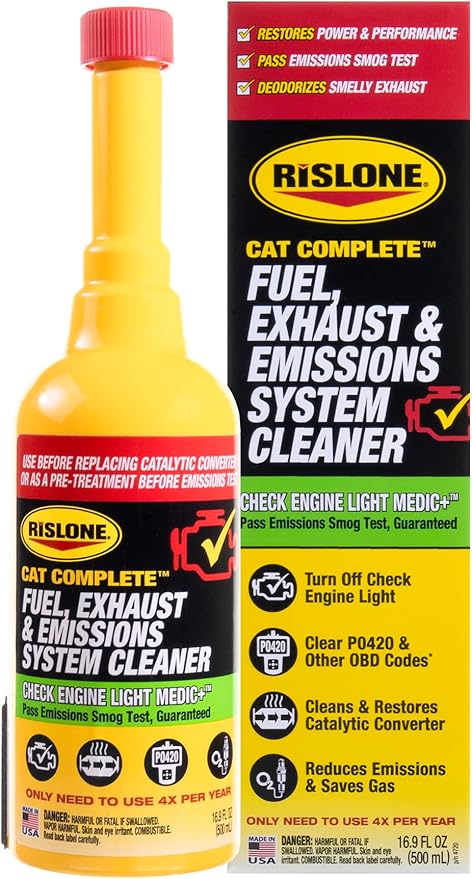
Rislone Cat Complete Fuel & Emissions System Cleaner suits drivers looking to improve power and mileage by cleaning both the fuel and emissions systems in one go. Its biggest strength lies in safely tuning these systems without risking the vehicle’s warranty, making it great for regular maintenance on a wide range of engines.
Using the cleaner involves adding it to your fuel at intervals of about 5,000 miles, which fits easily in regular upkeep routines. It works in gasoline, ethanol, and hybrid engines, so setup is simple regardless of vehicle type. Its compatibility with oxygen sensors and catalytic converters means you don’t have to worry about damaging sensitive parts while keeping the fuel and exhaust systems odor-free.
The cleaner manages to handle several tasks at once, removing buildup that can cause a check engine light to appear and helping engines run more efficiently. The bottle is compact and sturdy, making storage uncomplicated. Most praise highlights its effectiveness in passing emissions tests and eliminating sulfur smells, while some users mention that results can vary depending on the engine’s condition.
Effectiveness in passing emissions tests and reducing check engine lights stands out as the strongest plus, while some users note that it doesn’t fix all problems immediately, meaning regular applications are needed. The bottle size and straightforward use support easy integration into maintenance routines.
Those who want a product safe for modern emissions equipment and a simple tune-up approach will find it useful. Drivers looking for an instant fix or those with severe engine issues might need different, more intensive solutions.
Pros
- Cleans fuel and emissions systems simultaneously
- Safe for oxygen sensors and catalytic converters
- Improves mileage and power over time
- Eliminates sulfur exhaust odors
Cons
- Results may depend on engine condition
- Requires regular use every 5,000 miles
| Specification | Details |
|---|---|
| Item Weight | 1.08 pounds |
| Product Dimensions | 9.25 x 2.65 x 2.65 inches |
| Manufacturer Part Number | 4720 |
| Engine Compatibility | Gasoline, ethanol, hybrid vehicles |
| Special Features | 50 state legal, EPA registered, clears OBD P0420 codes |
5. MotorPower Care Catalytic Converter Cleaner

Liquid formula designed specifically for engine use, this catalytic converter cleaner suits anyone aiming to reduce emissions and clear trouble codes without the hassle of a mechanic. The strongest selling point lies in its government-tested emission reductions, providing measurable improvements in HC and NOx levels.
Adding the cleaner is straightforward, just pour it into the fuel tank along with 5 to 15 gallons of gasoline. The treatment takes about 40 minutes to work through your system.
It’s convenient for regular maintenance or to prepare for emissions testing, as it targets not only the catalytic converter but also O2 sensors, EGR valves, and turbochargers.
The cleaner delivers solid results on cutting down carbon buildup, which in turn reduces common engine fault codes like P0420 and P0430. Construction-wise, it’s a simple liquid product with a formula developed using German technology.
The main praise highlights how it can help pass smog tests, while some users mention it may not clear all codes depending on the extent of contamination.
Government testing confirms it significantly reduces harmful emissions while commonly clearing the most frequent check engine codes, though some fault codes may persist if damage is severe. Its ease of use and measurable results stand out in daily application.
Ideal for those preparing for emissions inspections and looking to avoid costly repairs. Those with severely damaged converters or advanced engine problems might need more intensive solutions.
Pros
- Proven reduction in HC and NOx emissions
- Clears P0420 & P0430 engine codes
- Works on multiple engine parts including O2 sensors
- Simple 40-minute fuel tank treatment
Cons
- May not clear all emission-related fault codes
- Requires 5-15 gallons of gas for use
| Specification | Details |
|---|---|
| Item Form | Liquid |
| Specific Uses For Product | Engine |
| Surface Recommendation | Floor |
| Treatment Time | 40 minutes |
6. Boost up Catalytic Converter Cleaner Kit

Easy application is the main draw for the Boost Up Catalytic Converter Cleaner Kit, ideal for anyone wanting to improve engine performance without ripping the system apart. It suits drivers looking for a straightforward way to reduce carbon build-up and help fuel flow without complicated tools or processes.
Using the cleaner involves pouring one bottle directly into the fuel tank during a refill. No need for mechanical skills or disassembly makes it convenient for anyone with a tank to top up. It targets not just the catalytic converter but fuel injectors and cylinders as well, aiming to promote smoother engine operation and cleaner fuel combustion as you drive.
Performance-wise, it effectively helps reduce carbon deposits and supports smoother engine responsiveness. The product weighs just 10.8 ounces and fits comfortably in small spaces, making storage simple. Users have noted the improved exhaust flow and engine smoothness, though some say results depend on the vehicle’s condition and timing of use.
It delivers on its primary goal but isn’t an instant fix for severe clogging.
The product is praised for making cleaning simple without needing to take anything apart, which fits into normal maintenance routines easily. Some users mention it doesn’t work miracles on heavily clogged converters but is better suited for routine upkeep.
People who want easy ongoing care for their engine and exhaust system will appreciate this cleaner. Those facing major catalytic converter issues might want to seek professional service or stronger treatments for more intensive restoration.
Pros
- No tools or mechanical skills required
- Targets fuel system and engine deposits
- Supports smoother engine operation
- Lightweight and easy to store
Cons
- Not a quick fix for severe catalytic blockages
- Effectiveness varies by vehicle condition
| Specification | Details |
|---|---|
| Brand | Ciirvoe |
| Model | Catalytic Converter Cleaner |
| Item Weight | 10.8 ounces |
| Package Dimensions | 7.48 x 5.2 x 1.73 inches |
| Manufacturer Part Number | CR-SY-001 |
7. LIQUI MOLY Catalytic System Cleaner 300ml

Great for anyone worried about catalytic converter clogging and engine performance, this cleaner stands out by protecting your catalytic converter from soot buildup. Suited for all gasoline engines with a catalytic converter, it also tackles injection system and combustion chamber cleaning in one bottle.
Adding the cleaner is straightforward, just pour it into the fuel tank before filling up. Daily use means better fuel combustion, which leads to reduced fuel consumption and lower CO2 emissions. It’s a practical solution you can keep ready in the garage, making regular maintenance a smooth part of your routine.
It performs well in cleaning and protecting the catalytic system, improving engine efficiency noticeably. The bottle feels solid and easy to handle at 1.37 pounds, and its 300 ml size is convenient.
Most appreciate how it keeps the converter soot-free, though some mention it takes a while to see significant effects on stubborn buildup.
The strongest praise is its ability to keep the catalytic converter clean and protect it from clogging, which helps engines run smoother and cleaner. The most common complaint highlights how the cleaner can take a while to show noticeable effects, especially if the converter is heavily clogged or neglected.
People looking for an easy, reliable way to maintain their gasoline engine’s catalytic system will appreciate this product. Those with diesel engines or who want immediate results on very dirty converters might want to explore other options better suited to those needs.
Pros
- Protects catalytic converter from soot clogging
- Cleans injection system and combustion chamber
- Improves fuel combustion and reduces emissions
- Simple to use, just pour into fuel tank
Cons
- Results may take time on heavy soot buildup
- Limited to gasoline engines only
| Specification | Details |
|---|---|
| Manufacturer | Liquii Moly |
| Item Weight | 1.37 pounds |
| Package Dimensions | 8.43 x 5.2 x 2.52 inches |
| Model | Catalytic System Clean 300ml |
| Suitable for | All gasoline engines with catalytic converter |
8. Dura Lube Catalytic and Exhaust Treatment

Catalytic converters often clog or lose efficiency over time, affecting engine performance. Dura Lube Catalytic and Exhaust Treatment suits anyone looking to maintain their emission system without an immediate costly replacement. Its biggest strength lies in protecting the catalytic system from harmful oil and keeping it efficient.
Adding the liquid treatment is straightforward and can be done anytime. Pouring it into the fuel tank helps reduce phosphorus and zinc retention levels at the catalyst inlet, contributing to smoother fuel system operation.
It works universally, fitting all engine types, and helps improve fuel economy while cleaning and maintaining essential emission components.
Performance-wise, it supports cleaner emissions and better engine running conditions, which benefits overall fuel efficiency. The bottle design is practical for dosing, and the liquid form mixes easily with fuel.
Some find the results subtle or gradual rather than dramatic, but generally, it helps maintain catalytic converter health when used regularly.
Strong points include effective protection of the catalytic system and improved fuel economy. Some users note the effects are not immediately obvious, which can be a drawback for those expecting quick changes.
Ideal for people who want to keep their vehicle’s emission system in good shape and possibly prevent early converter replacement. Not suited for those needing immediate cleaning results or a full catalytic converter repair.
Pros
- Works on all engine types
- Reduces phosphorus and zinc retention
- Protects catalytic system from oil damage
- Improves fuel economy
Cons
- Results can be slow to notice
- Does not replace a faulty converter
| Specification | Details |
|---|---|
| Item Form | Liquid |
| Specific Uses | Protect and treat Catalytic Converter & Exhaust System |
| Special Features | EMISSIONS |
| Recommended Uses | Engines |
| Fit Type | Universal fit |
9. EZ PASS Catalytic Converter & O2 Sensor Cleaner

Pouring one bottle into a full tank makes cleaning the catalytic converter and oxygen sensors simple. Designed for drivers looking to maintain engine efficiency and reduce emissions during regular driving, it focuses on keeping key components clear without extra steps.
Setup involves just adding the cleaner to a full fuel tank before driving as usual. It works quietly in the background, targeting the catalytic converter, oxygen sensors, fuel injectors, and combustion chamber.
This lets you maintain these parts without removing or disassembling anything, making it convenient for regular vehicle upkeep.
Performance lies in reducing carbon buildup that can hurt emissions and fuel economy. It supports smoother engine operation by cleaning restricted exhaust pathways.
The build is a single 15.2-ounce bottle designed for ease of use, though some mention it may not solve all emissions codes alone, pointing to its limits in tougher cases.
The most frequent praise highlights how it supports emissions system efficiency and smooth engine performance through a single tank treatment. The most common complaint is that it might not fully fix certain emissions-related trouble codes on its own, requiring additional steps.
Drivers wanting an easy, regular maintenance product for their catalytic converter and sensors will find it helpful. Those with severe or persistent emissions problems should consider professional service or stronger treatments beyond this cleaner.
Pros
- One-step addition to fuel tank
- Cleans multiple engine components
- Supports emissions checks
- Improves fuel economy and combustion
Cons
- May not clear all diagnostic trouble codes
- Only works when used as directed with full tank
| Specification | Details |
|---|---|
| Item Weight | 15.2 ounces |
| Product Dimensions | 2.5 x 2.5 x 9 inches |
| Brand | EZ PASS |
| Manufacturer | Into Great Brands, Inc. |
| Item model number | HL-40780 |
10. LIQUI MOLY Catalytic System Cleaner 2 Pack

Drivers looking to maintain their catalytic converter will appreciate a cleaner designed to target the entire catalytic system. Its main strength lies in breaking down sediments and impurities that affect performance, making it ideal for regular maintenance and improving emissions and fuel efficiency.
Using it is straightforward since it comes in a 300 ml bottle designed for easy pouring into the fuel tank. The 2-pack offers enough cleaning solution for two treatments, helping maintain the catalytic converter over time. It’s suitable for anyone who prefers scheduled upkeep rather than waiting for problems to arise.
Performance-wise, the catalytic system cleaner does a solid job of clearing out deposits in intake and combustion areas, helping your vehicle run smoother. The formula is a special mix of additives designed for cleaning without harming the system.
Reviews commonly praise its cleaning effect, though some note that results depend on how heavily the converter is clogged and might take more than one use.
The strongest praise highlights the cleaner’s effectiveness at removing sediments and impurities to improve catalytic converter performance. The most frequent complaint is that clogged converters might need repeated treatments before noticeable improvement occurs.
Drivers looking for an affordable, easy-to-use cleaning product will find good value with this 2-pack. Those with severe catalytic converter issues or specialized systems might want to consider professional cleaning or other products tailored for heavy-duty use.
Pros
- Cleans both intake system and combustion chamber
- Comes in a convenient 2-pack
- Easy-to-use 300 ml bottle
- Helps maintain catalytic converter efficiency
Cons
- May require multiple uses for heavy deposits
- Only suitable for vehicles with standard catalytic systems
| Specification | Details |
|---|---|
| Package Size | 300 ml per bottle |
| Weight | Approximately 0.299 kg |
| Dimensions | 17.6 cm L x 5.0 cm W x 5.0 cm H |
| Unit Count | 2 Count |
| Number of Items | 2 |
| Active Ingredients | Special combination of additives |
11. XADO Red Cat Shield Catalytic Converter Cleaner

Designed to prevent catalytic converter clogging and overheating, this cleaner suits anyone looking to maintain fuel system efficiency. Its main advantage lies in promoting complete combustion to cut down harmful carbon buildup, which is essential for keeping emissions low and protecting engine components.
Easy to add directly to the fuel tank, the cleaner uses a mix of oxygenates and catalysts to ensure fuel burns fully. Deep cleaning effects reach injectors, intake valves, and combustion chambers, helping your engine run more smoothly. It also forms a protective layer on key engine parts to reduce wear, making it ideal for regular maintenance without special tools.
The cleaner boosts combustion efficiency and prevents clogging using its OXY8 BOOST and 2xPEA & PIBA blends. It works well with all gasoline engines, including those using ethanol blends, without harming sensors or converters.
Some users mention it takes consistent use for noticeable results, but its build as a liquid additive is straightforward and reliable.
Many appreciate how well it reduces carbon buildup and protects engine parts, while some note that noticeable improvements need consistent application over time. The additive’s compatibility with ethanol fuels and oxygen sensors also gets positive mentions.
Anyone wanting a versatile cleaner that supports overall fuel system health will benefit from this product. Those looking for immediate or intensive catalytic converter repairs might want to consider alternatives better suited for heavy-duty cleaning needs.
Pros
- Promotes complete fuel combustion
- Deep cleans injectors and valves
- Protects fuel pump and cylinders
- Works with ethanol-blended fuels
Cons
- Results may require repeated use
- Only available as a liquid additive
| Specification | Details |
|---|---|
| Item Form | Liquid |
| Specific Uses for Product | Fuel System, Injector and Combustion Chamber Cleaning, Catalytic Converter and Ram Probe Protection, Recovery Fuel Injection Accuracy, Increased Octane Value/Knocking, Increased Combustion Efficiency |
| Surface Recommendation | Fuel System |
| Safe for All Gasoline Engines | Compatible with Catalytic Converters, Oxygen Sensors, and Ethanol-Blended Fuels (E5, E10) |
12. Oxicat Oxygen Sensor & Catalytic Converter Cleaner

AUTOPROFI’s OXICAT Oxygen Sensor & Catalytic Converter Cleaner is best at keeping your exhaust system clean by activating once the catalytic converter hits working temperature. Perfect for anyone wanting to maintain both gasoline and diesel engines, it stands out for being easy to use and safe on crucial parts like oxygen sensors.
Using OXICAT means adding the cleaner to your fuel regularly as part of maintenance. Because it’s set up to activate at typical operating temperatures, you just drive normally for it to work on the entire exhaust system over time.
No extra tools or complicated steps, just regular use to keep things running smoother without risking engine parts.
Performance-wise, OXICAT does a solid job removing buildup in catalytic converters and oxygen sensors, according to those who’ve used it, helping prevent costly repairs. The build is compact and light, easy to store, and meets European safety standards since it’s TUV certified and made in Germany.
Some users wish effects were quicker, but most agree it’s safe and steady in cleaning.
Many people praise OXICAT’s reliability and safety, noting it cleans the exhaust system effectively without harming sensors. A common downside mentioned is that noticeable improvements don’t happen quickly and need consistent use. The product is straightforward but demands patience.
Drivers who want a no-fuss, risk-free cleaner that supports regular vehicle care will appreciate this. Those needing a fast fix or a one-time deep clean might consider other options better suited to immediate results.
Pros
- Safe for gasoline and diesel vehicles
- Activated at catalytic converter’s working temperature
- Easy to use within preventive maintenance routines
- TUV certified and manufactured in Germany
Cons
- Effects may take longer to notice
- Requires regular use for best results
| Specification | Details |
|---|---|
| Brand | AUTOPROFI |
| Model | OXICAT twin-pack |
| Manufacturer | CTP GmbH |
| Item Weight | 1.12 pounds |
| Dimensions | 7.5 x 3 x 2 inches |
| Certification | TUV certified, Made in Germany |
Best Products to Clean Catalytic Converters Comparison Table
| Product | Item Form | Specific Uses | Weight | Special Features |
|---|---|---|---|---|
| Cataclean Fuel Cleaner | Liquid | – | – | Not_Performance_Used |
| LIQUI MOLY Catalytic Cleaner | Liquid | Automotive motor additive | – | Chlorine Reduction |
| MotorPower Care Converter Cleaner | Liquid | Engine | – | Unscented |
| Rislone Cat Fuel Cleaner | – | Exhaust & Emissions System | 1.08 pounds | Check Engine Light Medic |
| MotorPower Care Converter Cleaner II | Liquid | Engine | – | Floor surface recommendation |
| Boost Up Converter Cleaner Kit | – | – | 10.8 ounces | – |
| LIQUI MOLY Catalytic Cleaner 300ml | – | – | 1.37 pounds | – |
| Dura Lube Exhaust Treatment | Liquid | Catalytic Converter & Exhaust | – | Emissions, Reduce Phosphorus |
| EZ PASS O2 & Converter | – | Emissions Treatment | 15.2 ounces | – |
| LIQUI MOLY Catalytic Cleaner 2 | – | – | – | Pack of 2 |
| XADO Red Cat Cleaner | Liquid | Fuel System & Combustion | – | Increased Octane Value |
| Oxicat Oxygen & Converter Cleaner | – | – | 1.12 pounds | Easy-to-use |
- Item FormLiquid
- Specific Uses–
- Weight–
- Special FeaturesNot_Performance_Used
- Item FormLiquid
- Specific UsesAutomotive motor additive
- Weight–
- Special FeaturesChlorine Reduction
- Item FormLiquid
- Specific UsesEngine
- Weight–
- Special FeaturesUnscented
- Item Form–
- Specific UsesExhaust & Emissions System
- Weight1.08 pounds
- Special FeaturesCheck Engine Light Medic
- Item FormLiquid
- Specific UsesEngine
- Weight–
- Special FeaturesFloor surface recommendation
- Item Form–
- Specific Uses–
- Weight10.8 ounces
- Special Features–
- Item Form–
- Specific Uses–
- Weight1.37 pounds
- Special Features–
- Item FormLiquid
- Specific UsesCatalytic Converter & Exhaust
- Weight–
- Special FeaturesEmissions, Reduce Phosphorus
- Item Form–
- Specific UsesEmissions Treatment
- Weight15.2 ounces
- Special Features–
- Item Form–
- Specific Uses–
- Weight–
- Special FeaturesPack of 2
- Item FormLiquid
- Specific UsesFuel System & Combustion
- Weight–
- Special FeaturesIncreased Octane Value
- Item Form–
- Specific Uses–
- Weight1.12 pounds
- Special FeaturesEasy-to-use
How to Choose the Right Catalytic Converter Cleaner
Choosing a good catalytic converter cleaner depends on its compatibility with your vehicle, effectiveness in removing buildup, and ease of use. Selecting the right product ensures better engine performance, reduces repair costs, and prevents further damage, saving both money and trouble in the long run.
Effectiveness of Cleaning Agents
Carbon deposits and soot buildup can choke a catalytic converter, leading to reduced engine power and increased emissions. Some cleaning products break down these deposits effectively, restoring flow and performance. Others might only provide a temporary fix without sufficiently dissolving hardened buildup.
Choosing a product compatible with various types of converters, ceramic or metallic, is important, since chemical reactions differ based on converter material. A good cleaner should improve engine responsiveness and fuel economy noticeably after treatment.
Look for formulations containing strong detergents or solvents designed specifically for catalytic systems. Many users find products with explicit compatibility claims more reliable.
Products rated for both gasoline and diesel converters offer flexibility if you own multiple vehicles. Effectiveness often shows in improved exhaust smell and smoother idle shortly after use.
Ease of Application
Some treatments require the engine to be running during application, allowing the cleaner to circulate through the fuel system, while others work as a soak when added to fuel and left to sit. The soaking approach fits better into regular maintenance with minimal disruption.
Clear, precise dosing instructions are essential to prevent underuse or waste; vague directions tend to result in poor cleaning outcomes.
Convenience plays a big role since most people do not have specialized tools or mechanical skills. Products that only need pouring into the fuel tank plus a short drive offer ease without extra steps. Being able to apply the cleaner during routine fueling saves time and simplifies upkeep.
Compatibility with Vehicle Systems
The cleaner must be safe for fuel injection systems and emission controls to avoid causing costly damage. Some harsh chemicals can degrade oxygen sensors or the catalytic converter itself, which defeats the purpose.
A product that explicitly states it won’t harm these parts reduces the risk of engine check lights or sensor failures.
Compatibility with both gasoline and diesel engines is useful for garages servicing various vehicles. While formulations may differ, those that protect fuel pumps and injectors while cleaning deposits prevent maintenance headaches. Ensuring the product won’t disrupt engine management systems keeps the vehicle running smoothly after treatment.
Environmental and Safety Considerations
Many catalytic converter cleaners contain chemicals potentially harmful if handled improperly or if released into the environment. A more user-friendly formula is nontoxic and biodegradable, lowering environmental impact and making disposal easier. Such products also minimize risks of skin irritation or respiratory issues from fumes.
Safe handling without corrosion to metal parts or damage to rubber seals is another critical factor. Complying with environmental and safety regulations ensures that the cleaner meets minimum standards, which reassures users about both effectiveness and safety.
Cost and Value for Money
Pricing varies greatly depending on the amount of active cleaner in the bottle and its concentration. Products that require fewer applications per cleaning cycle deliver better long-term value despite a higher upfront cost.
Some brands offer larger containers or refill packs, which reduce the per-use cost substantially.
Frequency of use is key. A product that keeps a converter free of deposits with occasional treatments reduces overall expenditure on cleaning. Pay attention to the size options available: small bottles are good for occasional maintenance, while bulk versions suit frequent use or fleets.
Proper Application Techniques for Catalytic Converter Cleaners
Applying a catalytic converter cleaner correctly can extend the life of your vehicle’s emission system. Most products are added directly to the fuel tank, allowing the cleaner to pass through the engine and into the converter during normal driving.
It’s important to add the cleaner to a nearly full tank to ensure proper dilution and distribution.
Some products recommend using the cleaner before a long drive, as highway speeds and higher engine temperatures help remove deposits more effectively. Avoid stopping the car right after treatment, since prolonged idle may reduce cleaning performance. Follow the manufacturer’s dosage instructions closely to avoid overuse, which can harm the engine or catalytic converter.
In addition to adding the chemical cleaner, running the engine under varied driving conditions, including highway speeds, can help flush out contaminants trapped in the catalyst.
Common Mistakes to Avoid When Cleaning Your Catalytic Converter
Rushing the cleaning process often reduces the effectiveness of catalytic converter treatments. One common mistake is adding the product to an empty or nearly empty fuel tank, which can lead to concentrated chemicals potentially damaging fuel system components. Filling the tank right after adding the cleaner avoids this issue.
Another frequent error is assuming a single treatment permanently fixes clogged converters. Deposits build up over time, so periodic applications may be necessary.
Some people try to clean the catalytic converter manually without removing it, which can be difficult and risky since the converter contains fragile ceramic materials. Using harsher methods, such as pouring cleaning solvents directly into the converter, can cause irreversible damage.
Skipping a diagnostic check to confirm converter issues can lead to unnecessary cleaning or overlooking other engine problems. Always confirm symptoms before treatment.
Comparing Chemical Cleaners and Physical Cleaning Methods for Catalytic Converters
Chemical cleaners are convenient because they require no disassembly and can be added to the fuel tank. They treat minor buildups and help maintain converter efficiency over time but are less effective for severe contamination or physical damage. Physical cleaning involves removing the converter and using specialized equipment, such as ultrasonic cleaners or manual removal of deposits.
Physical methods can restore a clogged converter more thoroughly but are labor-intensive and costly. They often require professional service, which adds to expense and downtime.
Chemical treatments are generally best for routine maintenance or minor fouling, while physical cleaning is reserved for serious blockages or failed converters. Neither method fixes mechanical faults like cracks or broken components inside the converter.
Summary of differences:
- Chemical cleaners: easier, less costly, good for mild build-up
- Physical cleaning: more effective for heavy deposits, requires removal and professional tools
People Also Asked
How Do I Properly Clean a Catalytic Converter at Home?
Pour the cleaner into a nearly empty fuel tank and run the engine for a while to circulate the cleaner through the system. Make sure to follow the cleaner’s instructions closely; some require driving at highway speeds after treating the fuel to help clear out deposits.
Is Catalytic Converter Cleaner Safe for All Vehicle Types?
Most catalytic converter cleaners are designed for gasoline engines and safe for standard catalytic converters, but not all work with diesel or hybrid systems. Check the product label for compatibility with your fuel type and engine to avoid problems.
What Size Catalytic Converter Cleaner Should I Buy for My Car?
Choose a cleaner size that matches your fuel tank capacity, typically 12 to 16 ounces for a standard passenger car fuel tank up to 15 gallons. Oversized bottles can be saved for future use but expect one full treatment per tank.
How Long Does the Effect of a Catalytic Converter Cleaner Last?
The cleaning effect generally lasts until new deposits build up, which could be a few thousand miles depending on driving conditions and fuel quality. Repeated treatments might be necessary to keep the converter cleaner longer.
Can Using a Cleaner Damage My Catalytic Converter or Engine?
Using a cleaner as directed usually does not cause damage, but overuse or using the wrong type could harm sensors or clog the converter. Avoid mixing different additives and do not exceed recommended dosages to prevent problems.
Conclusion
Choosing a product to clean a catalytic converter comes down to effectiveness at removing buildup, ease of use, and compatibility with your vehicle. It’s important that the cleaner works without causing damage and fits your maintenance routine. Also consider how safe it is to handle and whether it comes with clear instructions for best results.
Think about how often you need to clean the catalytic converter and how much time or money you want to spend. Some options are better for occasional use, while others suit regular maintenance.
Check the comparison table and product details above to find the one that fits your needs and budget most closely.