
Top 12 Best Dust Collection for Small Shop You Must Own
The scent of sawdust lingering after a day’s work can be a sign that the best dust collection for small shop wasn’t chosen. A cheap or undersized unit often clogs quickly or barely moves any air, turning cleanup into a daily chore. Dust can coat surfaces and tools, and breathing in fine particles isn’t just unpleasant, it’s unhealthy, especially in confined shop spaces.
A good dust collector for a small shop balances size with power, usually around 1 to 2 horsepower motors paired with 500 to 700 CFM airflow. The collector’s setup should fit the shop’s square footage without hogging space, and be easy to empty without creating a mess.
Durable materials like metal housings last longer, and features like smooth ducting and proper filtration improve safety and make daily maintenance straightforward.
Need a Quick Check?
| Image | Product | Price |
|---|---|---|
Our Top Picks 1  | WEN DC1300 Dust Collector | Check Price |
Our Top Picks 2  | WEN DC3401 Dust Collector | Check Price |
Our Top Picks 3  | PRO Cyclone Collector | Check Price |
Our Selected Top 12 Dust Collection for Small Shop Worth Buying
This list features a carefully chosen range of dust collectors ideal for small workshops, highlighting each model’s performance, suitability, and main advantages and disadvantages. Readers will gain clear insights to help find the best fit for their specific dust collection needs.
1. WEN DC1300 Woodworking Dust Collector
Circulating up to 1,300 cubic feet of air per minute, this dust collector suits small woodworking shops looking for powerful cleanup. Its biggest strength lies in handling dust from two tools at once, saving time and effort while keeping the workspace cleaner.
Setup is straightforward thanks to the included mobile base with swivel casters, allowing easy movement around the shop. Attachment to tools is flexible with dual 4-inch air inlets.
The large 50-gallon vertical collection bag means you don’t have to empty it frequently, making daily cleanup less of a chore.
The 14-amp motor spins a 10-inch steel impeller at up to 3450 RPM, delivering solid suction power. The cartridge filter captures fine dust well.
Reviews praise the mobility and dust capacity, though some note the single speed limits control over suction strength.
Many users appreciate the large dust capacity and mobility, making it easier to keep the workshop clean without frequent stops. The main drawback mentioned is the lack of speed options, which can be an issue when working with different tools requiring varying suction forces.
Workshop users who need to connect multiple tools and handle large dust loads will find this unit dependable. Those wanting more control over suction power or outdoor use might consider alternatives with variable speed settings or outdoor suitability.
Pros
- Dual 4-inch air inlets for two tools
- 50-gallon dust collection capacity
- Mobile base with swivel casters included
- Powerful 14-amp motor
Cons
- Single speed limits suction adjustment
- Only suitable for indoor use
| Specification | Details |
|---|---|
| Maximum Suction | 1300 feet |
| Motor Power | 14-amp |
| Impeller Size | 10-inch steel |
| Dust Capacity | 50 gallons |
| Filter Type | Cartridge |
| Number of Wheels | 4 |
2. WEN DC3401 Woodworking Dust Collector
Ideal for small workshops or hobbyist woodworkers, the WEN DC3401 Dust Collector delivers solid airflow in a compact package. Its single strongest point is the 660 CFM air movement that helps manage wood dust effectively without taking up much space.
Setting up the unit is straightforward thanks to the 4-inch dust port that fits readily with most woodworking tools. The compact size and onboard carrying handle make it easy to move around, while lockable swivel casters keep it steady during use. The 12-gallon collection bag is simple to unzip and empty, which keeps maintenance quick and less messy.
It handles dust collection well, capturing the fine particles created by woodworking on engineered woods. The build feels sturdy for the size and weight, though some mention that the single power level limits control over suction strength. It keeps the workspace cleaner than without a dust collector but doesn’t offer variable speed options.
The unit is praised for its strong airflow and ease of emptying the dust bag, making daily cleanup less of a chore. Common feedback points to the single speed as a drawback, limiting the user’s ability to adjust suction for different tools or dust levels.
Those running a small shop focused on engineered woods will appreciate the size and power balance here. Users needing variable speed control or dealing with very fine dust might prefer a model offering more suction settings or higher filtration.
Pros
- Compact and easy to move around
- Strong 5.7-amp motor for good airflow
- Large 12-gallon dust collection bag
- Lockable swivel casters for stability
Cons
- Only one power level available
- Brush motor requires occasional maintenance
| Specification | Details |
|---|---|
| Maximum Suction | 660 feet |
| Motor | 5.7-amp brushed |
| Dust Port Size | 4 inches |
| Collection Bag Capacity | 12 gallons |
| Weight | 17 pounds |
| Number of Speeds | 1 |
3. PRO Cyclone Dust Collector
PRO Cyclone Dust Collector stands out by focusing on dust separation rather than just airflow rate. Ideal for small shops looking to trap fine sawdust and drywall powder efficiently, it’s built to reduce airborne particles better than many low-profile separators. Its design tackles common dust collector shortcomings, making it a solid option for dust management.
Setting it up is straightforward thanks to its compact size and manageable weight. It fits easily in limited spaces, and daily use revolves around how well it prevents dust from escaping the system.
The balance between air movement and particle separation means less frequent filter cleaning. Its 0.5-inch wall thickness and small footprint keep it stable without taking up much room.
Performance is strong, especially when handling both fine and coarse dust types as confirmed by third-party testing. The main strength lies in its dust separation efficiency, unlike other models that rely on higher airflow but lose effectiveness.
The build quality is sturdy for its size, with a lightweight body that feels durable. Common feedback points to excellent separation but occasional challenges with installation space in very tight shops.
Independent testing shows superior dust separation, which customers praise most, while some find fitting it into very small workspaces challenging. Its compact shape and thickness support sturdy performance but might limit where it can fit.
Those with small shops focusing on cleaner air and fine dust control will appreciate the design. People needing a longer collector or working in extremely confined spaces should explore other options for better fit flexibility.
Pros
- Efficient dust separation verified by independent tests
- Compact and lightweight design fits small spaces
- Thick walls add durability without weight
- Handles both fine and coarse dust effectively
Cons
- May require careful fitting in very tight workshops
- Limited length might restrict some setup options
| Specification | Details |
|---|---|
| Item Dimensions L x W | 13″L x 13″W |
| Item Weight | 1.63 kg |
| Nominal Wall Thickness | 0.5 inches |
| Outside Diameter | 2.25 inches |
| Item Length | 7 inches |
4. VEVOR 1 HP Wall Mount Dust Collector

VEVOR 1 HP Wall Mount Dust Collector is designed for small and medium woodworking shops that need reliable suction without taking up floor space. Its standout feature is powerful high-flow suction that quickly removes both sawdust and fine dust, keeping your work area clean and cutting down on cleanup time.
Setting it up involves mounting it on a wall to save floor room, which works well in smaller shops. The 21-gallon non-woven bag captures a lot of debris at once, so you can work longer without stopping to empty it. The system runs on standard 120 volts, and at 24 pounds and compact dimensions, it’s easy to install and maintain day to day.
Performance is solid with 560CFM airflow, strong enough to handle various wood dust types efficiently. The unit’s Q235A steel body feels sturdy and durable.
Many appreciate how effectively it manages dust during tasks, although some users mention the bag could fill up faster with heavier debris, requiring frequent emptying in larger jobs.
The dust collector is praised for its strong 560CFM suction that handles both fine and coarse dust effectively. Users find the large collection bag helpful but note it can fill faster than expected during heavy use, requiring more frequent emptying in some cases.
This dust collector suits small to medium woodworking areas that can accommodate wall-mount equipment and need powerful airflow. Those with very limited wall space or handling extremely heavy dust quantities might want to consider a different size or style.
Pros
- Strong suction removes fine and coarse dust quickly
- Large 21-gallon collection bag reduces emptying frequency
- Wall-mount design saves valuable floor space
- Sturdy steel construction for long-term use
Cons
- Bag may fill quickly with larger debris loads
- Somewhat bulky dimensions for very tight spaces
| Specification | Details |
|---|---|
| Power Source | ac |
| Voltage | 120 volts |
| Airflow | 560CFM |
| Collection Bag Capacity | 21-gallon (80L) |
| Weight | 24 pounds |
| Dimensions | 40.94 x 13.78 x 15.75 inches |
5. WEN 3410 Air Filtration System

Running at a low noise level and covering a good area, the WEN 3410 Air Filtration System fits nicely into small shops focused on air cleanliness. It shines with its remote control and timer features, making it easy to manage without interrupting your workflow.
Setup involves just plugging it in and placing it in a room up to 400 square feet. Changing filters is straightforward thanks to the 1-micron and 5-micron pre-filters, both easily replaceable. Daily use benefits from its adjustable airflow settings and remote, letting you control speed and power from across the room without needing direct sight.
It filters particles down to 1 micron effectively while running quietly between 50 and 60 decibels. The housing feels solid and compact at 17” L x 20.5” W x 10” H. Many appreciate the programmable timer, although some find the single-speed adjustment steps limiting.
It’s reliable in keeping shop air cleaner.
The most praised feature is the remote control system that works without direct sight lines, combined with easily replaceable filters. The common complaint focuses on the limited speed settings, which some feel restrict airflow adjustments in varied shop conditions.
This system suits small workshops needing quiet, controllable air filtration and easy maintenance. Spaces larger than 400 square feet or those requiring more airflow flexibility should consider other options.
Pros
- Remote control works from any room angle
- Programmable timer to auto shut off
- Quiet operation under 60 dB
- Easy filter replacement
Cons
- Limited airflow speed options
- Only suitable for rooms up to 400 sq ft
| Specification | Details |
|---|---|
| Air flow | 300/350/400 cubic feet per minute |
| Filter Type | Pre-Filter (1-micron filter and 5-micron pre-filter) |
| Floor Area Coverage | 400 sq ft |
| Noise Level | 50 to 60 dB |
| Power Source | 120V, 60 Hz, 1A |
| Controller Type | Remote Control |
6. Dust Separator with Stainless Steel Tank
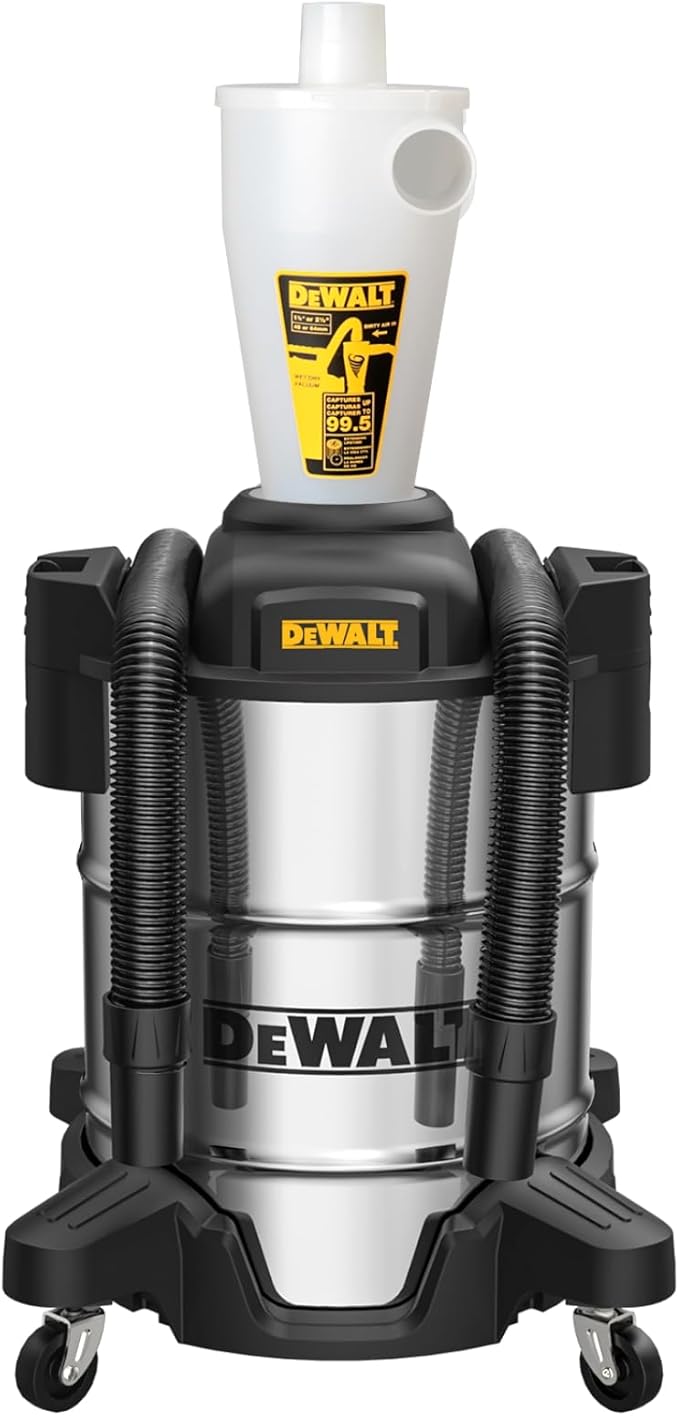
Great for small shops looking to keep their workspace cleaner, this dust separator offers a strong point in portability and capacity. It suits anyone needing a simple attachment for dust collection on hard and soft indoor surfaces, with a solid 10-gallon stainless steel tank that holds plenty between emptying.
Setup is straightforward with its portable design and four wheels to move it easily around the shop or garage. The cartridge filter ensures dust stays contained while handling different floor types such as concrete, carpet, or hardwood.
Running at just 70 dB means it won’t be too loud or distracting during regular use. Handling and moving it feels practical thanks to its attachment style and tank build.
The 10-gallon capacity handles dust separation reliably, reducing the need for frequent emptying. The stainless steel tank adds durability, standing up well to daily shop conditions. Most praise focuses on its quiet operation and portability, while common frustration lies in the single power level which limits suction control.
Build quality is solid, especially for indoor garage or home use.
The strongest praise focuses on its portability and quiet noise level, making it easy to move and comfortable to run during work. The most common complaint centers around the lack of adjustable power levels, which limits control over suction strength and may affect performance in different scenarios.
This product is ideal for shops needing a dependable, quieter dust separator that holds a good amount of debris and is easy to move indoors. Those requiring variable power or outdoor use should look for options with more control or weather-resistant features.
Pros
- Portable with four wheels for easy movement
- Durable 10-gallon stainless steel tank
- Quiet operation at 70 dB
- Works on various indoor surfaces
Cons
- Only one power level available
- Designed for indoor use only
| Specification | Details |
|---|---|
| Capacity | 10 gallons |
| Filter Type | Cartridge |
| Noise Level | 70 db |
| Number of Wheels | 4 |
| Surface Recommendation | Concrete |
| Recommended Uses For Product | Hard Floor, Carpet, Tile Floor, Hardwood, Garage, Home |
7. DEWALT 6 Gallon Dust Separator DXVCS002

Featuring a durable hard plastic build and a cyclonic filter system, the DEWALT 6 Gallon Dust Separator DXVCS002 suits small workshops looking to reduce vacuum filter clogs. Its biggest strength is capturing wood chips and debris before they reach your vacuum, saving time and money on filter replacements.
Setup is straightforward with its four-caster base that keeps it stable and easy to move around the shop. Daily use involves simply connecting it to your vacuum system, where it separates dust and debris effectively. Handling a mix of materials like wood chips, drywall dust, and even pet hair, it stays reliable on hard floors without much hassle.
Performance lives up to expectations by efficiently trapping a variety of materials, helping maintain vacuum suction power longer. The construction feels solid, and the yellow finish holds up well.
Most praise highlights its ability to reduce filter clogs drastically, while one common complaint is the single power level which offers less control over suction strength.
The separator strongly reduces suction loss by catching wood chips and debris before they reach your vacuum filter, which is its main praised feature. Some users mention the lack of adjustable power levels as a drawback, limiting tuning for different tasks.
People needing a dependable dust collection on hard floors who value stability and easy movement will appreciate this model. Those looking for more suction control or outdoor versatility might want to consider other options.
Pros
- Captures debris before vacuum filters clog
- Four wheels provide easy mobility
- Works with wet and dry materials
- Stable and durable build
Cons
- Only one power level available
- Limited to indoor hard floor use
| Specification | Details |
|---|---|
| Capacity | 6 gallons |
| Filter Type | Cyclonic |
| Number of Wheels | 4 |
| Recommended Uses | Hard Floor |
| Style Name | Separator |
8. POWERTEC 1 HP Wall Mount Dust Collector

Compact design stands out immediately, perfect for small professional or hobby workshops. Wall-mounted setup keeps floor space open, making it ideal for users needing effective dust collection without bulky equipment getting in the way.
Its ease of installation and effectiveness in filtering fine dust is a big selling point.
Setting it up involves mounting on a wall with the included bracket, which saves floor room and keeps your workspace clear. The reusable 1-micron cloth bag has a handy window to check dust levels, so you know when it needs emptying. Disposal zipper on the bag makes cleanup straightforward without dust escaping back into the air.
Performance centers on stopping woodchips and fine sawdust from airborne contamination around saws, sanders, planers, and routers. The 1 HP motor at a single power level moves air effectively while generating 80 dB noise, which is noticeable but not overwhelming in a busy shop.
Construction feels solid in steel blue with a cloth filter bag designed for repeated use. The most frequent praise is about dust control and easy maintenance; some wish it had variable speed settings for quieter operation.
Many users appreciate how well it traps fine dust with the included 1 micron bag and simple disposal system. The single-speed motor and noise level around 80 dB are the main drawbacks mentioned often, with some wishing for quieter or adjustable operation.
This unit suits small shops needing efficient dust collection without taking up floor space or complicated maintenance. Larger shops or those wanting quieter or multi-speed functionality might look for other options.
Pros
- Compact size fits tight small shops
- Reusable 1 micron dust collector filter bag
- Easy dust disposal zipper on filter bag
- Wall mount frees up floor space
Cons
- Single speed limits noise control options
- Moderate noise level at 80 db
| Specification | Details |
|---|---|
| Power | 1 HP |
| Noise Level | 80 db |
| Filter Type | Cloth (1 micron) |
| Capacity | 560 cubic centimeters |
| Mounting Style | Wall Mounted |
9. DEWALT DWXAF101 Air Filtration System

Good air quality in a small workshop hinges on capturing fine dust, and the DEWALT DWXAF101 Air Filtration System shines with its two-stage filtration including a HEPA filter that traps over 95% of 0.3-micron particles. It suits anyone looking to reduce airborne dust effectively without bulky setups.
Setup is straightforward, plugging into an AC outlet and using the included remote for control. The built-in timer lets you run it for 1, 2, 4, or 8 hours and shuts off automatically, so you can leave it working while away. Four running modes, including an automatic sensor sensing air quality, help adjust its operation without constant attention.
Performance in clearing dust is solid, especially thanks to the washable static cotton pre-filter combined with the H11 HEPA filter. It runs at a moderate noise level of 64 dB, not too distracting while you work.
It’s mostly praised for effectively improving air quality. The common issue mentioned involves the remote being occasionally unresponsive.
The filtration system is highly effective at cleaning fine dust from the air, and its automatic modes ease daily operation. Most users appreciate the quiet running compared to typical dust collectors, but the remote control occasionally loses signal and requires repeat presses.
Those focused on maintaining clean air in smaller shops will find this system fits well, especially with the timer feature for unattended use. Users wanting a completely silent or fully hands-off unit might look for alternatives without remote issues or lower noise ratings.
Pros
- Captures over 95% of fine dust particles
- Four operation modes including automatic sensor
- Timer settings up to 8 hours
- Washable static cotton pre-filter
Cons
- Remote control may be unresponsive at times
- Moderate noise level could be distracting to some
| Specification | Details |
|---|---|
| Power Source | AC |
| Control Method | Remote |
| Filter Type | HEPA |
| Noise Level | 64 dB |
| Particle Retention Size | 0.3 micron |
| Wattage | 105 watts |
10. WEN DC3474 Woodworking Dust Collector

Dust buildup in a small woodworking shop can be a serious hassle, but this compact collector is designed to keep your workspace cleaner. It fits well in limited spaces and handles moderate dust extraction efficiently, making it ideal for hobbyists and light shop use. Its greatest strength lies in its powerful 7.4-amp motor that moves a solid amount of air for consistent dust collection.
Setup is straightforward with a mounting option that saves floor space and keeps it accessible. The 4-inch dust port connects easily to standard woodworking tools. Maneuvering is easy thanks to swivel casters and a carrying handle, so you can move it around when needed.
The 15-gallon zippered bag makes disposal simple without much mess, and the whole setup feels stable and reliable during daily use.
The motor pushes up to 600 cubic feet of air per minute, which handles sawdust and small debris well in a compact shop environment. The construction is solid, underscored by a two-year warranty that shows some confidence in durability. Most praise the power and portability, while a common gripe is that the 15-gallon capacity may fill up quickly during heavy tasks.
Power and portability stand out as the strongest points of this dust collector, efficiently handling dust in small shops. The biggest downside is the relatively modest bag size compared to the motor’s capability, which means more frequent emptying is needed during busy sessions.
Anyone working in a small space with medium dust loads will appreciate this unit’s balance of power and mobility. Shops generating larger amounts of debris or requiring longer runtimes might want to consider units with bigger collection bags or higher capacities instead.
Pros
- Strong 7.4-amp motor for steady airflow
- Compact size with wall-mount option
- Easy to move with swivel casters and handle
- Large 15-gallon collection bag with zipper
Cons
- Bag capacity can fill quickly under heavy use
- May require frequent emptying in larger projects
| Specification | Details |
|---|---|
| Motor | 7.4-amp induction motor |
| Airflow | 600 cubic feet per minute |
| Dust Port Size | 4 inches |
| Collection Bag Capacity | 15 gallons |
| Weight | 41.1 pounds |
11. BUCKTOOL 1.2 HP Wall Mount Dust Collector

660 CFM airflow makes this wall mount dust collector ideal for small woodworking shops needing consistent suction. Its 1.2 HP TEFC induction motor is especially suited to frequent use, delivering quiet yet powerful dust collection without much upkeep.
Setting it up involves mounting on a wall or attaching locking caster wheels for portability, letting you switch between fixed or mobile use in minutes. The sealed induction motor reduces noise and maintenance, which helps keep daily routines smooth and less distracting.
Size and weight keep it manageable without sacrificing power.
Strong suction is maintained by an upgraded impeller, clearing dust efficiently during woodworking tasks. Its build focuses on durability with a TEFC induction motor that lasts longer than typical brushless types. Most reviews highlight the quiet operation, though some note that its 47.2-pound weight makes moving it a bit more challenging than expected.
The motor’s quiet operation and longevity are praised repeatedly, while the weight of 47.2 pounds is often mentioned as a drawback for moving it around, even with locking caster wheels. This adds a bit of a trade-off between stability and portability.
Those running a busy small shop will appreciate its reliable, maintenance-free operation and strong airflow, especially if mounting on a wall. People needing a very lightweight or easily moved dust collector might want to consider other options better suited for frequent repositioning.
Pros
- Quiet and long-lasting TEFC induction motor
- Strong 660 CFM airflow for effective dust capture
- Dual-mount design adds flexibility
- Easy maintenance with sealed motor design
Cons
- Heavy at 47.2 pounds, limiting easy movement
- Portability somewhat hindered by weight despite caster wheels
| Specification | Details |
|---|---|
| Airflow | 660 CFM |
| Motor Power | 1.2 HP |
| Motor Type | TEFC Induction |
| Item Weight | 47.2 pounds |
| Mounting Options | Wall mount or portable with locking caster wheels |
| Dimensions | 17.5 x 17.25 x 16.75 inches |
12. 2-in-1 Cyclone Wall Mounted Dust Collector

Woodworkers with limited space in their shops will appreciate this 2-in-1 Cyclone Wall Mounted Dust Collector, especially for its flexible installation options. Its standout feature is the efficient cyclone separator that handles dust and debris well, protecting your vacuum filter and keeping things cleaner for longer.
Setting it up is convenient thanks to two installation choices: wall-mounted when space is tight, or upside down on castors for moving around easily. The included 2-turn 2.5-inch connector and trousers fit standard hoses, making hook-up straightforward.
Daily switching between fixed and mobile setups suits different workshop tasks and locations without hassle.
The cyclone separation does a solid job removing wood chips, dust, and metal particles, which helps maintain vacuum power by reducing clogging. It’s built tough for industrial and small shop use, though some find the plastic filter less durable over time. The 4.8-gallon capacity keeps debris manageable but isn’t huge, so frequent emptying is needed during heavy work.
The cyclone separator effectively reduces dust build-up and protects the vacuum filter, which users highlight as a major benefit. Some find the plastic filter less sturdy, leading to replacement needs. The compact capacity demands regular emptying when tackling lots of debris in busy workshops.
Those needing space-saving or mobile dust collection appreciate the dual installation options and durability. Users with heavy-duty, large-volume cleanup may want to consider models with larger capacity or sturdier filters for longer intervals between maintenance.
Pros
- Two installation options for flexibility
- Efficient cyclone separator protects vacuum filter
- The design effectively manages a wide range of industrial waste
- Mobility with castors when used upside down
Cons
- Plastic filter may wear out over time
- 4.8-gallon capacity requires frequent emptying
| Specification | Details |
|---|---|
| Capacity | 4.8 gallons |
| Filter Type | plastics |
| Installation Options | Wall mount or upside down with castors |
| Connector Size | 2.5-inch |
| Recommended Uses | Bare Floor, Car, Carpet, Furniture, Garage, Hard Floor, Home, Office, Sofa, Truck, Van |
Best Dust Collection Systems for Small Shops Compared
| Product | Capacity | Power / Suction | Mobility | Recommended Uses |
|---|---|---|---|---|
| WEN DC1300 Dust Collector | 50 gallons | 1300 feet suction | Mobile base, swivel casters | Garage, Home, Workshop |
| WEN DC3401 Dust Collector | 12 gallons | 660 feet suction | Lockable swivel casters | Pet Hair |
| PRO Cyclone Collector | – | – | Portable, 1.63 kg | – |
| VEVOR 1 HP Wall Mount | – | 560 CFM | Wall mount | – |
| WEN 3410 Air Filter | – | 120 watts | Remote control | – |
| Stainless Steel Dust Separator | 10 gallons | – | Portable | Garage, Home, Floors |
| DEWALT DXVCS002 Separator | 6 gallons | – | Portable, wheels | Hard Floor |
| POWERTEC 1 HP Wall Mount | 560 cc | 1 HP | Wall mount | Garage |
| DEWALT DWXAF101 Air Filter | – | 105 watts | Remote control | Dust |
| WEN DC3474 Dust Collector | 15 gallons | 7.4 Amp motor | Rolling, optional wall mount | Woodworking |
| BUCKTOOL 1.2 HP Wall Mount | – | 660 CFM | Wall mount | – |
| 2-in-1 Cyclone Collector | 4.8 gallons | – | Upright, wet/dry | Garage, Home, Floor |
- Capacity50 gallons
- Power / Suction1300 feet suction
- MobilityMobile base, swivel casters
- Recommended UsesGarage, Home, Workshop
- Capacity12 gallons
- Power / Suction660 feet suction
- MobilityLockable swivel casters
- Recommended UsesPet Hair
- Capacity–
- Power / Suction–
- MobilityPortable, 1.63 kg
- Recommended Uses–
- Capacity–
- Power / Suction560 CFM
- MobilityWall mount
- Recommended Uses–
- Capacity–
- Power / Suction120 watts
- MobilityRemote control
- Recommended Uses–
- Capacity10 gallons
- Power / Suction–
- MobilityPortable
- Recommended UsesGarage, Home, Floors
- Capacity6 gallons
- Power / Suction–
- MobilityPortable, wheels
- Recommended UsesHard Floor
- Capacity560 cc
- Power / Suction1 HP
- MobilityWall mount
- Recommended UsesGarage
- Capacity–
- Power / Suction105 watts
- MobilityRemote control
- Recommended UsesDust
- Capacity15 gallons
- Power / Suction7.4 Amp motor
- MobilityRolling, optional wall mount
- Recommended UsesWoodworking
- Capacity–
- Power / Suction660 CFM
- MobilityWall mount
- Recommended Uses–
- Capacity4.8 gallons
- Power / Suction–
- MobilityUpright, wet/dry
- Recommended UsesGarage, Home, Floor
How to Choose the Right Dust Collector
Choosing a dust collector for a small shop depends on factors like airflow capacity, filter efficiency, and ease of maintenance. Selecting the right combination ensures effective dust removal, improves air quality, and reduces wear on equipment, saving money and preventing costly repairs or downtime.
Airflow and Suction Power
Dust collectors with low airflow struggle to keep up during intense sessions of sanding or planing. Measured in CFM (cubic feet per minute), airflow indicates how much air the system can move, which directly affects dust removal efficiency. For small shops handling typical woodworking dust, systems rated around 350 to 600 CFM usually work well.
Static pressure becomes important when using longer duct runs or multiple tools at once. Lower static pressure means the motor struggles to pull dust through the ducts, causing clogs and poor collection.
Manufacturers often list static pressure ratings in inches of water lift; look for models offering 6 to 8 inches for effective suction with longer hose runs.
Size and Footprint
Shop space is often limited, so choosing a unit that fits comfortably without crowding the workspace is key. Some models stand only two feet tall and fit in corners, while larger ones need a dedicated area. Take the unit’s footprint into account along with the overhead clearance.
Portability matters if the collector must move between stations. Look for wheels or handles that actually ease relocation during daily tasks. Also, check the dust capacity, larger bins or bags reduce trips to empty the system, which saves time during busy days.
Filtration Efficiency
Fine dust is a serious health hazard, so filtration quality really matters. Many systems include cartridge filters or pleated bags that trap particles down to 1 micron or less.
Higher filtration means cleaner air and less cleaning in the shop.
Filters clog over time, which lowers suction. Easy access for cleaning or replacing filters helps maintain performance.
Some units offer secondary microfilters for extra filtration or upgrade options, useful if you’re sensitive to airborne dust or have neighbors close by.
Noise Levels
Dust collectors can get loud enough to disrupt concentration or communication. Noise levels are measured in decibels; models rated below 75 dB tend to be more tolerable for small workshops.
Machines with insulated housings or built-in silencers often run noticeably quieter.
Balancing noise and power is a trade-off. Always consider how much noise you’re willing to tolerate against the suction needed. Quiet machines often require some compromise in CFM or static pressure.
Ease of Maintenance
Clearing collected dust should be quick and simple. Access panels or large latches on collection bins prevent dust spills and speed up disposal. Bags that can be sealed after removal help keep the shop cleaner.
Filters and internal parts need cleaning or replacement over time. Look for tool-free access or filters that slide out without hassle. Designs that reduce screws or clamps during maintenance make routine upkeep less annoying and extend the system’s lifespan.
Optimizing Dust Collection Efficiency with Proper Setup Techniques
Positioning the dust collector close to the primary dust-producing tools significantly improves collection efficiency. Shorter hoses reduce airflow loss and prevent clogging.
Using smooth, rigid ducting instead of corrugated flexible hoses keeps debris moving swiftly through the system.
Key setup tips:
- Seal all duct connections tightly to avoid leaks that reduce suction.
- Install blast gates to control airflow and increase suction power where it’s needed.
- Keep the dust collector inlet clear of obstructions for consistent performance.
- Consider the layout of your workspace to minimize awkward hose bends or extended runs.
These setup practices lead to a noticeable difference in how effectively dust gets captured during woodworking or metalworking tasks, making cleanup easier and the environment healthier.
Essential Maintenance Practices to Prolong Your Dust Collector’s Lifespan
Emptying the dust collection bin or bag regularly prevents the system from clogging and reduces strain on the motor. Leaving dust to accumulate decreases airflow and can cause overheating. Checking and cleaning filters is equally important; clogged filters compromise suction and allow fine dust to escape.
Regular maintenance steps include:
- Inspecting and replacing filters based on manufacturer guidelines or when visibly dirty.
- Cleaning the dust collector’s impeller and housing to remove trapped debris.
- Lubricating moving parts if recommended in the user manual.
- Verifying all hose and duct connections are secure and free from cracks or holes.
Sticking to these maintenance routines extends the dust collector’s life and maintains consistent suction power over time, saving money on costly repairs or replacements.
Comparing Downdraft Tables and Portable Dust Collectors for Small Shops
Downdraft tables pull dust and debris downward through a perforated surface, which keeps particles contained at the work area. They are especially useful for sanding and grinding tasks on smaller pieces. Portable dust collectors rely on strong suction and large hose diameters to capture dust directly from machines or work surfaces.
Differences to consider:
- Downdraft tables: Limited to workbench use, provide constant localized collection, require a proper connected dust collector system.
- Portable dust collectors: Versatile, can move between tools, require space for the unit, may need multiple hose setups.
Choosing between the two depends on your shop layout, the types of projects, and dust control preferences. Some shops benefit from combining both solutions to target dust at the source and keep the air cleaner overall.
People Also Asked
How Do I Size a Dust Collector for a Small Shop?
Choose a dust collector that matches the total airflow needs of your machines, measured in CFM. Measure or find the CFM demands of your tools and add them up to avoid under-sizing. A collector with too low airflow will not capture dust effectively.
What Safety Precautions Should I Follow Using a Dust Collector?
Always keep dust collection hoses tightly connected and inspect filters regularly to avoid clogs that reduce suction. Turn off and unplug the system before any maintenance. Avoid running the unit near flammable dust or debris to reduce fire risk.
How Long Do Typical Dust Collection Units Last with Regular Use?
Typical dust collectors can last 5 to 10 years with proper maintenance like regular filter cleaning or replacement and checking the motor. Overuse without upkeep can shorten the life of the blower motor and seals. Using the system as intended extends its lifespan.
Can a Dust Collector Be Used with Multiple Woodworking Machines?
A dust collector can be connected to multiple machines using blast gates to direct airflow where needed. Keep the total CFM requirements of all running machines within the collector’s capacity to maintain good suction. Otherwise, dust collection efficiency drops significantly.
What Are Common Problems with Dust Collectors and How to Fix Them?
Common problems include clogged filters and leaks in hoses that reduce suction. Fix clogs by cleaning or replacing filters regularly and check hoses for holes or loose fittings. Motor overheating can happen; confirm proper ventilation and avoid overloading by running too many tools at once.
Conclusion
Choosing a dust collection system for a small shop mainly depends on the size of your workspace, the type of tools you use, and how much dust you need to manage. A system that fits your shop layout and connects well with your machinery is critical.
Also, consider the filtration quality to keep the air clean and reduce cleanup time.
Match the dust collector to your budget and the frequency of your projects, so you do not overpay or buy something that is underpowered. Take a good look at the comparison table and the details given for each model above to find the best fit for your shop’s needs and space.