
Top 12 Best Cyclone Dust Collector That Will Blow You Away
Dust collectors that clog quickly or lose suction make workshop cleanup a frustrating chore; anyone aiming for the best cyclone dust collector knows these issues all too well. Poorly designed models often allow fine dust to escape, which not only makes a mess but can harm your health and damage tools over time.
The best cyclone dust collector keeps airflow steady and separates dust efficiently, preventing clogs and reducing maintenance.
A good cyclone dust collector stands out by using durable materials like heavy-gauge steel or thick plastic that withstand abrasive particles and frequent cleaning. Size plays a critical role, units with larger collection bins, often 30 gallons or more, reduce how often you have to empty them. Power matters too; models with at least 2 to 3 horsepower motors provide sufficient suction without overloading your circuit.
Easy access to the cyclone chamber and smooth airflow design also make cleaning faster and improve overall effectiveness.
Need a Quick Check?
| Image | Product | Price |
|---|---|---|
Our Top Picks 1  | VEVOR Cyclone Separator | Check Price |
Our Top Picks 2  | Laguna D | Check Price |
Our Top Picks 3  | Oneida DD Deluxe Kit | Check Price |
Our Selected Top 12 Cyclone Dust Collector for Different Needs
This list features carefully chosen cyclone dust collectors designed for various workshop needs. Each review covers performance details, suitability for different users, and highlights strengths and weaknesses to help you find the most appropriate option for your dust collection requirements.
1. VEVOR Cyclone Dust Separator
Capturing dust with a 99.61% separation rate, this cyclone dust separator suits those wanting to cut down on vacuum filter changes. Its transparent design stands out, letting you track dust buildup as it happens, ideal for people working around heavy wood or metal dust.
Setting up involves connecting the cyclone separator to a compatible 4.0-inch hose, which fits most commercial vacuums. Watching dust swirl and settle inside the clear chamber is practical, making cleanup visual and timely. The black steel drum underneath holds separated material, simplifying waste disposal without interrupting your workflow.
The separator excels at capturing fine dust efficiently, reducing clogging and extending vacuum life. It’s built from sturdy high-transparent ABS plastic and steel, designed to last.
Praise often highlights how easy it is to check the dust level without opening the tank, but some find its weight of nearly 18 pounds a bit heavy to move frequently.
Highly efficient dust separation and clear visibility of dust buildup receive frequent praise, while some notice the weight and bulk can limit mobility and workspace fit. The lightweight plastic combined with steel adds durability but may feel cumbersome moving around.
Well suited for users needing reliable heavy-duty dust separation and visual dust monitoring. Those with limited space or frequent relocation needs might want a lighter or more compact alternative.
Pros
- High dust separation rate reduces filter changes
- Fully transparent design allows real-time monitoring
- Compatible with standard 4.0-inch vacuum hoses
- Durable materials in ABS and steel construction
Cons
- Relatively heavy at 17.86 pounds
- Size might be bulky for tight workshop spaces
| Specification | Details |
|---|---|
| Separation Rate | 99.61% |
| Compatible Hose Diameter | 4.0-inch / 101.6 mm |
| Material Type | High-transparent ABS + Steel |
| Item Weight | 17.86 pounds |
| Product Dimensions | 19.49 x 17.91 x 17.91 inches |
2. Laguna Cyclone Dust Collector D|Flux:3
Woodworkers who need reliable dust collection will appreciate this model’s strong airflow and efficient particle separation. It suits home workshops and small professional spaces, with its standout feature being a powerful motor that handles heavy dust loads without slowing down.
Setting up involves placing the 45-gallon collection drum and connecting the hoses, which stay secure thanks to the quick-release drum lid with air-strut assistance. Cleaning the 1-micron canister filter is a manual but straightforward process that keeps airflow steady.
The eight wheels make it easy to roll around on hard floors, adding convenience during daily use.
It delivers 1941 CFM airflow through a 3-HP TEFC motor paired with a 16 cast aluminum impeller, efficiently separating heavy debris from fine dust to protect the filter from clogging. Built mostly from metal, it handles wear well but runs at 79 decibels, which could be a consideration in quieter environments. The most frequent praise centers on its power and dust separation, while some mention the manual filter cleaning as a small drawback.
The unit is praised for its powerful motor and effective two-stage cyclone system, which keeps the filter from clogging too quickly. Most people find the manual cleaning of the 1-micron canister filter to be the biggest inconvenience. The noise level is noticeable but typical for equipment of this size.
Ideal for woodworkers who prioritize strong suction and dust separation in a workshop setting with hard floors. Those seeking quieter operation or less frequent filter maintenance might consider alternatives with different designs or filtration methods.
Pros
- Strong 3-HP motor with efficient dust separation
- Large 45-gallon collection capacity
- Easy-to-move with eight wheels
- Quick-release drum lid with air-strut assistance
Cons
- Manual cleaning required for the canister filter
- Noise level is moderately high at 79 dB
| Specification | Details |
|---|---|
| Motor Power | 3-HP |
| Airflow | 1941 CFM |
| Filtration Type | 1-Micron Canister Filter |
| Collection Capacity | 45 gallons |
| Noise Level | 79 dB |
| Number of Wheels | 8 |
3. Oneida Air Systems DD Deluxe Dust Collector Kit
What makes the Oneida Air Systems DD Deluxe Dust Collector Kit stand out is its anti-static cyclone design that keeps nearly all dust and debris from clogging your vacuum filter. Ideal for anyone using a 5-gallon shop vac, it excels at protecting your vacuum while handling a range of cleanup tasks efficiently.
Setting up is straightforward, coming as a full kit with everything needed: a separator, 5-gallon bucket, quick-release lid, caster wheels, hose, and adapters. Daily use means attaching the kit to your shop vac and moving it easily around the shop thanks to the wheels. The hose and clamp connections make changing setups simple, and cleanup on hard floors is smooth since it deals with a variety of materials like wood dust, drywall, and pet hair.
Performance centers on capturing 99% of dust before it reaches your vacuum filter using centrifugal force and neutral-vane technology. The build feels solid with quality hardware and easy assembly parts. Praises largely focus on how well it protects the vacuum and keeps filters clean.
The main downside noted is its best use being on hard floors, which may limit effectiveness on carpets or uneven surfaces.
Most users praise the way it keeps vacuum filters clean and extends vacuum life by capturing nearly all dust and debris upfront. A noted limitation is its effectiveness mainly on hard floors, which means cleaning carpets or uneven surfaces might not work as well.
People needing a reliable dust collector for workshop floors and multiple types of debris will appreciate this setup. Those requiring versatile use on varied floor types or larger capacity might want to look for alternatives better suited to their needs.
Pros
- Captures 99% of dust before vacuum filter
- Includes caster wheels for easy mobility
- Handles dust from multiple materials
- Quick-release lid simplifies emptying
Cons
- Works best on hard floors only
- Limited to 5-gallon bucket size
| Specification | Details |
|---|---|
| Brand Name | Oneida Air Systems |
| Package Size Name | Kit |
| Number of Items | 1 |
| Model Number | AXD000004B |
| Manufacturer Part Number | AXD000004B |
4. Grizzly G0860 Portable Cyclone Dust Collector

Grizzly G0860 Portable Cyclone Dust Collector is perfect for anyone needing a compact dust solution on hard floors. It stands out with its portability combined with a 20-gallon capacity, making it easy to move around while capturing fine dust efficiently.
Set up takes just a moment thanks to its lightweight design and four wheels that glide smoothly across hard floors. The 1-micron canister filter traps very fine dust particles, keeping your indoor workspace cleaner.
Daily use involves minimal noise at 78 dB, and running its single power level keeps operation straightforward.
The 20-gallon container holds a lot of dust before needing to be emptied, which cuts down on maintenance time. The build feels solid and the portability is a highlight. Most praise the effective dust capture, but some mention the noise level could be lower for indoor use.
The most praised feature is its ability to collect very fine dust thanks to the 1-micron filter while maintaining portability and good capacity. The main downside noted is that at 78 dB, it can be a bit noisy during extended indoor use.
This dust collector suits anyone who needs a portable unit for hard floors and wants a large container for less frequent emptying. People looking for variable power options or quieter operation might want to consider other models.
Pros
- Compact and easy to move around
- Large 20-gallon dust capacity
- Effective 1-micron filter for fine dust
- Quiet enough for most indoor rooms
Cons
- Noise level could be quieter
- Single power level limits control
| Specification | Details |
|---|---|
| Capacity | 20 gallons |
| Filter Type | 1-Micron Canister |
| Surface Recommendation | Hard Floor |
| Noise Level | 78 db |
| Number of Wheels | 4 |
| Number of Power Levels | 1 |
5. Cyclone Dust Collector Separator

Running a workshop means dealing with dust, and this Cyclone Dust Collector Separator makes that less of a headache. Designed for anyone using a shop vac or dust extractor, its biggest strength is keeping filters clean by trapping over 99% of debris before it reaches your vacuum, so suction stays powerful.
Setup involves a simple rigid PVC connection that fits nicely and don’t require you to mess with bolts or duct tape. Daily use is smooth because the parabolic shape speeds up airflow, helping more dust settle out before it reaches your vacuum.
It comes with two hose adapters for wet or dry use, making it easy to switch between tasks without fuss.
The separator works well at its main job, consistently removing most dust before it hits the vacuum filter. It feels solid with its one-piece, glossy finish design and cut-to-fit PVC connector, which avoids leaks. Many users like how it keeps filters cleaner longer, though some mention the separator’s size feels a bit bulky to handle.
Nearly all debris gets trapped before reaching the vacuum, which keeps filters cleaner and suction strong. Some mention the unit’s bulkiness as a drawback during use, feeling it takes up more space than expected.
Anyone wanting a reliable dust separation for a compatible shop vac will appreciate this device. Those seeking something smaller or with more universal fitting might look for other options.
Pros
- Pre-separates over 99% of debris
- Rigid, cut-to-fit PVC connection
- Parabolic design increases suction
- Works for wet and dry applications
Cons
- Size can feel bulky during handling
- Only fits specific shop vac setups
| Specification | Details |
|---|---|
| Item Weight | 11.3 pounds |
| Package Dimensions | 29 x 16.25 x 12.5 inches |
| Power Source | Shop vac or dust extractor |
| Sound Level | 72 db |
| Included Components | 2x Mullet Wet/Dry Vac Hose Adapters |
6. Dust Separator with Stainless Steel Tank
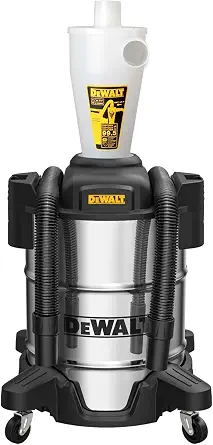
Great for anyone needing a straightforward dust separation solution on a budget, the Dust Separator with Stainless Steel Tank stands out because of its durable 10-gallon stainless steel tank. It’s especially suited for indoor use on concrete, hardwood, tile, and carpeted floors, making cleanup manageable in garages or homes.
Setting it up takes only moments thanks to its portable design and four wheels, allowing easy movement around your workspace. The single power level keeps operation simple, while the cartridge filter handles dust effectively without complicated maintenance.
Its noise level is moderate at 70 db, so it won’t be overly disruptive during daily use.
Designed to keep dust contained, the stainless steel tank feels solid and rugged, built to last. It handles collecting dust well on various indoor floor types.
Users appreciate its effectiveness, although some find the one power level limiting and the cartridge filter requiring regular attention to maintain efficiency.
Performance is reliable, with the tank holding dust securely and the filter effectively managing fine particles. The most frequent downside is the single power level, limiting flexibility, and the need to clean the cartridge filter often to prevent clogs.
Ideal for someone looking for a solid, no-frills dust collector that is easy to move around indoors. Anyone needing adjustable power settings or less frequent filter maintenance may want to explore other options better suited to those needs.
Pros
- Durable 10-gallon stainless steel tank
- Portable with four wheels for easy movement
- Cartridge filter captures fine dust well
- Suitable for various indoor floor types
Cons
- Only one power level available
- Filter needs regular cleaning to maintain performance
| Specification | Details |
|---|---|
| Capacity | 10 gallons |
| Filter Type | Cartridge |
| Surface Recommendation | Concrete |
| Noise Level | 70 db |
| Number of Wheels | 4 |
| Indoor Outdoor Usage | Indoor |
7. DEWALT 6 Gallon Dust Separator DXVCS002

Durable hard plastic and a compact 6-gallon design make the DEWALT Dust Separator ideal for small shops or home workshops. Its single biggest strength is how effectively it traps wood chips and debris before reaching your vacuum, keeping filters cleaner for longer.
Setup is straightforward thanks to its four-caster base, which makes moving it around a workshop easy and stable. It works well with both wet and dry materials, covering everything from wood dust to concrete and even pet hair.
The separator pairs smoothly with most shop vacuums, so daily cleanup feels less like a chore because clogging and suction loss are minimized.
Performance-wise, the cyclonic filter type does a solid job of separating dust and debris, extending vacuum filter life. The build quality is solid with a durable paint finish that stands up to regular use. The most common praise revolves around how well it captures debris, while some mention its limited 6-gallon capacity as a drawback for larger jobs.
The most praised feature is how efficiently it traps debris to prevent vacuum filter clogging, saving filter replacements. The most frequent complaint focuses on its modest 6-gallon size, which can require frequent emptying during extensive use.
People handling smaller projects or looking to protect their vacuum filters will appreciate this dust separator. Those needing higher capacity or adjustable power levels might want to look for a larger or more feature-rich model.
Pros
- Captures wood chips before vacuum filters clog
- Four-caster base for mobility and stability
- Works with wet and dry debris
- Compatible with most vacuum cleaners
Cons
- Only one power level available
- 6-gallon capacity may fill quickly for big jobs
| Specification | Details |
|---|---|
| Capacity | 6 gallons |
| Filter Type | Cyclonic |
| Surface Recommendation | Hard Floor |
| Number of Wheels | 4 |
| Indoor Outdoor Usage | Indoor |
8. Cyclone Dust Separator for 5 Gallon Buckets

High efficiency of dust separation stands out right away with this cyclone dust collector, perfect for anyone working with a 5-gallon bucket setup. Its main strength lies in keeping your workshop vacuum filter free from clogging, meaning suction power stays strong over long periods.
Attaching the dust separator to a 5-gallon bucket is straightforward, making day-to-day use simple. Dust and debris get funneled into the bucket before reaching the vacuum filter, reducing how often the filter needs cleaning or replacement.
It fits well in indoor workshop spaces, especially on concrete floors, and works consistently without complex adjustments.
The cyclone effectively maintains vacuum performance by preventing dust from blocking the filter cartridge. Build quality feels solid, designed specially for indoor dust collection on concrete surfaces.
Negative feedback mostly revolves around the limitation to indoor use and the required bucket compatibility rather than poor function.
The dust collector is praised for significantly extending vacuum filter life and maintaining strong suction without frequent filter cleaning. Most complaints focus on usability strictly indoors and the need for a specific bucket size, which could limit versatility.
People working regularly in home workshops with concrete floors and 5-gallon buckets will appreciate the improved performance and reduced maintenance. Others needing outdoor use or varied bucket sizes might want to look for a different solution.
Pros
- Prevents vacuum filter clogging efficiently
- Simple setup with 5-gallon buckets
- Keeps suction power strong over long use
- Designed for indoor concrete surface use
Cons
- Only suitable for indoor use
- Must be used with compatible 5-gallon buckets
| Specification | Details |
|---|---|
| Special Features | Cyclone Dust Collection |
| Surface Recommendation | Concrete |
| Recommended Uses | Home |
| Indoor/Outdoor Usage | Indoor |
9. DIY Cyclone Dust Collector Separator Canister

Ideal for woodworking and DIY enthusiasts, the DIY Cyclone Dust Collector Separator Canister stands out by protecting your vacuum cleaner from dust and debris. It’s perfect for those wanting a reliable double filtration system that captures fine particles before they can reach the vacuum, helping to extend its life.
Setup is straightforward with all necessary adapters included, plus two extra connectors to fit various vacuum hoses. Attaching it to your wet-dry vacuum is simple, making daily cleaning less of a chore.
You won’t worry about constant vacuum maintenance since the canister collects most dust, keeping your workspace cleaner and vacuum filters intact.
The canister traps fine sawdust and debris effectively using its cyclone action and double filtration design for solid performance. The build feels sturdy enough for regular use, with components designed for easy assembly.
The biggest compliment notes its success in protecting vacuums, while some mention that compatibility issues can arise, albeit partly solved by the included adapters.
The canister’s strongest feature is its ability to trap fine dust efficiently, which helps protect vacuum cleaners from damage and reduces filter maintenance. The frequent complaint involves figuring out which adapter fits best, making initial setup a bit fiddly for some users.
Woodworkers and DIY hobbyists seeking to protect their vacuum equipment and cut down on filter cleaning will appreciate this dust collector. Those without compatible vacuums or looking for a plug-and-play model might prefer an alternative solution with guaranteed fit.
Pros
- Includes adapters for multiple vacuum sizes
- Double filtration reduces vacuum filter clogging
- Sturdy construction suitable for regular use
- Captures fine dust effectively
Cons
- Some compatibility issues despite included adapters
- May require trial to find the correct connector
| Specification | Details |
|---|---|
| Brand Name | PEMEDOR |
| Unit Count | 1 Count |
| Number of Packs | 1 |
| Manufacturer Part Number | PM02 |
| Included Components | adapter |
| Item Type Name | Wet-Dry Vacuum Accessories |
10. VEVOR 2 HP Portable Vortex Dust Collector

Trying to keep a workshop clean while working with wood or metal can be tough without the right equipment. Perfect for hobbyists and small shop users, the VEVOR 2 HP Portable Vortex Dust Collector delivers strong dust suction to keep your workspace cleaner and healthier during tough projects.
Setting it up involves little more than placing it near your tools and plugging it in. Its large 39-gallon collection drum with quick-release levers makes emptying dust and chips easier than many smaller units. The separate bags for heavy chips and finer dust work quietly, so it won’t drown out conversation or concentration.
The cyclone design improves separation, reducing how often the filters need cleaning.
Handling a strong 1167 CFM airflow from a 2 HP motor means fine dust and larger debris both get trapped efficiently. The steel body with powder coating feels solid and durable, able to take daily wear and tear without problems.
One common complaint is its weight near 142 pounds, making it less portable than some expect, but most praise how quiet it runs, rated at ≤85dB.
The quiet operation at ≤85dB and the efficient dust separation system are highlights frequently mentioned. Many find the weight cumbersome, which can complicate repositioning within the workspace.
Anyone needing strong, continuous dust collection in a fixed spot will appreciate this collector. Those requiring lighter, more portable options may want to explore smaller, less hefty models.
Pros
- Strong suction power for heavy dust and chips
- Large capacity collects long without emptying
- Quiet operation despite powerful motor
- Durable steel frame with powder coating
Cons
- Heavy, making moves around the shop harder
- Bulky size may limit tight workspace placement
| Specification | Details |
|---|---|
| Power | 2 HP |
| Airflow | 1167 CFM |
| Sound Rating | ≤85 dB |
| Collection Drum Capacity | 39 Gallon / 147 L |
| Weight | 142 pounds |
| Voltage | 110 volts |
11. Dustopper PRO Dust Collector

Capturing up to 99.9% of dust and debris, the Dustopper PRO Dust Collector is a powerful low-profile dust separator perfect for any workshop or woodworking area. It operates smoothly with wet and dry vacuums of 5.0HP or more, providing cleaner air and less mess in your workspace.
Setup is straightforward since it fits the common 2-½” nominal (2-¼” actual) dust collection hose. You simply connect it between your vacuum and hose system. Using it daily means less frequent filter changes because it separates most dust before reaching the vacuum.
The low-profile design doesn’t take much space, which is handy in a crowded garage or workshop.
It performs exceptionally well by removing almost all dust and debris before they hit your vacuum filter, helping maintain suction power longer. Constructed from anti-static resin with thick walls and a reinforced top, it feels solid and built to last. The usual downside mentioned is that it’s just the separator, so you have to supply your own vacuum.
Otherwise, it’s reliable and durable.
Nearly all dust and debris get captured before reaching the vacuum, helping maintain suction longer and reducing filter cleaning. Common complaint is the need to provide your own wet/dry vacuum, as this unit is only the separator.
This suits anyone with a 5.0HP or stronger wet/dry vacuum who wants cleaner air and less filter maintenance. Those looking for an all-in-one dust collection system including vacuum should consider other options.
Pros
- Captures up to 99.9% of dust and debris
- Fits common 2-½” nominal dust collection hose
- Durable anti-static resin construction
- Works with wet and dry vacuums 5.0HP+
Cons
- Only the separator; vacuum not included
- Single speed and power level only
| Specification | Details |
|---|---|
| Capacity | 20 liters |
| Filter Type | Cyclonic Dust Separator |
| Compatible Vacuum HP | 5.0HP or more |
| Hose Size | 2-½” nominal (2-¼” actual) |
| Material | Anti-static resin with thick walls |
| Usage | Indoor (workshop, garage, construction) |
12. Laguna Cyclone Dust Collector D|Flux:1

Woodworkers looking for a reliable dust collector will appreciate this for its strong motor and efficient dust separation. Ideal for workshops focused on keeping the air clear, it handles both large debris and fine dust well.
Its biggest strength lies in its powerful airflow combined with effective filtration that keeps the workspace cleaner.
Setting it up requires connecting the canister filter and collection drum, which is straightforward thanks to its design. Daily use centers around managing the two-stage cyclone system, which sends bigger chips into the drum while letting fine dust get caught in the 1-micron filter. Cleaning the filter is manual but manageable and helps maintain good airflow without frequent interruptions.
The motor delivers 868 CFM airflow, making quick work of dust and wood chips. The metal build feels durable and stable on the floor. Many note how well it captures fine airborne dust, improving air quality, while a few point out the noise level at 78 dB can be a bit loud during long use.
It lives up to its main job of effective dust control without frequent clogs.
Its ability to separate larger debris from fine dust without quickly clogging the filter is highly valued, keeping the filter effective longer between cleanings. Regular manual cleaning of the canister filter is needed to maintain strong airflow, which some find inconvenient over time.
Woodworkers who prioritize air quality and strong dust separation will find this a solid choice. Those needing quieter operation or less hands-on filter maintenance might want to look for alternatives with quieter motors or self-cleaning filters.
Pros
- Powerful 1.5-HP motor delivers strong airflow
- Efficient two-stage cyclone prevents filter clogging
- High-efficiency 1-micron filter captures fine dust
- Durable metal construction
Cons
- Manual filter cleaning requires regular attention
- Noise level can be distracting during extended use
| Specification | Details |
|---|---|
| Motor Power | 1.5-HP |
| Motor Voltage | 110V |
| Airflow | 868 CFM |
| Filter Type | 1-Micron Canister Filter |
| Noise Level | 78 dB |
| Usage | Indoor |
Best Cyclone Dust Collectors Comparison Table
| Product | Capacity | Weight | Material | Recommended Uses |
|---|---|---|---|---|
| VEVOR Cyclone Separator | – | 17.86 pounds | ABS + Steel | – |
| Laguna D | 45 gallons | – | Metal | Hard Floor |
| Oneida DD Deluxe Kit | – | – | – | – |
| Grizzly G0860 Portable | 20 gallons | – | – | Hard Floor |
| Universal Cyclone Separator | – | 11.3 pounds | – | – |
| Stainless Steel Dust Separator | 10 gallons | – | – | Hard Floor, Carpet |
| DEWALT DXVCS002 Separator | 6 gallons | – | – | Hard Floor |
| Bucket Cyclone Separator | – | – | – | Home |
| DIY Canister Separator | – | – | – | – |
| VEVOR 2HP Vortex Collector | – | 142 pounds | Steel Powder Coated | – |
| Dustopper PRO Collector | 20 liters | – | – | Construction, Home |
| Laguna D | – | – | – | Bare Floor, Carpet |
- Capacity–
- Weight17.86 pounds
- MaterialABS + Steel
- Recommended Uses–
- Capacity45 gallons
- Weight–
- MaterialMetal
- Recommended UsesHard Floor
- Capacity–
- Weight–
- Material–
- Recommended Uses–
- Capacity20 gallons
- Weight–
- Material–
- Recommended UsesHard Floor
- Capacity–
- Weight11.3 pounds
- Material–
- Recommended Uses–
- Capacity10 gallons
- Weight–
- Material–
- Recommended UsesHard Floor, Carpet
- Capacity6 gallons
- Weight–
- Material–
- Recommended UsesHard Floor
- Capacity–
- Weight–
- Material–
- Recommended UsesHome
- Capacity–
- Weight–
- Material–
- Recommended Uses–
- Capacity–
- Weight142 pounds
- MaterialSteel Powder Coated
- Recommended Uses–
- Capacity20 liters
- Weight–
- Material–
- Recommended UsesConstruction, Home
- Capacity–
- Weight–
- Material–
- Recommended UsesBare Floor, Carpet
How to Choose the Right Cyclone Dust Collector
Choosing the right cyclone dust collector depends on factors like airflow capacity, dust containment efficiency, and compatibility with your tools. Prioritizing these ensures better air quality, reduces maintenance, and prevents damage, ultimately saving money and minimizing downtime.
Airflow Capacity and Cfm
A dust collector with low airflow capacity struggles to capture all levels of dust, especially when multiple tools operate simultaneously. Machines like planers or sanders produce heavier dust particles that require stronger suction.
Many tools recommend airflow above 400 CFM to work properly with a collector. Falling short causes dust to settle around the workspace instead of being collected, which means more cleanup and potential respiratory hazards.
A device offering at least 600 to 800 CFM usually handles heavier dust and multiple connections better, allowing dust to be separated before reaching the filter. The improved airflow helps maintain cleaner filters and a safer working environment over time.
Pay attention to the rated CFM that the collector can sustain continuously rather than just peak values for practical assessment.
Cyclone Design and Separation Efficiency
The shape and angle of the cyclone chamber directly impact how thoroughly dust separates from the airflow. Poorly designed cyclones allow fine dust to re-enter the air stream and reach the filter, causing frequent clogging.
This not only reduces suction power but forces constant filter cleaning or replacement.
A well-designed cyclone uses smooth curves and proper vortex formation to push particles into the collection bin efficiently, keeping the filter cleaner longer. Designs that avoid dust falling back into the intake extend performance between cleanings and keep suction steady.
Look for models emphasizing reentrainment prevention and published separation effectiveness.
Dust Collection Bin Size and Ease of Emptying
Small dust bins fill quickly and demand interruptions to empty, which becomes tiresome during long projects. Dust hiding inside the bin creates a mess and increases the risk of inhaling fine particles.
Transparent bins or those with windows simplify fill-level checks, so disposal can happen before overflow.
Collectors with easy-release mechanisms make removal and cleaning of the bin simpler, reducing downtime and mess. Features like secure latches that open without tools and smooth interior surfaces that prevent dust buildup improve daily use. A bin volume of around 10 to 15 gallons typically balances capacity and manageability for hobby or small professional shops.
Durability and Build Materials
Constant exposure to abrasive wood or metal dust wears down cheap plastics and unsealed joints quickly. Collectors built with heavy-gauge steel or sturdy polymer parts last much longer in demanding environments. Corrosion resistance matters especially if the dust includes moisture or chemical residues.
Seals play a vital role in maintaining suction by preventing leaks where hoses or lids connect. A collector with tight, reinforced seals and secure fittings retains consistent vacuum power throughout use.
Expect to see thicker materials and rust-resistant finishes in models designed for daily, long-term operation.
Compatibility and Installation Flexibility
Different workshops use a variety of tools and hose sizes, so a collector that can adapt easily reduces compatibility headaches. Some come with multiple adapters or universal connectors to fit 4-inch, 5-inch, or larger hoses without custom parts. This flexibility supports future tool additions as well.
Installation convenience influences how quickly a collector becomes productive. Units with mounting brackets that adjust for height or position make it easier to fit into tight or awkward spaces. Mobile dust collectors with wheels or casters provide better access and ergonomic positioning for larger shops or changing setups.
How to Maximize Efficiency When Using Cyclone Dust Collectors
The design of a cyclone dust collector helps separate dust and debris from the airflow before it reaches the filter, reducing clogging and maintaining suction power. To get the most out of your unit, position the cyclone as close to the dust-producing tool as the workspace allows. This minimizes the distance dust travels and reduces the chance of buildup in the ductwork.
Also consider these practical points:
- Seal all connections tightly to prevent air leaks, which lower suction efficiency.
- Use smooth, rigid ducting over flexible hoses where possible to maintain strong airflow.
- Keep the dust collection system powered on during machine operation, ensuring continuous dust removal.
Following these steps can help maintain steady suction and reduce dust cleanup time around your shop.
Essential Maintenance Tips to Prolong the Life of Your Cyclone Dust Collector
Regular cleaning of your cyclone dust collector extends its performance and service life. Dust and debris tend to accumulate in the collection bin, so empty it before it becomes too full to maintain airflow.
Here are common maintenance tasks that help maintain your system:
- Inspect the cyclone’s vortex cone and inlet for blockages or wear.
- Check and clean the filter according to the manufacturer’s guidelines, avoiding damage during cleaning.
- Lubricate any moving parts, like the fan motor bearings, if specified in the manual.
- Ensure ducting remains secure and free of holes to keep suction optimal.
Carrying out these steps regularly will prevent system strain and costly repairs.
Comparing Cyclone Dust Collectors with Traditional Dust Collection Systems
Cyclone dust collectors separate large dust particles from the airflow before they reach a filter, unlike traditional dust collectors that rely mainly on filters. This first stage of separation helps prevent clogging and reduces the frequency of filter replacements.
Advantages compared to standard systems include:
- Improved airflow consistency due to fewer filter blockages.
- Lower filter maintenance costs as filters last longer.
- Better containment of fine dust, improving air quality.
However, cyclone units can be larger and sometimes more expensive upfront. Traditional collectors may suit smaller workshops or less demanding applications, but cyclone systems offer better long-term reliability and performance in dusty environments.
People Also Asked
How Do I Properly Size a Cyclone Dust Collector for My Workshop?
Match the dust collector’s airflow capacity to the combined requirements of all your tools to size it properly. Check the CFM ratings each tool needs to ensure the cyclone can handle them without losing suction.
What Safety Precautions Should I Follow When Using a Cyclone Dust Collector?
Always wear a dust mask or respirator and ensure the workspace is well-ventilated. Keep the collector stable on a flat surface and avoid direct skin contact with moving parts or dust that may cause irritation.
How Do I Maintain and Clean My Cyclone Dust Collector Effectively?
Empty the dust bin regularly to prevent clogs and inspect the cyclone body for leaks or dust buildup. Clean the filters according to the manufacturer’s instructions, often by lightly tapping or using compressed air.
What Common Problems Occur with Cyclone Dust Collectors and How to Fix Them?
Loss of suction often results from leaks or a full dust bin; seal or tighten connections and empty the container to restore performance. Blockages in hoses or the cyclone inlet can be cleared by detaching and inspecting for debris.
How Long Does a Typical Cyclone Dust Collector Last with Regular Use?
A cyclone dust collector can last several years if cleaned and maintained properly, especially if filters and seals are replaced when worn. Routine checks and timely part replacements keep it working reliably for typical workshop use.
Conclusion
Capacity, airflow power, and filtration quality matter most when choosing a cyclone dust collector. The unit needs to handle the volume of dust your tools create and trap fine particles efficiently.
Durable construction is also important since dust collectors often operate for long periods.
Consider the size of your workspace and how frequently you’ll use the dust collector before buying. Matching capacity and airflow to your setup helps avoid overspending or underperformance.
Check the comparison table and the detailed picks above to find the best fit for your specific needs and budget.