
Top 12 Best Catalytic Cleaner That Will Blow Your Mind!
Using a catalytic cleaner that doesn’t live up to expectations can cause more hassle than help. The best catalytic cleaner makes a noticeable difference in maintaining engine or exhaust system performance by effectively removing carbon buildup without damaging sensitive components.
Cheap or poorly made cleaners often leave residues or fail to fully dissolve deposits, leading to clogged parts and reduced efficiency over time.
What separates a good catalytic cleaner from a poor one is primarily its chemical formulation and compatibility with your vehicle’s system. A strong cleaner targets carbon and soot at the right pH balance, avoiding corrosion. The fit matters too, as the cleaner should work well with standard catalytic converters, typically sized to handle exhaust gases efficiently without risking damage.
Safety is important as well, look for non-toxic ingredients and a product that won’t harm rubber or metal parts.
Need a Quick Check?
| Image | Product | Price |
|---|---|---|
Our Top Picks 1  | Cataclean Fuel Cleaner | Check Price |
Our Top Picks 2  | Liqui Moly Catalyst Cleaner | Check Price |
Our Top Picks 3  | MotorPower Catalytic Cleaner | Check Price |
Our Selected Top 12 Catalytic Cleaner You Can Trust
This list features carefully chosen catalytic cleaners, each reviewed for effectiveness, suitability, and key advantages and drawbacks. Readers will find clear insights into how well each product performs and which users they are best suited for, helping make an informed choice.
1. Cataclean Fuel & Exhaust System Cleaner
Cataclean Fuel & Exhaust System Cleaner is designed to cut down carbon build-up and keep your catalytic converter, injectors, and oxygen sensors clean. It works well for drivers wanting to pass emissions tests confidently while improving fuel economy and engine performance.
Using it is straightforward since it’s a liquid formula meant to be added directly to the fuel tank. Regular additions help clean fuel injectors and cylinder heads, which supports better combustion and restores engine power over time.
It fits naturally into routine vehicle maintenance without requiring any special tools or complicated steps.
It effectively reduces hydrocarbon emissions by up to 50%, making it easier to meet smog standards. The formula is reliable and steady, praised for noticeably helping with fuel mileage and engine smoothness.
Some users mention it takes several uses before seeing clear differences, so patience is necessary for full effect.
Many praise how well it helps pass emissions tests and improve mileage, though some note it requires consistent use before evident changes appear. The liquid form makes it easy to add but means effects build gradually.
Drivers focused on cleaner emissions and better fuel economy will be satisfied. Those looking for immediate or high-performance gains might want to explore other options tailored more toward power enhancement.
Pros
- Reduces hydrocarbon emissions up to 50%
- Cleans catalytic converters and injectors
- Improves fuel combustion and engine power
Cons
- Results may take multiple uses to appear
- Not designed for performance enhancement
| Specification | Details |
|---|---|
| Item Form | Liquid |
| Special Features | Not_Performance_Used |
2. Liqui Moly Catalytic System Cleaner
Liqui Moly Catalytic System Cleaner works quietly in the background, keeping your engine cleaner and running smoother. Suited for anyone driving a gasoline engine with a catalytic converter, its biggest strength lies in preventing soot buildup that can harm the catalytic converter over time.
Using this cleaner is straightforward. You pour the liquid into your fuel tank before filling up, letting it mix with the gasoline. Its basil scent is a subtle but pleasant surprise, making the experience less harsh.
Regular use helps clean the injection system and combustion chamber, which can improve overall fuel combustion and is simple to incorporate into routine maintenance.
The cleaner does its job by reducing soot deposits, which in turn protects your catalytic converter and improves fuel efficiency. Reviews often mention how it noticeably reduces emissions and fuel consumption. Some users note that results aren’t instant and require consistent use.
The bottle itself feels well-made and easy to handle during application.
Many appreciate how effectively the cleaner reduces soot and improves fuel economy when used regularly. However, some note that the effects are gradual and need patience, as it doesn’t provide immediate engine performance boosts.
Anyone looking to maintain their gasoline engine’s catalytic converter and reduce emissions will find this additive helpful. Those expecting quick fixes or using diesel engines should look for alternatives more suited to their needs.
Pros
- Prevents soot buildup in catalytic converter
- Cleans injection system and combustion chamber
- Improves fuel combustion and lowers emissions
- Easy to use by adding directly to fuel tank
Cons
- Results require regular, repeated use
- Not designed for diesel or non-catalytic engines
| Specification | Details |
|---|---|
| Item Form | Liquid |
| Scent | Basil |
| Specific Uses For Product | Automotive motor additive |
| Suitable For | All gasoline engines with catalytic converter |
3. MotorPower Care Catalytic Converter Cleaner
MotorPower Care Catalytic Converter Cleaner is a straightforward solution for anyone looking to restore engine performance, especially those driving gasoline or hybrid vehicles. Its main strength lies in cleaning the catalytic converter without any fuss, provided the converter is intact and not damaged.
Using the cleaner is simple since it comes as a liquid and has no scent, making it easy to add to your fuel system without extra preparation. Regular use fits naturally into vehicle maintenance routines, ensuring the engine runs smoother without any noticeable inconvenience.
The product focuses solely on cleaning, so you won’t have to worry about application complexity or compatibility issues.
Performance-wise, it effectively cleans the catalytic converter to help maintain engine efficiency. The product’s formula suits both gasoline and hybrid engines but won’t fix any physical damage to the converter itself. Some users highlight its cleaning power as a highlight, while the main downside is that it does not repair cracks or melting in converters, limiting its use to cleaning tasks.
The product earns praise for its ability to restore engine performance through cleaning, making it a solid option for regular maintenance. The main limitation noted is its inability to fix any physical damage to the catalytic converter, which restricts its use to cleaning only.
People who want a simple cleaner for maintaining their catalytic converter will appreciate its compatibility and ease of use. Those dealing with cracked or severely damaged converters should look elsewhere, as this product is not designed for repairs.
Pros
- Compatible with gasoline and hybrid engines
- Easy-to-use liquid form
- Unscented, no strong odors
- Restores engine performance effectively
Cons
- Does not repair damaged catalytic converters
- Only effective if catalytic converter is intact
| Specification | Details |
|---|---|
| Item Form | Liquid |
| Scent | Unscented |
| Specific Uses For Product | Engine |
| Vehicle Compatibility | Gasoline & Hybrid Vehicles |
4. Dura Lube Catalytic and Exhaust Treatment

Formulated as a liquid treatment, it suits anyone looking to protect their vehicle’s catalytic converter while boosting fuel efficiency. Its biggest strength lies in maintaining catalytic efficiency and reducing harmful deposit build-up before considering a costly converter replacement.
Pouring the treatment into your fuel tank is straightforward, fitting all engine types universally. Regular use helps clean and maintain the emission system, while also reducing phosphorus and zinc at the catalyst inlet. The formula supports engine performance and lowers the carbon footprint, making daily engine care simple and practical.
Performance is focused on protecting the catalytic system and improving overall emission control. Its liquid form is easy to use and works well in preventing harmful oil build-up.
Most praise highlights its ability to help increase fuel economy, while some mention it doesn’t completely replace the need for a new catalytic converter if one is badly damaged.
Strong points include improved fuel economy and protection from harmful deposits, but most users notice it’s not a permanent fix for a failing catalytic converter. Regular application is needed to maintain its benefits and protect the exhaust system consistently.
Anyone wanting to extend the life of their catalytic converter and improve fuel efficiency will appreciate this treatment. It’s less suitable for those dealing with seriously damaged converters who need a direct replacement rather than a preventive solution.
Pros
- Universal fit works on all engine types
- Reduces harmful phosphorus and zinc levels
- Helps increase fuel economy
- Protects catalytic system from oil deposits
Cons
- Does not fully replace a damaged catalytic converter
- Requires regular use for best effect
| Specification | Details |
|---|---|
| Item Form | Liquid |
| Fit Type | Universal fit, works on all engines |
| Specific Uses | Protect and treat Catalytic Converter & Exhaust System |
| Special Features | Emissions |
| Recommended Uses | Engines |
5. Rislone Cat Complete Fuel and Emissions Cleaner
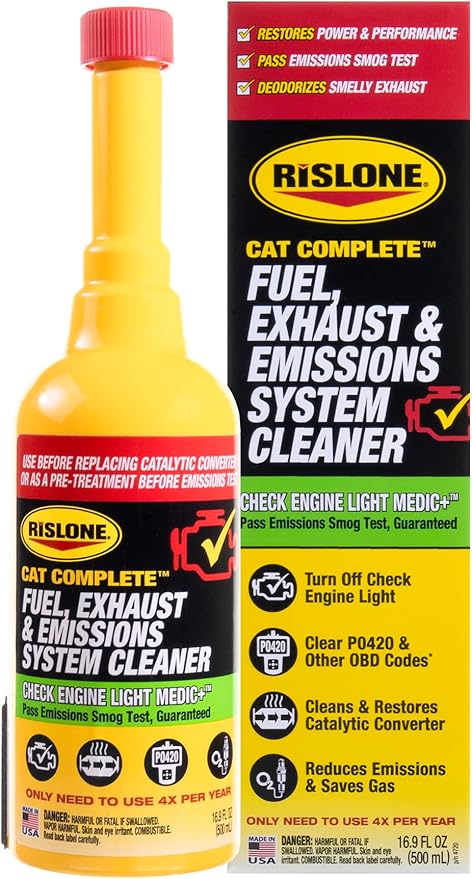
Rislone Cat Complete Fuel and Emissions Cleaner is designed to boost your vehicle’s power and fuel efficiency by cleaning both the emissions and fuel systems. It works on various engine types including gasoline, ethanol, and hybrids.
Its biggest strength is maintaining engine performance while avoiding costly repairs and protecting your vehicle’s warranty.
Using the cleaner is straightforward; pour it into your fuel tank every 5,000 miles to keep your fuel and emissions systems clean. It’s compatible with a wide range of engines, including fuel injected, direct injected, and turbocharged ones.
Regular use helps prevent the check engine light from turning on again and also reduces smelly exhaust odors caused by sulfur.
The cleaner effectively maintains power and improves mileage by thoroughly cleaning your fuel and exhaust system. It’s built to meet EPA compliance and safe for oxygen sensors and catalytic converters.
Many users praise its ability to clear OBD codes and pass emissions tests, but some note that it requires consistent use for noticeable results.
Many users highlight how well it clears emission codes and prevents the check engine light from coming back. Some find it takes a few treatment cycles before seeing noticeable improvements, requiring consistent commitment.
Drivers looking for a reliable cleaner to maintain emissions systems and fuel efficiency over time will appreciate this product. Those wanting instant results or a one-time fix might want to consider alternatives.
Pros
- Works on gasoline, ethanol, and hybrid engines
- Safe for catalytic converters and oxygen sensors
- Clears check engine light codes like P0420
- Helps pass emissions smog tests
Cons
- Requires regular use every 5,000 miles
- Results may not be immediate for some vehicles
| Specification | Details |
|---|---|
| Manufacturer | Bar’s Products |
| Brand | Rislone |
| Item Weight | 1.08 pounds |
| Dimensions | 9.25 x 2.65 x 2.65 inches |
| Model Number | 4720 |
| Special Features | EPA registered, clears OBD P0420 codes, deodorizes sulfur exhaust smell |
6. MotorPower Care Catalytic Converter Cleaner

Proven to cut down emissions significantly, MotorPower Care Catalytic Converter Cleaner stands out for anyone needing a real fix for high pollution levels from their vehicle. Ideal for those facing emission test failures or engine codes like P0420 and P0430, its genuine test data support is the biggest selling point.
Using the cleaner requires a straightforward process: just pour it into your fuel tank alongside 5-15 gallons of gas. The treatment only takes about 40 minutes, making it easy to fit into your routine without long waits or complicated setups. It works on key parts such as the catalytic converter, O2 sensors, EGR valve, and turbocharger, addressing the common trouble spots affecting exhaust emissions.
The cleaner effectively dissolves tough carbon deposits, helping to clear fault codes that often lead to costly repair visits. It’s designed with German technology and is favored by many mechanics and testing centers, which speaks to its reliability. Common praise highlights its ability to pass smog tests, while the biggest drawback is that it only comes in liquid form, which some might find messy to handle.
MotorPower Care Catalytic Converter Cleaner has strong evidence showing it significantly cuts emissions and clears common engine codes related to catalytic converter issues. The most frequent negative point is the handling of the liquid formula, which some find inconvenient compared to sprays or tablets.
Vehicle users facing difficulties with smog tests and error codes will find this especially helpful. Those looking for a ready-to-use product without measuring fuel volumes may prefer a different format.
Pros
- Reduces HC from 108 to 67 ppm
- Clears P0420 and P0430 engine codes
- Supported by government-tested data
- Treated fuel tank volume up to 15 gallons
Cons
- Only comes in liquid form, can be messy
- Effectiveness depends on proper fuel dilution
| Specification | Details |
|---|---|
| Item Form | Liquid |
| Specific Uses For Product | Engine |
| Surface Recommendation | Floor |
| Treatment Time | 40 minutes |
| Fuel Tank Capacity for Use | 5-15 gallons |
7. Cataclean Fuel and Exhaust System Cleaner

Cars that struggle with sluggish performance and poor fuel economy often suffer from carbon build-up in key engine parts. Ideal for gasoline, diesel, hybrid, and flex-fuel engines, Cataclean Fuel and Exhaust System Cleaner targets these deposits, helping to reduce hydrocarbon emissions by up to 50 percent. Its standout feature is the ability to clean multiple vital components at once, improving overall drivability.
Using the liquid cleaner is straightforward, you pour it into the fuel tank during a fill-up, so no special equipment or complex setup is required. Since it doesn’t alter the fuel itself, it fits into regular maintenance routines easily. Because it’s scent-free and compatible with several fuel types, it suits a wide range of vehicles without causing unwanted smells or engine damage.
Avoid mixing it with two-stroke or oil/gas engines, though.
Cataclean effectively reduces carbon build-up in catalytic converters, oxygen sensors, fuel injectors, and cylinder heads, which translates into smoother starts, less engine hesitation, and better fuel economy. It feels reliable and safe to use due to its formula not affecting fuel mixes. The most common complaint lies in its limitation for two-stroke engines and oil/gas mixes, which restricts use for some vehicle types.
The cleaner effectively reduces carbon build-up and improves performance, but its restriction against two-stroke and oil/gas mix engines limits its use for some vehicles. Day-to-day use is simple since you just add it to your fuel tank without changing driving habits.
Drivers of gasoline, diesel, hybrid, or flex-fuel vehicles looking to maintain or restore engine efficiency will appreciate it. Those with two-stroke or mixed oil/gas engines should consider alternatives due to incompatibility.
Pros
- Reduces hydrocarbon emissions up to 50%
- Improves fuel efficiency and drivability
- Compatible with multiple fuel types
- Neutral scent and no fuel alteration
Cons
- Not suitable for two-stroke engines
- Cannot be used with oil/gas mix engines
| Specification | Details |
|---|---|
| Item Form | Liquid |
| Scent | Unscented |
| Specific Uses For Product | Fuel and Exhaust System |
| Surface Recommendation | Metal |
| Compatible Fuel Types | Gasoline, Diesel, Hybrid, Flex-fuel |
8. Liqui Moly Catalytic System Cleaner

Protecting your catalytic converter from soot buildup stands out as the biggest strength of this cleaner, making it suitable for all gasoline engines equipped with a catalytic converter. It focuses on cleaning the injection system and combustion chamber to improve fuel combustion efficiently.
Using the cleaner involves adding it to your fuel tank, where it works during regular driving. Its ability to clean the injection system and combustion chamber helps reduce fuel consumption, contributing to lower CO2 emissions.
The 300ml bottle is easy to handle and applies straightforwardly to any compatible gasoline engine.
Performance is solid with clear effects on reducing soot and maintaining cleaner engine parts. The build is standard for a liquid fuel additive, packaged in a 1.37-pound bottle that fits well on a shelf.
One of the main praises is its reliable effect on fuel combustion, while some mention the limited bottle size as a drawback if frequent use is needed.
Its strong suit lies in cleaning fuel combustion components effectively, which many note helps reduce fuel use and emissions. The main drawback mentioned involves the bottle size, which might not be enough for extensive or repeated maintenance needs.
Drivers looking to protect and clean their gasoline engine’s catalytic system will find this helpful. Those needing larger quantities or a product for diesel engines should consider different options better suited to those requirements.
Pros
- Protects catalytic converter from soot buildup
- Cleans injection system and combustion chamber
- Improves fuel combustion and reduces emissions
- Suitable for all gasoline engines with catalyst
Cons
- Relatively small 300ml bottle may require repeat use
- Only compatible with gasoline engines, not diesel
| Specification | Details |
|---|---|
| Manufacturer | Liquii Moly |
| Brand | Generic |
| Model | Catalytic System Clean 300ml |
| Item Weight | 1.37 pounds |
| Package Dimensions | 8.43 x 5.2 x 2.52 inches |
| Manufacturer Part Number | 7110 |
9. BlueDevil Catalytic and Emission System Cleaner

Anyone looking to reduce emissions and keep their catalytic converter running well will find this cleaner very useful. It works for a wide range of gasoline and hybrid engines, making it a solid choice for people who want better fuel economy and fewer engine codes.
Pour the liquid into your fuel tank as the product is designed for straightforward use. It safely works with various engine types including direct injection, turbo engines, and hybrids without causing harm.
The cleaner starts working on carbon build-up and supports catalytic converter performance with no added scents or abrasive chemicals, so you can keep using it regularly without worrying about damage.
It effectively removes carbon deposits and clears common trouble codes like P0420, leading to better acceleration response and fuel economy. The product doesn’t cause wear since it’s non-abrasive and liquid-based.
Most appreciate how it supports catalytic systems well. Some users mention it can take time to see visible improvements, so patience is necessary.
Many users note that it successfully clears engine codes and helps catalytic performance. Patience is required since the effects don’t always show immediately. The non-abrasive liquid form offers safe use across various fuel systems without damage.
People wanting gradual, reliable catalytic cleaner action will appreciate this product. Those seeking quicker or more intense cleaning might want to look for alternatives that promise faster results.
Pros
- Compatible with a wide range of gasoline and hybrid engines
- Reduces emissions and improves fuel economy
- Non-abrasive formula safe for fuel systems
- Removes carbon deposits effectively
Cons
- Improvements may take time to notice
- Limited scent options, only unscented
| Specification | Details |
|---|---|
| Item Form | Liquid |
| Scent | Unscented |
| Specific Uses For Product | Catalytic converter |
| Surface Recommendation | Catalytic Converter |
| Special Features | Non Abrasive |
10. Catalytic System Cleaner

Designed specifically for gasoline engines, this cleaner stands out by tackling resinous and hard deposits in the intake and combustion areas. Ideal for those wanting to reduce harmful emissions while improving catalytic converter safety, it focuses on powerful cleaning that protects the engine system.
Using the cleaner involves adding it to the fuel system, where its active formula gets to work on stubborn buildup. Its compact size makes handling straightforward, and consistent use can help maintain smooth engine performance. Suitable for regular maintenance without complicated setup or special tools.
Performance-wise, it effectively clears deposits that often cause issues in catalytic converters and intake systems. Built with a weight of 10.2 ounces and dimensions of 7.4 by 2 by 2 inches, it feels solid and easy to store. Praised for its cleaning power, some have noted it might not work as quickly on very heavy deposits.
Many users appreciate its strong cleaning effect that helps reduce emissions and protect engine safety. A common drawback is the slower action on extensive buildup, which requires patience for noticeable results.
Drivers looking for a focused, reliable cleaner for gasoline engines will find it fitting. Those needing quick results on heavy deposits or using diesel systems might want to consider alternatives.
Pros
- Effectively reduces harmful emissions
- Cleans tough resinous and hard deposits
- Compact and easy to handle
- Improves safety of catalytic converter system
Cons
- May take time to clear very heavy deposits
- Only suitable for gasoline engines
| Specification | Details |
|---|---|
| Manufacturer | boto gen |
| Brand | boto gen |
| Model | BT1736 |
| Item Weight | 10.2 ounces |
| Dimensions | 7.4 x 2 x 2 inches |
| Manufacturer Part Number | BT1734 |
11. Liqui Moly Catalytic-System Cleaner

Liqui Moly Catalytic-System Cleaner helps keep the catalytic converter in good shape by removing sediment and impurities from the intake and combustion areas. Suited for anyone wanting to maintain their vehicle’s emissions system and improve overall engine performance, its main strength lies in effectively cleaning without complicated application steps.
Using it is straightforward, just pour the cleaner into the fuel tank from its 300 ml bottle. The product comes in a two-pack, so you get enough for multiple treatments.
Its additives work through your regular driving, meaning no extra tools or dismantling parts. The 300 ml size fits easily in a glove compartment or garage shelf, ready for whenever maintenance is due.
The cleaner does its job reliably by targeting buildup that slows down the catalytic system and affects engine efficiency. It is designed specifically for the catalytic system and combustion chamber, making it specialized rather than a general-purpose cleaner.
Durable packaging holds well without leaks, although some might find the bottle a bit small for repeated use. Praises focus on noticeable engine smoothness after use, while occasional critiques mention that benefits take some time to become apparent.
Many have noted smoother engine performance after using the cleaner, pointing to its effectiveness at clearing deposits. On the downside, some found it takes a while before feeling these improvements. The straightforward two-bottle kit and precise focus on catalytic systems keep the process simple and focused.
Drivers wanting routine maintenance for emissions components will appreciate this cleaner’s targeted action and ease of use. Those seeking instant results or who favor larger quantities might want to explore alternative options or complementary products.
Pros
- Two-pack offers extra value
- Special additive formula for catalytic systems
- Easy to use, just pour into fuel tank
- Compact bottle size for convenient storage
Cons
- Benefits may take time to notice
- Bottle size might be small for heavy users
| Specification | Details |
|---|---|
| Package Size | 300 ml per bottle |
| Unit Count | 2 Count |
| Number of Items | 2 |
| Weight | Approximately 0.299 kg |
| Dimensions | 17.6 cm L x 5.0 cm W x 5.0 cm H |
12. Liqui Moly Catalytic-System Cleaner

Easy to use and effective, Liqui Moly Catalytic-System Cleaner suits anyone looking to keep their car’s intake system and combustion process cleaner. It stands out for reducing chlorine, which helps prolong catalytic converter life and maintain engine health.
Pouring the liquid additive into the fuel tank before driving is simple and straightforward. Its unscented formula means no strong chemical smell, which makes the process more pleasant.
You don’t need any special tools or complicated steps, just add it as part of regular maintenance to help manage deposits and impurities.
It cleans the catalytic system by breaking down typical sediments and impurities, which helps improve vehicle efficiency. The packaging is compact, a small bottle that stores easily without taking room.
Positive feedback highlights its noticeable cleaning effect while some users mention that results may take time and aren’t immediately visible.
The strongest praise focuses on its ability to clean impurities and reduce chlorine in the catalytic system, helping maintain engine performance. Some people note that visible changes aren’t immediate, requiring patience to notice effects. The formula is liquid and unscented, which simplifies use without unpleasant odors.
Those wanting a straightforward, low-effort way to protect their catalytic converter and intake system will appreciate the product. Drivers expecting quick, obvious improvements might prefer alternatives, as this works gradually as part of regular vehicle upkeep.
Pros
- Reduces harmful chlorine deposits in catalytic system
- Unscented, avoids strong chemical smells
- Simple to add directly to fuel tank
- Compact bottle size for easy storage
Cons
- Results may take time to become noticeable
- Only suitable for external automotive use
| Specification | Details |
|---|---|
| Item Form | Liquid |
| Scent | Unscented |
| Special Features | Chlorine Reduction |
| Specific Uses For Product | Automotive Exterior |
| Item Package Weight | 0.299 kg |
| Item Package Dimension | 17.6cm L x 5.0cm W x 5.0cm H |
Best Catalytic Cleaners Comparison Table
| Product | Item Form | Specific Uses | Special Features | Weight |
|---|---|---|---|---|
| Cataclean Fuel Cleaner | Liquid | – | Not_Performance_Used | – |
| Liqui Moly Catalyst Cleaner | Liquid | Automotive motor additive | – | – |
| MotorPower Catalytic Cleaner | Liquid | Engine | – | – |
| Dura Lube Exhaust Treatment | Liquid | Catalytic Converter & Exhaust | EMISSIONS | – |
| Rislone Cat Emissions Cleaner | – | Fuel, Exhaust & Emissions Cleaner | – | 1.08 pounds |
| MotorPower Converter Cleaner | Liquid | Engine | – | – |
| Cataclean Exhaust Cleaner | Liquid | Fuel and Exhaust System | – | – |
| Liqui Moly Catalyst System | – | – | – | 1.37 pounds |
| BlueDevil Emissions Cleaner | Liquid | Catalytic Converter | Non Abrasive | – |
| Generic Catalyst Cleaner | – | – | – | 10.2 ounces |
| Liqui Moly Cat Cleaner | – | – | – | – |
| Liqui Moly Catalyst Aid | Liquid | Automotive Exterior | Chlorine Reduction | – |
- Item FormLiquid
- Specific Uses–
- Special FeaturesNot_Performance_Used
- Weight–
- Item FormLiquid
- Specific UsesAutomotive motor additive
- Special Features–
- Weight–
- Item FormLiquid
- Specific UsesEngine
- Special Features–
- Weight–
- Item FormLiquid
- Specific UsesCatalytic Converter & Exhaust
- Special FeaturesEMISSIONS
- Weight–
- Item Form–
- Specific UsesFuel, Exhaust & Emissions Cleaner
- Special Features–
- Weight1.08 pounds
- Item FormLiquid
- Specific UsesEngine
- Special Features–
- Weight–
- Item FormLiquid
- Specific UsesFuel and Exhaust System
- Special Features–
- Weight–
- Item Form–
- Specific Uses–
- Special Features–
- Weight1.37 pounds
- Item FormLiquid
- Specific UsesCatalytic Converter
- Special FeaturesNon Abrasive
- Weight–
- Item Form–
- Specific Uses–
- Special Features–
- Weight10.2 ounces
- Item Form–
- Specific Uses–
- Special Features–
- Weight–
- Item FormLiquid
- Specific UsesAutomotive Exterior
- Special FeaturesChlorine Reduction
- Weight–
How to Choose the Right Catalytic Cleaner
Choosing a good catalytic cleaner depends on its effectiveness at removing buildup without damaging the catalyst, safety for your vehicle’s components, and ease of use. Picking the right cleaner ensures the catalytic converter works efficiently, helping avoid costly repairs and prolonging your car’s lifespan.
Cleaning Effectiveness
Some cleaners take hours or multiple treatments to show real results on stubborn carbon deposits. That slow process means a person can waste time and product without fully clearing critical engine parts.
Effective products noticeably break down soot and contaminants fast, often with just one application. They should reach all parts of the catalytic converter or engine system, not just the surface.
Daily use benefits include smoother engine performance and reduced emissions. Look for a cleaner that states compatibility with your vehicle’s catalytic converter type, as some formulas target ceramic or metallic substrates differently. Cleaning speed also matters; most good products work within one tank of fuel or a single soak, saving effort and downtime.
Safety and Chemical Composition
Using harsh chemicals on your engine risks damaging vital metal or rubber components. Noncorrosive formulations avoid this by breaking down deposits without eating away protective layers. This keeps your parts intact and functioning longer.
Many cleaners now use biodegradable, low-toxicity ingredients that meet environmental standards and won’t worsen emissions. Handling precautions vary, but it’s important to use gloves and work in a ventilated area to avoid skin irritation or inhaling fumes.
Reading the product label for safety details ensures proper care during use.
Ease of Use
Some products require spraying directly into the exhaust, others add to the fuel tank, and some need part removal and soaking. Fluids added to gas tanks offer convenience but may work slower, while sprays or soaks provide targeted cleaning but take more prep time and tools. Clear instructions are essential to avoid mistakes and wasted product.
Most users prefer cleaners that can be used without engine disassembly, as taking apart components adds time and risk. Look for options that specify “in situ” application or fuel system use to keep the job simple and quick.
Compatibility and Versatility
Cleaners differ in their fit across various engines and catalytic converters. Those designed for a range of vehicle sizes and converter models reduce guesswork and allow use on multiple vehicles. Heavy buildup demands stronger formulas, while lighter maintenance cleans suit gentler products.
Some cleaners also work on other exhaust parts like oxygen sensors or intake valves, adding versatility. Compatibility with other maintenance chemicals can improve overall engine health, but always check that ingredients won’t react adversely when combined.
Value and Cost Efficiency
The amount of solution in one purchase affects cost efficiency, especially since some treatments cover multiple cleaning cycles. Larger bottles or packs reduce the cost per use, which benefits regular maintenance routines.
Relatively inexpensive products that deliver consistent results often outperform pricier alternatives. Investing in a quality cleaner preserves catalytic converter life, helping avoid costly replacements and reducing emissions over time, making it a practical longterm choice for vehicle upkeep.
Proper Usage Techniques for Maximum Effectiveness of Catalytic Cleaners
Catalytic cleaners require specific application steps to deliver strong results. For the best outcome, start by shaking the container well to activate the formula.
Apply the cleaner directly onto a warm catalytic converter rather than a cold one, since heat helps the chemicals break down the carbon deposits more effectively. Allow the cleaner to soak for at least 15 minutes before running the engine to facilitate deep penetration.
Key usage tips include:
- Use the product on a warm engine for improved absorption.
- Follow the manufacturer’s dosage instructions closely to avoid overuse or residue buildup.
- Run the vehicle for several minutes after application to flush out loosened deposits.
- Repeat the process periodically if buildup is heavy, rather than trying to fix it all in one go.
By combining proper surface preparation with repeated maintenance treatments, catalytic cleaners can restore filter efficiency and reduce emissions over time.
Safety Precautions and Handling Tips When Using Catalytic Cleaners
Handling catalytic cleaners demands attention to safety due to the chemical components involved. Wearing nitrile gloves protects against skin irritation caused by solvents and acids often found in these products. Avoid inhaling fumes by operating in a well-ventilated area or outdoors.
Ensure that the container is kept tightly closed and stored away from heat or open flames, as some ingredients may be flammable.
Practical precautions include:
- Keeping the cleaner away from children and pets.
- Never mixing the cleaner with other chemicals to prevent hazardous reactions.
- Using eye protection to prevent accidental splashes.
- Properly disposing of any leftover product according to local hazardous waste guidelines.
Following these steps can prevent accidents and maintain a safe working environment during cleaning tasks.
Comparing Catalytic Cleaners with Alternative Cleaning Methods
Catalytic cleaners target carbon deposits chemically, differing from mechanical methods that physically scrape or blast residue off. This chemical approach reaches areas inside the catalytic converter that are inaccessible by hand or tools.
Compared to fuel additives, catalytic cleaners tend to produce faster, more visible results by directly treating the converter surface rather than relying on engine combustion.
Other common methods include:
- Manual scraping or wire brushing, which can risk damage if done improperly.
- Hydrocarbon-based fuel additives, which pass through the system but work less effectively on stubborn deposits.
- Ultrasonic cleaning, requiring specialized equipment and component removal.
Catalytic cleaners balance convenience and effectiveness for routine maintenance, though severe clogging may still call for professional intervention.
People Also Asked
How Often Should I Apply Catalytic Cleaner for Best Results?
Use catalytic cleaner every 3,000 to 5,000 miles or with every oil change for consistent results. Applying it regularly prevents buildup and helps maintain exhaust efficiency over time.
Is Catalytic Cleaner Safe to Use on All Vehicle Types?
Most catalytic cleaners are safe for gasoline-powered vehicles with catalytic converters. Check the product label for compatibility with diesel or specialized engines, as some formulas are specific.
What Size Catalytic Cleaner Do I Need for My Exhaust?
Choose a cleaner size based on your vehicle’s engine and tank capacity, often listed on the product packaging. Small cars usually need around 8-12 ounces, while larger engines may require more.
Can Catalytic Cleaner Cause Damage to My Catalytic Converter?
Catalytic cleaner will not damage your catalytic converter if used as directed. Avoid using cleaners not designed for catalytic systems, as some harsh chemicals could potentially harm internal components.
How Long Does Catalytic Cleaner Remain Effective After Application?
Catalytic cleaner typically works during the fuel cycle it is added to and does not provide long-term residue protection. Regular treatment is necessary to keep the catalyst functioning properly over time.
Conclusion
The most important factors when choosing a catalytic cleaner are its compatibility with your specific catalytic converter, how easy it is to use, and the cleaning effectiveness. You want a product that won’t damage your vehicle while removing build-up and restoring performance.
Also consider how frequently you plan to clean, as that can affect which formula or size is best.
Pick a cleaner that fits your vehicle size and budget while matching your usage frequency. Cleaning only occasionally calls for a smaller, more cost-effective option.
For frequent maintenance, spending a bit more upfront on a larger or stronger product may make sense. Review the comparison table and the detailed picks above to find the right fit.