
Top 12 Best Dust Extractor for Small Workshop Revealed!
Dust control in a small workshop often gets overlooked until sawdust starts clogging tools or settling on every surface. Choosing the best dust extractor for small workshop use makes a visible difference, preventing mess and protecting respiratory health.
Cheap models usually lack the suction needed to capture fine particles, which quickly leads to ineffective cleanup and more frequent filter changes.
A good dust extractor combines strong motor power around 1000 to 1500 watts with a compact design that fits small spaces without limiting movement. Filter quality matters a lot; HEPA or cartridge filters catch the tiny dust that standard filters miss.
Easy access to bags or filters for quick emptying, along with durable hoses that resist clogging, round out the features that separate solid extractors from weak ones.
Need a Quick Check?
| Image | Product | Price |
|---|---|---|
Our Top Picks 1  | WEN Air Filtration | Check Price |
Our Top Picks 2  | WEN Dust Collector | Check Price |
Our Top Picks 3 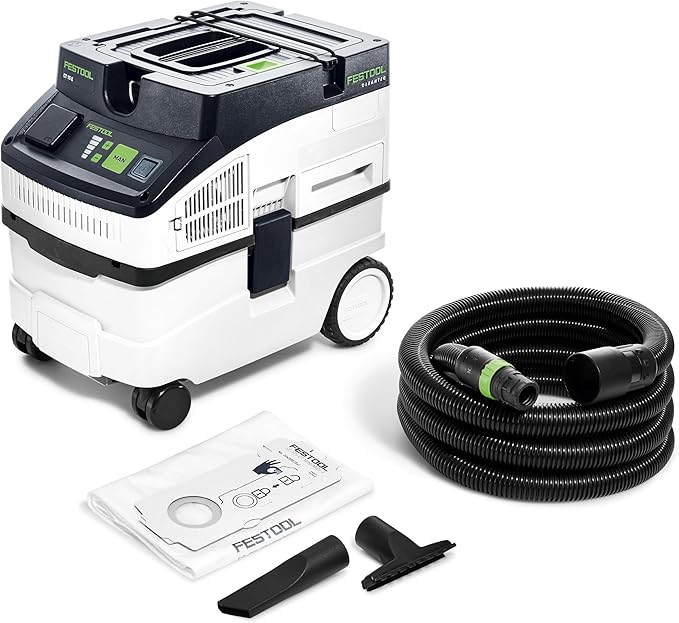 | Festool CT 15 | Check Price |
Our Selected Top 12 Dust Extractor for Small Workshop for Different Needs
This list features carefully chosen dust extractors ideal for small workshops, covering various needs and setups. Each review explains the performance, suitable users, and highlights the strengths and limitations to help readers make an informed decision based on their specific requirements.
1. WEN 3410 Air Filtration System
Perfect for small workshops up to 400 square feet, this air filtration system works quietly to clear the air of dust particles as small as 1 micron. Its main strength lies in offering good airflow rates while maintaining low noise, making it suitable for woodworking or similar dusty projects without disturbing your focus.
Setting up involves plugging it into a standard 120V outlet and choosing from three airflow speeds via the remote control. The programmable timer is handy, shutting it off automatically after a set period.
Replacement filters are easy to swap out, and the remote works even from behind obstacles, controlling power and speed from across the room.
It handles dust capture effectively thanks to a 1-micron main filter and a 5-micron pre-filter. The unit stays fairly quiet at 50 to 60 dB, which helps your workspace stay comfortable.
Its compact size fits well on a shelf or bench, though some find the airflow could be stronger for bigger spaces. Filter replacement is straightforward, but keeping spares handy is necessary for continuous use.
This air filtration system is praised for its quiet operation and remote control convenience, allowing users to easily adjust settings from across the room. The most common drawback is the need for regular filter replacements, which can interrupt continuous work if spares are not on hand.
Workshops under 400 square feet will get great use from this unit, especially for light to moderate dust levels. Larger spaces or very heavy dust production might need a unit with stronger airflow and more durable filtration to keep air cleaner longer.
Pros
- Effective 1-micron and 5-micron filters
- Quiet operation rated 50 to 60 dB
- Remote control works through walls
- Programmable timer for automatic shutoff
Cons
- Airflow might be low for larger shops
- Frequent filter changes needed for heavy use
| Specification | Details |
|---|---|
| Air flow | 300/350/400 cubic feet per minute |
| Floor Area Coverage | 400 sq ft |
| Noise Level | 50 to 60 dB |
| Filter Type | Pre-Filter (1 micron main, 5 micron pre-filter) |
| Power | 120 watts |
| Control Method | Remote Control (RF, up to 26 feet) |
2. WEN DC3401 Woodworking Dust Collector
Perfect for a small workshop, this dust extractor stands out by balancing strong suction with easy mobility. It’s designed to handle engineered woods with a 5.7-amp motor that moves a solid 660 cubic feet of air per minute, making it effective without taking up too much space.
Setting it up doesn’t take long thanks to the compact design and the onboard carrying handle that makes moving it around simple. The lockable swivel casters keep the tool steady when needed while allowing you to move it easily between different work areas.
The 4-inch dust port fits most woodworking tools, and cleaning the 12-gallon collection bag is straightforward with its zippered design. Maintaining the foam filter is convenient given the easy-access feature.
It performs well at pulling dust from engineered wood, capturing a good amount before the bag needs emptying. Built with a lightweight frame and a motor tuned for steady suction, it holds up well during everyday tasks. Users like the quiet operation and portability; some wish it had adjustable speeds for different tasks, but the single speed still manages the job reliably.
The suction reliably handles dust from woodworking projects without being overly loud. Easy transportation and storage come up as a major benefit, while some users find the lack of multiple speeds limiting for varied dust collection needs. The filter keeps dust contained but requires regular care to maintain performance.
People working mainly with engineered woods on moderate projects will appreciate this design and power level. Those needing more control over suction settings or handling heavier dust loads might want to look for a model with variable speeds or stronger motors.
Pros
- Compact and easy to move around
- Strong enough suction for small workshop needs
- Large 12-gallon collection bag
- Easy-access maintenance for cleaning filter
Cons
- Only one speed available
- Foam filter may need frequent cleaning
| Specification | Details |
|---|---|
| Motor | 5.7-amp brushed motor |
| Air Movement | 660 cubic feet per minute |
| Dust Port Size | 4 inches |
| Collection Capacity | 12 gallons |
| Dimensions | 34.25 x 13 x 14.2 inches |
| Weight | 17 pounds |
3. Festool CT 15 Dust Extractor
Festool CT 15 Dust Extractor is ideal for small workshops needing consistent, powerful dust removal with a compact footprint. Its standout feature is a HEPA-certified filter combined with a 15-liter container, allowing long cleaning sessions without interruptions.
It fits well in tight spaces and handles indoor and outdoor tasks alike.
Setup is straightforward, thanks to the included crevice and upholstery nozzles that store neatly on the extractor itself. The automatic tool start means it turns on as soon as you power your connected tool, saving time and effort. Its flat top surface lets you keep your work materials close by, which adds convenience during busy workdays.
Performance is solid with high-power suction picking up dust from bare floors, carpets, and upholstered furniture effectively. The chassis features steel axles and a sturdy design that ensures a long service life. Most users appreciate its consistent suction, while some mention its single power level could limit control in delicate situations.
The extractor consistently delivers strong suction and excellent dust capture with its HEPA filter. It is praised for a sturdy build and useful onboard tool storage. The most common complaint mentions the limited power adjustment, which some users find restrictive for delicate cleanup tasks.
People needing a dependable, no-fuss dust extractor in a small workshop will be satisfied. Those requiring variable suction power or very large dust capacity should consider a different model better suited to heavy-duty use.
Pros
- HEPA filtration for cleaner air quality
- Compact, stable footprint for small workshops
- Tools included and stored onboard
- Reliable automatic tool start feature
Cons
- Only one power level for suction control
- Limited container size for very heavy dust loads
| Specification | Details |
|---|---|
| Filter Type | HEPA Filter |
| Capacity | 15 liters |
| Number of Speeds | 1 |
| Recommended Uses | Bare Floor, Carpet, Furniture, Hard Floor, Home, Office, Upholstery |
| Other Features | Automatic Tool Start, AutoClean System, Cleaning Tools Included |
4. SHOPMAX 13.2 Gal. Portable Dust Collector

Quiet and easy to move around, the SHOPMAX 13.2 Gal. Portable Dust Collector is ideal for small workshop spaces where dust control matters most. Its strong motor provides solid suction, making it a dependable choice when cleaning up sawdust and other debris quickly and efficiently.
Setup involves just a few simple steps thanks to easy installation. The compact size fits well into cramped spots and lifting it is straightforward due to the convenient top handle. Changing hose adapters to match different tools is quick, while the built-in cord wrap helps keep your workspace tidy.
Its HEPA filter ensures smaller particles don’t escape back into the air.
Performance excels in moving air at 108 CFM, capturing dust right at the source well enough for most small workshop needs. The sturdy build feels reliable and set up is never frustrating.
Most appreciate how much dust it holds with a 3.2-gallon capacity, but some mention it would be nice to have variable speeds instead of just one power setting.
Strong suction combined with a capable HEPA filter makes it an effective dust collector for small workshops, but limited speed control restricts precision for some tasks. The dust container size balances portability and capacity, though frequent emptying can interrupt continuous work.
People working in compact spaces who want a reliable, portable dust extractor with good filtration will be satisfied. Those needing varied suction power or less frequent maintenance might look for options with adjustable speeds and larger dust bins.
Pros
- Powerful suction at 108 CFM
- Compact size fits small spaces well
- HEPA filter captures fine dust particles
- Multiple hose adapters for various tools
Cons
- Only one speed setting available
- 3.2-gallon dust capacity may require frequent emptying
| Specification | Details |
|---|---|
| Motor Power | 1.48 HP |
| Maximum Airflow Capacity | 108 CFM |
| Capacity | 3.2 Gallons |
| Filter Type | HEPA Filter |
| Number of Speeds | 1 |
5. DEWALT Dust Separator DXVCS002

Perfect for small workshops, the DEWALT Dust Separator DXVCS002 handles debris before it reaches your vacuum, saving filter and bag costs. Its main strength lies in efficiently trapping wood chips and heavy dust, making it ideal when working with wood and mixed materials.
Setting it up is straightforward thanks to the four-caster base, letting you move it easily across hard floors. You connect it ahead of your vacuum, where it captures large particles so vacuum filters clog less often. The 6-gallon capacity is enough for typical day-to-day dust and debris without constant emptying.
It works wet or dry, adding versatility for varied shop messes.
Performance is solid, capturing a wide range of materials from wood chips to pet hair. The cyclonic filter system prevents suction loss reliably.
Built from durable plastic, it stands up to workshop conditions. The most praised feature is its efficiency at dust separation, while some do note it can be bulky in tighter spaces.
It excels at preventing suction loss by capturing most wood chips and dust before they reach the vacuum filter, which saves on costly replacements and keeps performance steady. Some find its size cumbersome in small or crowded workshops, which can limit maneuverability around tight benches.
Anyone wanting reliable dust separation for indoor use on hard floors will be satisfied. Those needing finer filtration control or smaller footprint might consider other options better suited for compact spaces or multi-level suction adjustments.
Pros
- Effectively traps large wood chips before vacuum
- Four wheels make it easy to move
- Works with wet and dry debris
- Durable hard plastic construction
Cons
- Can be bulky for tight workshop spaces
- Only one power level available
| Specification | Details |
|---|---|
| Filter Type | Cyclonic |
| Capacity | 6 gallons |
| Number of Wheels | 4 |
| Surface Recommendation | Hard Floor |
| Indoor/Outdoor Usage | Indoor |
| Other Features | High Power, Portable, Wet/Dry, Wheels |
6. PRO Cyclone Dust Collector

Lightweight design and solid construction make it a smart pick for small workshops needing a reliable dust extraction system. Suited for those who want efficient dust separation without oversized equipment, its biggest strength is clearly the focus on maximum dust collection efficiency rather than just airflow volume.
Setup is straightforward with compact dimensions that fit easily in limited spaces. Everyday use involves connecting it to a shop vacuum or dust collector system where it efficiently traps dust before it reaches the filter.
The 0.5-inch wall thickness and 2.25-inch outside diameter provide durability with a manageable weight of 1.63 kg, making it easy to handle or reposition as needed.
Performance-wise, it excels at separating various types of dust, fine sawdust, coarse sawdust, and drywall powder, thanks to engineering optimized specifically for dust separation instead of just maximizing CFM. Reviewers often note impressive dust collection efficiency, though some found it less effective if used with larger setups needing higher airflow.
Build quality is solid with no complaints about material durability.
Tests confirm it collects dust more efficiently than other low-profile separators, especially for fine and coarse sawdust, but performance depends on matching airflow properly. Most users praise its solid build and dust separation, while common downsides include limitations when paired with high-CFM machinery.
Ideal for small workshops or hobbyists using lower airflow tools who want better dust control. Those with larger dust collection systems or power tools needing greater air movement might want to look for higher capacity options instead.
Pros
- High dust collection efficiency
- Compact size fits small spaces
- Durable construction with thick walls
- Lightweight for easy handling
Cons
- Limited airflow capacity for larger tools
- May require precise fitting for best results
| Specification | Details |
|---|---|
| Item Dimensions L x W | 13″L x 13″W |
| Item Weight | 1.63 kg |
| Nominal Wall Thickness | 0.5 inches |
| Outside Diameter | 2.25 inches |
| Item Length | 7 inches |
7. DYNAVEX 10 Amp Woodworking Dust Extractor

Strong suction power stands out with a 1.5 HP motor and 142 CFM airflow, making it well suited for small workshops that need reliable dust collection during woodworking tasks. Its 12-gallon tank holds a generous amount of debris, cutting down on the need to empty frequently.
Setting it up involves connecting the power tool to the linked socket and activating the AUTO mode, which starts the extractor automatically when the tool powers on. Mobility is added by optional wheels, letting you move it easily across your workshop or garage. The included hose and fittings make installation straightforward and ready for daily use.
It does an impressive job capturing fine dust and debris from sawing, sanding, and routing. The steel construction feels durable and solid.
People often mention how well the auto start linked switch works, but the common complaint is the weight at nearly 30 pounds, which can feel cumbersome without the wheels installed.
The dust extractor is praised for its powerful suction and convenient auto start linked switch, making dust collection easy and efficient in a small workshop environment. The heavier weight and need to install wheels stand out as the main drawbacks to moving it around comfortably.
People working in small to medium-sized woodworking spaces with occasional tool changes will appreciate this model. Anyone looking for a lightweight or fully mobile unit right out of the box might want to explore other options.
Pros
- Strong suction with 1.5 HP motor
- Large 12-gallon tank reduces emptying frequency
- Auto start linked switch adds convenience
- Mobile with optional wheel installation
Cons
- Relatively heavy at 29.5 pounds
- Wheels require separate installation
| Specification | Details |
|---|---|
| Motor Power | 10 Amp, 1.5 HP |
| Airflow | 142 CFM |
| Capacity | 12 Gallon |
| Weight | 29.5 pounds |
| Dimensions | 15.75 x 15.75 x 24.4 inches |
| Voltage | 120 volts |
8. ECOMAX 8 Gallon Dust Extractor

Power tool integration is what sets this dust extractor apart, making it ideal for small workshops focused on woodworking. It automatically activates when the connected tool starts, saving you the hassle of manually switching it on.
Versatile enough for wet or dry messes, it fits well for both indoor and outdoor use where strong suction and filter care are priorities.
Setup is straightforward thanks to its dual-mode operation. You can switch easily between standard vacuuming around the workshop and hooking it up for dust extraction on power tools like sanders or saws.
The hands-free semi-automatic filter cleaning kicks in as needed, helping to maintain suction without you stopping to clean the filter manually. A dust-full indicator keeps you informed when it’s time to empty the canister.
The 8-gallon capacity is large enough to handle frequent cleanups without constant emptying. Build quality feels solid with its HEPA filter tackling fine dust and allergens effectively.
Most users like how it automatically powers on with their tools, but some mention that it can be a bit bulky to move around. Suction stays strong over time due to the filter system, offering reliable performance in busy workspaces.
The automatic power tool activation is praised for keeping the workspace cleaner by starting the vacuum exactly when needed. The most frequent downside mentioned is its bulky size, which can make moving it around less convenient in tight spaces. The HEPA filter and dust sensor help sustain good suction for tough jobs.
Users working primarily on woodworking projects and wanting to reduce dust exposure will appreciate this extractor. Those needing something more compact or cordless might want to consider alternatives better suited for mobility or lighter duty cleanup.
Pros
- Automatically starts with connected power tools
- HEPA filter traps fine dust effectively
- Semi-automatic filter cleaning maintains suction strength
- Handles both wet and dry messes
Cons
- Bulky to move around workshop
- Limited to corded operation only
| Specification | Details |
|---|---|
| Capacity | 8 gallons |
| Filter Type | HEPA Filter |
| Special Features | Corded, Power Tool Activation, Semi-Automatic Filter Clean |
| Indoor/Outdoor Usage | Indoor, Outdoor |
9. Bosch VAC090AH Dust Extractor

Managing dust in a small workshop can feel like a never-ending task, especially with fine particles that settle everywhere. Ideal for indoor use on hard floors and garages, this dust extractor impresses most with its automatic filter cleaning, making it a good fit for anyone wanting steady suction without constant maintenance.
Setting up involves attaching the HEPA filter and fleece dust bag, which together catch both fine and larger dust particles. The vacuum runs quietly at 60 dB with three power levels, so adjusting suction is straightforward.
Wheels make moving it around easy, and the automatic filter cleaning happens every 15 seconds, helping maintain suction without manual intervention.
Suction power stays consistent thanks to the automatic cleaning feature, and its HEPA filter traps 99.97% of particles 0.3 microns or larger, which is excellent for dust control. The build feels solid with a brushed finish, and users praise its quiet operation. Some note it’s less ideal for outdoor use.
Capacity holds up well for dry dust and debris.
The automatic filter cleaning is highly effective at keeping suction power consistent, while some find the unit’s size too large for tighter workshops. It’s well built and quiet, making dust extraction less of a chore.
This dust extractor fits well in a small to medium indoor workshop where dust compliance and air quality matter. Those needing outdoor or compact solutions might prefer alternatives better tailored for those conditions.
Pros
- Automatic filter cleaning every 15 seconds
- HEPA filter captures 99.97% of fine dust
- Quiet operation at 60 dB
- Wheeled design for easy mobility
Cons
- Not suited for outdoor use
- Relatively large capacity may be bulky for very small spaces
| Specification | Details |
|---|---|
| Filter Type | HEPA Filter |
| Capacity | 4488.32 quarts |
| Maximum Suction | 97 inches |
| Noise Level | 60 db |
| Number of Power Levels | 3 |
| Indoor/Outdoor Usage | Indoor |
10. Festool CT MIDI I Dust Extractor

Compact size and integrated Bluetooth make this dust extractor a solid pick for small workshops. Ideal for woodworking and construction tasks, it shines by combining portability with easy control, letting you start and stop the vacuum remotely without fuss.
Setting it up is straightforward because of the smooth suction hose and internal hose garage, keeping things tidy in a small space. The touch controls simplify operation, removing the need to fumble with buttons. Changing filters takes no tools and is quick, while manual filter cleaning helps keep suction consistent throughout the day.
It handles dust extraction effectively with a HEPA filter that suits hard floors and wood surfaces well. The chassis feels sturdy enough for regular movement around a workshop, and the four wheels help with its mobility.
Common praise highlights how easy it is to use in tight spaces, while some note the single speed as a limitation for varied tasks.
Easy handling in tight spaces and the Bluetooth feature received high marks for convenience. The limited power control options brought up a few concerns, restricting efficiency on tougher jobs.
Small workshops that regularly clean wood and hard floors will find this useful. Those needing stronger, variable power for heavy debris might look for a different extractor.
Pros
- Compact with easy mobility
- Touch controls for simple use
- Quick tool-free filter changes
- Bluetooth remote start and stop
Cons
- Only one speed setting available
- May feel light on power for heavy dust loads
| Specification | Details |
|---|---|
| Filter Type | HEPA Filter |
| Number of Wheels | 4 |
| Other Special Features | SELFCLEAN Filter Bag, Smooth Suction Hose, Internal Hose Garage, Integrated Bluetooth Technology, Automatic Tool Start |
| Surface Recommendation | Hard Floor, Tile Floor, Hardwood |
| Style Name | Canister |
11. DEWALT DWV010 HEPA Dust Extractor

Perfect for small workshop users needing reliable dust extraction, it features a powerful 15-amp motor and automatic filter cleaning. Its biggest strength lies in maintaining suction without interruption, allowing continuous work on various indoor surfaces without losing efficiency.
Setup is straightforward with a universal hose connector and a 15 ft. anti-static hose that swivels for flexible movement around your workspace. Power tool actuation lets the vacuum turn on and off smoothly by responding to the connected tool.
Heavy-duty wheels and casters make it easy to move around the job site despite its 8-gallon capacity.
It performs well, delivering 150 CFM airflow and continuously cleaning the filter every 30 seconds, which keeps suction consistent. The build feels sturdy, suited to rough environments with its yellow/black design and durable wheels.
Most praise the uninterrupted operation, while some find the single speed limits precise suction control.
Constant filter cleaning ensures continuous suction during use, highly praised for keeping work uninterrupted. The main downside is its single-speed motor, which doesn’t allow adjusting suction strength for delicate or highly varied tasks.
Those needing reliable, heavy-duty dust extraction for routine workshop use will appreciate its features. For users requiring more suction control or working in very tight spaces, a more compact or variable speed model might be a better fit.
Pros
- Automatic filter clean pulses every 30 seconds
- Heavy-duty wheels for easy maneuvering
- Power tool actuation for convenient control
- Anti-static hose reduces clogs and static buildup
Cons
- Only one speed limits suction flexibility
- Can be bulky for smaller cramped spaces
| Specification | Details |
|---|---|
| Motor Power | 15-amp |
| Airflow | 150 CFM |
| Hose Diameter | 1.25 inch |
| Capacity | 8 gallons |
| Noise Level | 80 db |
| Filter Type | HEPA Filter |
12. Festool CTC MIDI Basic

Powerful cordless operation makes the Festool CTC MIDI Basic ideal for small workshops that need mobility without sacrificing suction strength. Its 36 V turbine delivers power on par with a corded extractor, ensuring efficient dust collection during sanding, sawing, or drilling jobs.
Easy transport and automatic start complete its appeal for small spaces.
Setting up involves choosing from up to four battery packs to maintain continuous operation alongside the TCL 6 DUO Rapid Charger. Remote control or Bluetooth-enabled battery pack activation means switching on the extractor fits smoothly into the workflow. At around 30 lbs.
, it’s light enough to move around quickly, while the compact footprint means it won’t hog space.
Suction performance is strong thanks to the multiple power levels and a HEPA filter that supports nearly dust-free operation. The manual filter cleaning keeps suction power consistent after extended use. The build feels solid and practical, with four wheels adding to mobility.
Most praise centers on its cordless convenience, while the common complaint focuses on manual filter cleaning requiring occasional effort.
Users appreciate the cordless power that matches corded extractors, making dust extraction flexible and effective. On the downside, cleaning the filter manually can be a bit of a chore during longer jobs. The unit’s mobility and automatic start system make it practical for frequent use.
Anyone using Festool cordless tools in a small workshop will find this extractor a good fit, especially where portability is key. Those who prefer less maintenance or need a lighter device regardless of power should consider alternatives.
Pros
- Power comparable to corded extractors
- Works continuously with four battery packs
- Remote control and Bluetooth start options
- Compact and easy to transport
Cons
- Manual filter cleaning required
- Weight varies depending on battery choice
| Specification | Details |
|---|---|
| Filter Type | HEPA Filter |
| Number of Speeds | 3 |
| Number of Power Levels | 3 |
| Weight | 30 lbs. (14.0 kg) or less depending on battery selection |
| Indoor/Outdoor Usage | Indoor |
| Number of Wheels | 4 |
Best Dust Extractors for Small Workshop Comparison
| Product | Capacity | Power Source | Filter Type | Special Features |
|---|---|---|---|---|
| WEN Air Filtration | – | AC | Pre-Filter | Programmable, Remote Control |
| WEN Dust Collector | 12 gallons | – | Foam | Easy Maintenance, Lockable Casters |
| Festool CT 15 | 15 liters | – | HEPA | Auto Tool Start, AutoClean |
| SHOPMAX Portable Collector | 50 liters | – | HEPA | Easy Installation |
| DEWALT Dust Separator | 6 gallons | – | Cyclonic | Portable, Wet/Dry, Wheels |
| PRO Cyclone Collector | – | – | – | – |
| DYNAVEX Dust Extractor | 12 gallons | AC | – | 1200 watts, Steel |
| ECOMAX Dust Extractor | 8 gallons | Corded | HEPA | Power Tool Activation, Semi-Auto Clean |
| Bosch VAC090AH | 4488 quarts | – | HEPA | Wet/Dry, High Power, Wheels |
| Festool CT MIDI I | – | – | HEPA | Bluetooth, Auto Tool Start |
| DEWALT HEPA Extractor | 8 gallons | – | HEPA | Portable, Wheels |
| Festool CTC MIDI Basic | – | Cordless | HEPA | Auto Start, Manual Clean |
- Capacity–
- Power SourceAC
- Filter TypePre-Filter
- Special FeaturesProgrammable, Remote Control
- Capacity12 gallons
- Power Source–
- Filter TypeFoam
- Special FeaturesEasy Maintenance, Lockable Casters
- Capacity15 liters
- Power Source–
- Filter TypeHEPA
- Special FeaturesAuto Tool Start, AutoClean
- Capacity50 liters
- Power Source–
- Filter TypeHEPA
- Special FeaturesEasy Installation
- Capacity6 gallons
- Power Source–
- Filter TypeCyclonic
- Special FeaturesPortable, Wet/Dry, Wheels
- Capacity–
- Power Source–
- Filter Type–
- Special Features–
- Capacity12 gallons
- Power SourceAC
- Filter Type–
- Special Features1200 watts, Steel
- Capacity8 gallons
- Power SourceCorded
- Filter TypeHEPA
- Special FeaturesPower Tool Activation, Semi-Auto Clean
- Capacity4488 quarts
- Power Source–
- Filter TypeHEPA
- Special FeaturesWet/Dry, High Power, Wheels
- Capacity–
- Power Source–
- Filter TypeHEPA
- Special FeaturesBluetooth, Auto Tool Start
- Capacity8 gallons
- Power Source–
- Filter TypeHEPA
- Special FeaturesPortable, Wheels
- Capacity–
- Power SourceCordless
- Filter TypeHEPA
- Special FeaturesAuto Start, Manual Clean
How to Choose the Best Dust Extractor
Choosing the right dust extractor involves considering airflow capacity, filter quality, and portability to ensure effective dust removal and easy handling in a small space. Getting these factors right helps maintain a clean workshop, protects your health, and reduces costly maintenance or replacements.
Extraction Power and Airflow
Working with a low suction extractor means dust piles up quickly, clouding the air and settling on surfaces long after you’ve finished. The key figures to check are the airflow capacity, measured in CFM (cubic feet per minute), and the static water lift, which shows the suction strength. A higher CFM means the machine can move more air, crucial for picking up loose dust and chips.
The static water lift rating is just as important for fine dust that clings inside hoses and filters.
Matching extraction power to your typical tools avoids underperformance. Light hand tools might do with 90-120 CFM, while stationary machines like sanders and saws generate more dust, needing 150 CFM or more.
Static water lift should hover around 80-100 inches to handle the fine particles without loss of suction. Oversized units waste space and energy, while too-small ones leave a mess.
Size and Portability
Small workshops don’t have room for bulky equipment that’s hard to move, so the size and portability of the unit matters in day-to-day use. A compact design that slips under shelves or fits in a corner keeps the workspace clear.
Weight plays into how often you can easily relocate it, especially if your workflow changes or you share tools around.
Handles positioned on top or the sides aid quick lifting, while a flexible hose that can coil tightly saves space and prevents tangling. Some models offer clip-in accessories for hose storage or wheels for smooth rolling.
These features keep the area less cluttered and improve your efficiency.
Filtration Efficiency
Many extractors trap large particles but miss fine dust, which affects health more severely. A HEPA filter or equivalent is essential to catch particles as small as 0.3 microns. Using the right filter protects your lungs and keeps air quality safe indoors, especially when dust lingers in small rooms.
Look for filters that don’t clog too quickly and can be cleaned repeatedly without losing effectiveness. Replacement frequency varies; some require monthly changes in heavy use, while others last longer. Checking that filters meet standards like HEPA 13 or similar gives confidence you’re not breathing harmful dust long-term.
Noise Levels
Extractors with noisy motors can make long work sessions exhausting and reduce concentration. Decibel ratings around 65-70dB are common; quieter models dip below 60dB, which feels noticeably more comfortable. Machines with insulation around the motor or noise dampening chambers reduce sound without sacrificing suction power.
Choosing quieter units matters when working indoors or near living spaces. Avoiding continuous high sound levels prevents fatigue, though very quiet options may come with lower airflow.
The balance depends on your tolerance and workspace conditions.
Maintenance and Cleaning Ease
Frequent emptying of dust bags or bins impacts daily convenience. Easy access with simple latches and tool-free removal speeds up cleaning and prevents dust clouds when emptying. Durable bags or canisters resist tearing and reduce mess.
Filters that snap out easily simplify maintenance, especially if cleaning by shaking or washing is recommended. The materials used on casings and parts need to handle regular handling without cracking or clogging spots.
Optimizing Dust Extraction for Different Workshop Tools
Matching a dust extractor with your specific workshop tools is crucial for effective dust control. Power tools like sanders and routers produce fine dust particles that require a high-efficiency extractor capable of capturing small debris.
Larger tools such as table saws and planers create a mix of coarse and fine dust, so an extractor with a strong suction capacity and a suitable hose diameter will perform best.
Consider the port size on your tool when selecting your extractor hose. A mismatch causes loss of suction or places excess strain on the extractor motor.
Dust extractors with adjustable suction settings let you control airflow depending on tool output, preventing motor overload and maintaining consistent dust capture.
- Measure dust port diameter for hose compatibility
- Choose extractors with HEPA filters for fine dust
- Use smooth, short hoses to reduce airflow drop
These factors help optimize dust extraction efficiency across different tools in small workshops.
Essential Maintenance Tips for Prolonging Dust Extractor Life
Regular upkeep of a dust extractor ensures reliable performance and extends its service life. One of the most important tasks is cleaning or replacing filters on schedule.
Clogged filters reduce suction and force the motor to work harder. Inspect fabric or cartridge filters for holes and tears too.
Empty dust collection bags or bins before they become overly full. Overfilled containers can back pressure into the system, decreasing effectiveness.
Check hoses for cracks or blockages, as small leaks lower suction and let dust escape.
- Clean filters with compressed air or wash if washable
- Store the extractor in a dry place to prevent rust and electrical damage
- Examine power cords and switches for safety
Routine maintenance avoids costly repairs and keeps your extractor running smoothly for years.
Comparing Dust Extractors to Alternative Dust Control Methods
Dust extractors offer vacuum-based dust collection, while alternative methods like air filtration units or manual sweeping serve different purposes. Air filtration units circulate clean air by capturing airborne dust particles but do not capture dust at the source, allowing dust to settle on surfaces.
Manual sweeping helps clean visible dust but stirs particles into the air, increasing inhalation risk.
Compared to air filtration units, dust extractors attach directly to tools, collecting dust immediately and preventing messy accumulation. They are also quieter and more energy efficient than some air scrubbers.
For small workshops where space and budget are limited, a dust extractor is often more practical. It reduces cleanup time and exposure to harmful dust, especially with a built-in HEPA filter. However, combining an extractor with a room air purifier can provide comprehensive dust control by addressing both dust at the source and airborne particles.
People Also Asked
How Do I Choose the Right Size Dust Extractor for My Workshop?
Choose a dust extractor that matches the airflow needs of your tools and the size of your workspace. Check the cubic feet per minute (CFM) rating to ensure it can handle your dust load. It’s better to pick slightly larger capacity than just enough to avoid frequent clogging.
What Safety Features Should I Look for in a Dust Extractor?
Look for dust extractors with automatic filter cleaning and overload protection to keep the motor safe. A good seal on the dust bag or container is important to prevent fine dust from escaping. Some models also have spark arrestors when working with materials that could cause sparks.
How Often Should I Clean and Maintain My Dust Extractor?
Clean the dust extractor filter and empty the dust bag or container regularly, typically after every few uses to maintain suction power. Inspect hoses and connections for blockages or damage during each cleaning. Proper maintenance prolongs motor life and keeps dust control effective.
Can This Dust Extractor Work with Different Power Tools and Machines?
Most dust extractors can work with various power tools, but check the inlet size and CFM rating to match your tools. Adaptors might be needed for different hose diameters. Setting the extractor close to the tool reduces airflow loss and keeps dust capture efficient.
What Are Common Problems with Dust Extractors and How to Fix Them?
Common problems include clogged filters, reduced suction, and hose blockages. Fix blockages by detaching and inspecting hoses, then clearing debris manually or with compressed air. Regularly cleaning or replacing filters and checking seals can prevent most issues before they affect performance.
Conclusion
Choosing a dust extractor for a small workshop mainly depends on the unit’s size, extraction power, and ease of maintenance. The dust collector should fit your workspace without overcrowding it.
It needs enough power to handle your typical dust volume but not be so large that it wastes energy. Regular filter cleaning or replacement should be straightforward to avoid downtime. Noise level might also matter if you spend long hours working nearby.
Consider how often you use your workshop and how much dust you generate before settling on a model. Balancing capacity and cost helps avoid overspending on features you don’t need. Check the comparison table and detailed picks above to find the right match based on your budget and workshop size.
Taking time here ensures the extractor suits your daily routine and workspace setup.